You step into the shower, soap up, and then it happens – the water turns ice cold. Your tank heater just ran out. Again. That moment makes you wonder: should I replace my water heater with a tankless model? It’s a question I hear from homeowners every week. Tankless units promise endless hot water, smaller size, and lower energy bills. But promises and reality don’t always match.
I’ve installed, serviced, and lived with both types for over a decade. This article gives you the straight facts – the numbers, the catches, the real installation costs, and the models that actually work. You’ll walk away knowing whether a tankless swap makes sense for your home, your budget, and your family’s water habits. No fluff.
Rheem
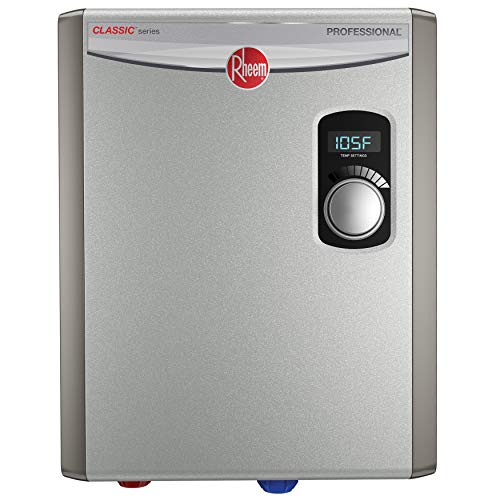
Rheem 18kW 240V Tankless Electric Water Heater, Gray
External digital thermostatic control with LED display (+/1 degree accuracy)
Buy on AmazonIf you’re leaning toward electric, the Rheem 18kW 240V Tankless Electric Water Heater (ASIN B01MR7Z39V) is a solid option. It delivers up to 4.4 gallons per minute, has an external digital thermostat with LED display (accurate to within one degree), and uses copper immersion heating elements that can be serviced in the field rather than requiring a full unit replacement. The self-modulation feature adjusts power to match demand – it doesn’t run full blast when you’re just washing hands.
How a Tankless Water Heater Actually Works
A tankless unit heats water only when you turn on a tap. Cold water flows through a heat exchanger (either a gas burner or electric heating elements), and you get hot water on demand. No storage tank, no standby heat loss.
That sounds simple. But the physics matters. Electric units like the Rheem 18kW draw a massive amount of power – 18,000 watts at full load. That’s like running six large space heaters at once. Your electrical panel needs to handle it, and many older homes require a serious upgrade.
Gas tankless models use a powerful burner that vents through a sealed pipe. They produce a higher flow rate than most electric units, but they also need proper gas line sizing (often ¾-inch or 1-inch pipe) and a stainless-steel exhaust system. Installation complexity jumps fast.
The key limitation: flow rate. A typical gas tankless unit provides 6–8 gallons per minute. An electric model like the Rheem gives 4.4 GPM. For comparison, a standard shower runs 2–2.5 GPM. So you can run two showers with a gas tankless, but with an electric unit you’ll be fine for one shower plus a sink, not much more.
The Real Cost of Switching (Not Just the Unit Price)
Most people look at the sticker price and think, “A tankless costs $600–$1,200, a tank costs $400–$800, so the difference is small.” That’s wrong.
The installed cost tells the real story. A drop-in replacement of an old tank heater with a new tank heater is straightforward – typical labor runs $200–$400. Total job: $600–$1,200. A tankless conversion? Expect $1,500–$3,500 for gas, or $1,200–$2,500 for electric, depending on your existing infrastructure.
Why so much more?
- Electrical work for an electric tankless: new 60-amp double-pole breaker, 6-gauge wire from panel to unit, possibly a subpanel. That’s $400–$800 by itself.
- Gas line upsizing for a gas tankless: many homes run ½-inch gas lines to the water heater. Tankless needs ¾-inch or larger. Running new pipe through walls or crawlspaces adds $300–$700.
- Venting for gas tankless: PVC can’t handle the exhaust temperature – you need Category III stainless steel venting, typically $200–$400 in materials alone.
- Permits and inspection in most jurisdictions: another $100–$300.
On top of that, many tankless units require annual descaling (removing mineral buildup) to maintain performance. You can DIY that for about $20 in vinegar and a bucket, but if you hire a plumber, budget $150–$200 per year.
So the question “should I replace my water heater with a tankless?” becomes an economic one: will the energy savings offset those upfront costs within the unit’s lifespan?
Energy Savings: Do They Pay Off?
Tankless heaters are more efficient than tanks – no question. Gas tankless units have an Energy Factor (EF) of 0.82–0.96, compared to 0.59–0.67 for a standard gas tank. Electric tankless units approach 0.99 EF (essentially no standby loss), versus 0.90–0.95 for a heat pump water heater.
But the math depends on your usage. A family of four using 60 gallons of hot water per day will save roughly $80–$120 per year switching from a gas tank to a gas tankless. At that rate, the $1,500–$2,500 installation premium takes 12–20 years to recover. That’s longer than the typical 15-year lifespan of a tankless unit. So the financial break-even is borderline.
Where tankless shines: low-usage households. If you live alone or in a two-person home, your standby losses from a tank are proportionally higher. A tankless can cut your water heating bill by 30–40% in that scenario. Also, if you’re building new construction or doing a major remodel, the incremental cost of going tankless is much smaller – you’re already paying for electrical or gas work.
Let’s compare the options side by side.
| Factor | Standard Tank (Gas) | Tankless Gas | Tankless Electric (e.g., Rheem 18kW) |
|---|---|---|---|
| Lifespan | 10–12 years | 15–20 years (with maintenance) | 15–20 years (with descaling) |
| First-hour rating | 40–80 gallons | Unlimited (at rated flow) | Unlimited (at rated flow) |
| Flow rate (typical) | N/A | 6–8 GPM | 3–5 GPM |
| Installation cost (new) | $600–$1,200 | $2,000–$3,500 | $1,200–$2,500 |
| Annual energy cost (family of 4, gas) | $350–$450 | $250–$330 | $400–$550 (electric rates vary) |
| Space saved | None (keeps tank) | Wall-mount, 2 cu. ft. | Wall-mount, 1 cu. ft. |
| Maintenance required | Minimal (drain yearly) | Annual descaling + filter cleaning | Annual descaling + filter cleaning |
| Best for | High simultaneous demand, tight budget | Homes with large gas lines, high usage | Small households, mild climates, solar-ready homes |
When You Absolutely Should NOT Switch to Tankless
I’ve seen homeowners rip out a perfectly good tank heater for a tankless, then regret it. Here’s when the answer to “should I replace my water heater with a tankless” is a clear no.
If you have hard water (over 10 grains per gallon) and won’t install a water softener. Scale buildup inside a tankless heat exchanger is the #1 killer. Descaling every 6 months becomes mandatory, and eventually the exchanger clogs. A tank can tolerate hard water much longer.
If your electrical panel is maxed out. An electric tankless needs a dedicated 60-amp or two 40-amp breakers. If your panel has no room, upgrading to a 200-amp service costs $1,500–$2,500 before you even buy the unit. That alone kills the payback.
If you have a large household with multiple simultaneous uses. Three people taking showers while the dishwasher runs and the washing machine fills – that’s 8–10 GPM demand. No single tankless unit can handle that without a serious system (two units in series, or a hybrid with a small buffer tank). Most homeowners don’t realize that “endless hot water” means one or two fixtures at a time, not the whole house.
If your incoming water temperature is very cold (below 45°F in winter). The flow rate specs on every tankless unit are based on a 77°F temperature rise (say, from 50°F to 127°F). If your groundwater comes in at 40°F in January, you need a 90°F rise. That cuts the flow rate by roughly 40%. The Rheem 18kW, rated at 4.4 GPM, might only deliver 2.5 GPM in a Minnesota winter. Enough for one shower and not much else.
Frequently Asked Questions
How long does a tankless water heater last compared to a tank?
A tankless unit typically lasts 15–20 years with proper maintenance. A standard tank heater lasts 10–12 years. The catch – tankless units are harder to repair. When the heat exchanger fails (usually due to scale), replacement costs nearly as much as a new unit. Tanks are simpler to swap. So the lifespan advantage is real, but the repair cost risk is higher.
Can a tankless water heater run out of hot water?
Technically no – it heats water continuously. But if you exceed its flow rate, the output temperature drops. You’ll get lukewarm water instead of hot. That’s effectively running out of hot water, just in a different way. Oversizing is critical. Never buy a unit that exactly matches your peak demand; buy one that exceeds it by at least 1 GPM.
Do I need a permit to install a tankless water heater?
Almost always yes. Tankless units involve electrical, gas, and venting work that requires inspection in most municipalities. Skipping the permit can void your home insurance and create liability if something goes wrong. The permit cost is usually $100–$300, and it’s worth every penny.
What size tankless water heater do I need for a family of 4?
For a gas unit, look for a model rated at 6.5–8 GPM at a 77°F rise. Brands like Rinnai, Noritz, and Rheem make those. For an electric unit, the Rheem 18kW (4.4 GPM) is borderline – it works for a family of 4 only if you stagger showers and avoid simultaneous hot water use. If two people want to shower at the same time, you need a 27kW or 36kW unit, which requires even heavier electrical service (up to 150 amps). That’s rare in residential homes.
Is it worth switching from tank to tankless for just two people?
Yes, from an energy perspective. Standby losses from a 40-gallon tank are significant for low usage. A tankless could cut your water heating bill by 30–40%. But the installation cost still matters. If you have a gas line already sized for tankless, the payback is around 7–10 years. For electric, the payback is longer unless you have solar panels or a very low electric rate. I’d recommend it for small households, especially if you’re already remodeling.
Seven Things to Do Before You Decide
- Measure your peak hot water demand – count all fixtures that could run at once and add their GPM ratings. Multiply by 1.2 for safety. That’s your target flow rate.
- Check your incoming water temperature in winter. Call your local water department or measure it with a thermometer at the coldest tap. Subtract that from 120°F – that’s your temperature rise.
- Look at your electrical panel or gas meter. Does the panel have two open slots for a 60-amp breaker? Is the gas line ¾ inch or larger? If not, get quotes for upgrades before you buy anything.
- Calculate your payback period. Use your annual water heating energy cost (look at your utility bill) and the efficiency gain. Divide installation cost by annual savings. If it’s over 10 years, reconsider.
- Read the warranty carefully. Most tankless units have a 10–15 year heat exchanger warranty, but only 1–5 years on parts. Labor is not covered. Descaling may be required to keep warranty valid.
- Consider a hybrid approach: a smaller tankless paired with a small buffer tank (2–5 gallons). Some homeowners install a tankless for the main bath and keep an old tank for backup. It’s inelegant but practical.
- Get at least three installation quotes from licensed pros. Don’t trust the first price. Tankless installation prices vary wildly by region and contractor. A good quote includes all materials, permits, and a fixed price for unforeseen issues (like outdated wiring).
At the end of the day, the question “should I replace my water heater with a tankless” doesn’t have a universal answer. It depends on your home’s infrastructure, your family’s water habits, your budget, and your tolerance for maintenance. If you want endless hot water and you’re okay with higher upfront cost and careful sizing, a tankless unit like the Rheem 18kW can be a great fit. If you want simplicity and don’t mind a tank, stick with what works. Either way, don’t rush the decision – measure twice, buy once.