You plug in a space heater on a cold night, and within ten minutes the cord feels warm, the surface glows orange, and your cat keeps sniffing the base. That nagging worry in your gut is justified. Every winter, portable heaters are involved in a significant share of home heating fires, and most of those fires trace back to things like drapes falling against the unit or the heater tipping over onto a rug.
Electric fireplaces promise the same warmth with a lot less anxiety. But are they actually safer, or is that just marketing? This article breaks down the real differences in heating technology, surface temperatures, shut-off mechanisms, and the fire statistics that matter. You’ll walk away knowing exactly which unit fits your home, your kids, and your peace of mind.
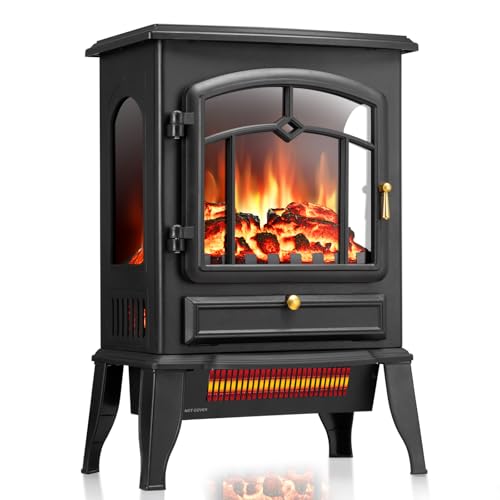
ZAFRO
Electric Fireplace Stove with 3D Flame Effect, 1000/1500W & Flame-Only Mode | Electric Fireplace Heater with 5100 BTU Output, Built-In Thermostat, ETL, Overheat Protection, for Indoor Use, 22 in
- Charming Design: ZAFRO electric fireplace stove adopts a vintage - style stove body design, paired with highly realistic simulated…
- Fast & Powerful Heating: With up to 5,100 BTU of heating power and two heat settings—1000W and 1500W. This fireplace heater quickl…
- Realistic flame effect: This fireplace electric stove adopts 3D dancing flame technology with freely adjustable flame brightness f…
If you’re in the market for a unit that balances retro charm with modern safety features, the ZAFRO Electric Fireplace Stove is a solid example of what to look for: a freestanding design with dual heat settings and an automatic overheat shutoff. We’ll get into why those specific features matter shortly.

How Each Technology Actually Generates Heat
Space heaters and electric fireplaces both use electricity to make heat, but they do it in completely different ways, and that difference drives the safety gap.
Most portable space heaters use either a ceramic element or a metal coil. A fan blows air across the hot element and pushes it into the room. The element itself can reach 500°F to 1,100°F during operation. That’s hot enough to ignite paper (ignition point around 451°F) or singe a cotton curtain within seconds of contact.
Electric fireplaces, by contrast, use a heating element that warms a metal chamber, and air circulates over it through convection. The exterior glass and cabinet of a typical electric fireplace stay far cooler than a space heater’s grill. Surface temperatures on the glass usually land between 100°F and 150°F on the front, depending on the model and setting. That’s warm to the touch but not skin-searing. The ZAFRO unit, for instance, keeps the heat inside the stove body while the flame effect runs independently, so you can even run the flames without any heat at all on milder days.
Here’s the trade-off: space heaters heat a room faster because they force air over a red-hot element. Electric fireplaces take longer to raise ambient temperature, but they don’t create a hazard zone around the unit.
Tip-Over Risk and Surface Contact
Ask any fire investigator about portable heater fires, and they’ll tell you the same thing: most incidents involve the heater falling over or something falling onto the heater.
A typical tower space heater is tall and narrow. Even with a tip-over switch, the switch only works after the unit has already fallen. If it lands against a bed skirt or a pile of laundry, the element is still hot and the switch may not trigger instantly. The CPSC estimates that over 1,100 residential fires per year involve portable heaters, with tip-over scenarios among the leading causes.
Electric fireplaces have a structural advantage here. They’re wider and lower to the ground, with a center of gravity that makes tipping far less likely. The ZAFRO model even has outwardly expanding feet that widen the base contact area, which is a deliberate engineering choice to reduce tip-over risk. That’s not a gimmick; it’s a real stability feature you don’t get on most cylinder-style space heaters.
Surface contact matters just as much. A toddler walking past a space heater can brush against the grill and get a second-degree burn in under a second. The same child touching the glass of an electric fireplace will feel heat, but the injury threshold is much higher. You still shouldn’t let kids press their faces against the glass, but the risk profile is categorically different.
Shut-Off Mechanisms and Overheat Protection
Both product categories now include safety shutoffs, but they’re not all created equal.
Most space heaters have two basic protections: a tip-over switch and an overheat sensor. The overheat sensor trips when internal temperature exceeds a set point, usually around 190°F to 210°F. That’s fine for catching a blocked air intake, but it doesn’t help if the heater is sitting next to a flammable object that ignites before the sensor trips.
Electric fireplaces use the same overheat protection, but they run at lower internal temperatures to begin with. The ZAFRO stove, for example, shuts off automatically when it detects overheating, and its 5100 BTU output is split across two settings (1000W and 1500W) so you can run it at a lower intensity when you don’t need full output. Lower wattage means lower internal heat, which means a wider safety margin before anything reaches ignition temperature.
One more thing worth noting: electric fireplaces don’t have exposed heating elements. The element is enclosed inside the unit, behind the glass or metal body. That eliminates the possibility of a stray sock or paper towel drifting onto a red-hot coil. Space heaters, even the ones with safety grills, still have exposed elements that can catch airborne debris.
Real-World Fire Statistics and Failure Modes
Let’s look at the numbers without the scare tactics. The National Fire Protection Association (NFPA) reports that space heaters account for about 43% of home heating fires and 85% of home heating fire deaths. The primary causes are things you’d expect: placing the heater too close to combustibles, leaving it on while sleeping, and using it with an extension cord that isn’t rated for the load.
Electric fireplaces don’t have a separate statistical category because they’re still relatively new to the market. But the physics of their design puts them in a safer class. They don’t reach the same internal temperatures, they don’t have exposed elements, and their base geometry makes them harder to knock over.
That doesn’t mean electric fireplaces are risk-free. The glass front can still crack if struck hard. The cord can still overheat if you use a damaged outlet. And if you buy a cheap unit with poor internal wiring, you’re trading one set of risks for another. The key is to buy from a brand that lists safety certifications (UL or ETL) and includes the basic protections we’ve covered.
One common failure mode for electric fireplaces is the heating element inside the unit shorting out due to dust buildup. That’s why the manual will tell you to vacuum the interior vents periodically. It’s a maintenance task, not a reason to avoid the product.
Direct Comparison: Electric Fireplace vs. Space Heater
| Factor | Electric Fireplace | Space Heater |
|---|---|---|
| Typical surface temp | 100°F–150°F (glass front) | 400°F–1,100°F (element) |
| Tip-over risk | Low due to wide, low base | High for tower models; tip-over switch helps but only after fall |
| Exposed heating element | No, element is enclosed | Yes, even with grills |
| Time to heat a 200 sq ft room | 20–40 minutes | 10–20 minutes |
| Overheat shutoff | Standard on quality units | Standard on most units |
| Burn risk for children/pets | Moderate; glass gets warm but not scalding | High; exposed grill can cause severe burns |
| Fire risk from nearby combustibles | Lower, but keep 3 ft clearance per manual | Higher; NFPA recommends 3 ft clearance and many people ignore it |
| Noise level | Quiet; fan runs but no coil hum | Fan noise plus element cycling clicks |
| Energy use | 1,000W–1,500W typical | 1,200W–1,500W typical |
That table makes it clear: electric fireplaces win on nearly every safety metric, but they sacrifice heating speed. If you need to warm a drafty garage in five minutes, a space heater will do it faster. For a living room or bedroom where you can plan ahead, the fireplace is the safer call.
What About the Flames? Are They Real?
No, they’re not real flames, and that’s exactly why they’re safer. The ZAFRO unit uses 3D simulated flame technology with adjustable brightness. There’s no combustion, no carbon monoxide, no chimney, and no smoke. The flame effect is LED light reflecting off a patterned screen, so you get the ambiance without the risk of embers landing on your rug.
This matters more than you might think. Real wood-burning fireplaces cause thousands of house fires each year from creosote buildup and stray sparks. Gas fireplaces have their own risks with gas leaks and ventilation failure. An electric fireplace eliminates all of those failure modes entirely. The only energy source is the wall outlet.
You can also run the flame effect without the heater on. That’s a feature space heaters can’t match. On a cool fall evening, you get the visual warmth without adding heat to the room. The ZAFRO’s flame-only mode is perfect for that, and it draws almost no power compared to the heating mode.
Five Questions People Actually Ask
Can I leave an electric fireplace on overnight?
Most manufacturers say no, and you shouldn’t. Even with overheat protection, running any heating appliance unattended while you sleep is a bad idea. The ZAFRO manual will tell you to turn it off before bed. If you want heat while you sleep, use a heated blanket or set your home thermostat lower. The overheat shutoff is a safety net, not a license to ignore the unit.
Do electric fireplaces use a lot of electricity?
They use the same as a space heater at equivalent settings. A 1500W unit running for an hour uses 1.5 kWh. At the national average of about 16 cents per kWh, that’s 24 cents per hour. Running it eight hours a day for a month adds roughly $58 to your bill. The ZAFRO’s dual settings let you drop to 1000W, which cuts that to 16 cents per hour, and the flame-only mode uses just pennies per day.
Will the glass front get hot enough to burn a child?
It gets warm, but not to the level of a space heater’s grill. Most electric fireplace glass stays between 100°F and 150°F on the exterior. That’s uncomfortable to hold against the skin for more than a few seconds, but it won’t cause instant second-degree burns like a 500°F coil will. Still, if you have toddlers, place the unit out of reach or use a safety gate. The ZAFRO’s compact size (about 22 inches tall) makes it easy to position on a hearth or high shelf.
Can I plug an electric fireplace into a regular outlet?
Yes, but check the circuit. A 1500W unit draws about 12.5 amps. A standard 15-amp household circuit can handle it, but only if nothing else significant is running on that same circuit. Don’t plug it into an extension cord unless the cord is rated for at least 15 amps. The ZAFRO’s cord is short for a reason; plug it directly into the wall.
Are electric fireplaces worth it compared to just using central heating?
It depends on your situation. If you’re heating one room while the rest of the house stays cold, a 1500W electric fireplace is far cheaper than cranking the furnace. If you’re trying to heat an entire drafty house, central heating wins. Use the fireplace as a zone heater, not a whole-home solution. That’s where it shines.
What to Look For Before You Buy
Safety certifications matter. Look for a UL or ETL listing on the product page or packaging. That means an independent lab tested it for basic electrical safety. The ZAFRO unit includes overheat protection and a stable base, which are the two most important passive safety features.
Check the cord length and plug type. Some units have a three-prong grounded plug, which is safer than a two-prong. Also check the wattage settings. A unit with a low setting (1000W) and a high setting (1500W) gives you more control than a single fixed output.
Pay attention to the footprint. A freestanding unit like the ZAFRO at 15.35 inches wide and 22.28 inches tall fits on a side table or a small hearth. Make sure you have at least three feet of clearance on all sides, per NFPA recommendations, even though the unit runs cooler than a space heater.
Finally, consider the noise. Some electric fireplaces have a fan that’s audible at high settings. The ZAFRO’s fan is quiet on the 1000W setting, but you’ll hear it on 1500W. If you’re sensitive to noise, test it at the highest setting before committing.
So Which One Should You Buy?
If you’re heating a bedroom, a nursery, or any room where kids or pets roam freely, an electric fireplace is the safer choice. The lower surface temperatures, enclosed elements, and stable base reduce the two biggest risk factors: contact burns and tip-over fires. You give up some heating speed, but you gain peace of mind.
If you’re heating a workshop, garage, or an unoccupied space where fast warmth is the only priority, a space heater is fine. Just keep it away from sawdust, rags, and anything flammable, and never leave it running unattended.
For most homes, the electric fireplace is the better long-term investment. It doubles as a piece of furniture, provides ambient light, and doesn’t make you wince every time the cat walks near it.
- Electric fireplaces run cooler on the outside, so burn risk is much lower than with space heaters.
- Tip-over risk is lower because of the wide, low base design.
- No exposed heating element means no accidental ignition of nearby fabrics.
- You’ll trade a bit of heating speed for that safety margin.
- Always keep a three-foot clearance, even with the safer unit.
- Check for UL or ETL certification on any unit you consider.
- Use the flame-only mode for ambiance without heat, and save energy.



