Your Bosch AquaStar has finally quit. Or maybe it’s limping along with a leaky heat exchanger, and your plumber just quoted more to repair it than a new unit costs. You’re not alone. Thousands of homeowners and off-grid cabin owners are facing the same decision right now.
A good replacement needs to match three things: your existing gas line size, your venting setup, and your hot water demand. Miss any of those, and you’ll be paying for a second installation. The best alternatives also fix the AquaStar’s known weak spots, like its stubborn minimum activation flow and discontinued parts supply.
This guide maps legacy AquaStar models to modern equivalents, covers the retrofit details most articles skip, and reviews five propane tankless heaters that actually work as replacements. The Novieex 4.3 GPM is the closest thing to a direct indoor swap, while the ORBEK RV unit wins for mobile setups. Keep reading for the full breakdown.
Here’s a quick look at how the five units stack up on the specs that matter most for an AquaStar replacement.
| Features | Novieex 4.3 GPM | Baococo 18L | Baococo 8L | VEVOR 4.3Gal | ORBEK RV |
|---|---|---|---|---|---|
| BTU Input | 100,000 BTU | 115,425 BTU | 40,824 BTU | 100,000 BTU | 60,000 BTU |
| Flow Rate | 4.3 GPM | 4.76 GPM | 2.11 GPM | 4.3 GPM | RV on-demand |
| Install Type | Indoor wall-mount | Portable outdoor | Portable outdoor | Indoor vented | RV 12V DC |
| Temp Control | 95-149°F ±1°F | 17-113°F | 17-113°F | ±1°F precision | 95-123°F remote |
| Best Use Case | Whole-house swap | Camping / RV | Budget outdoor | Whole-house upgrade | RV replacement |
Why Bosch AquaStar Owners Are Switching in 2026

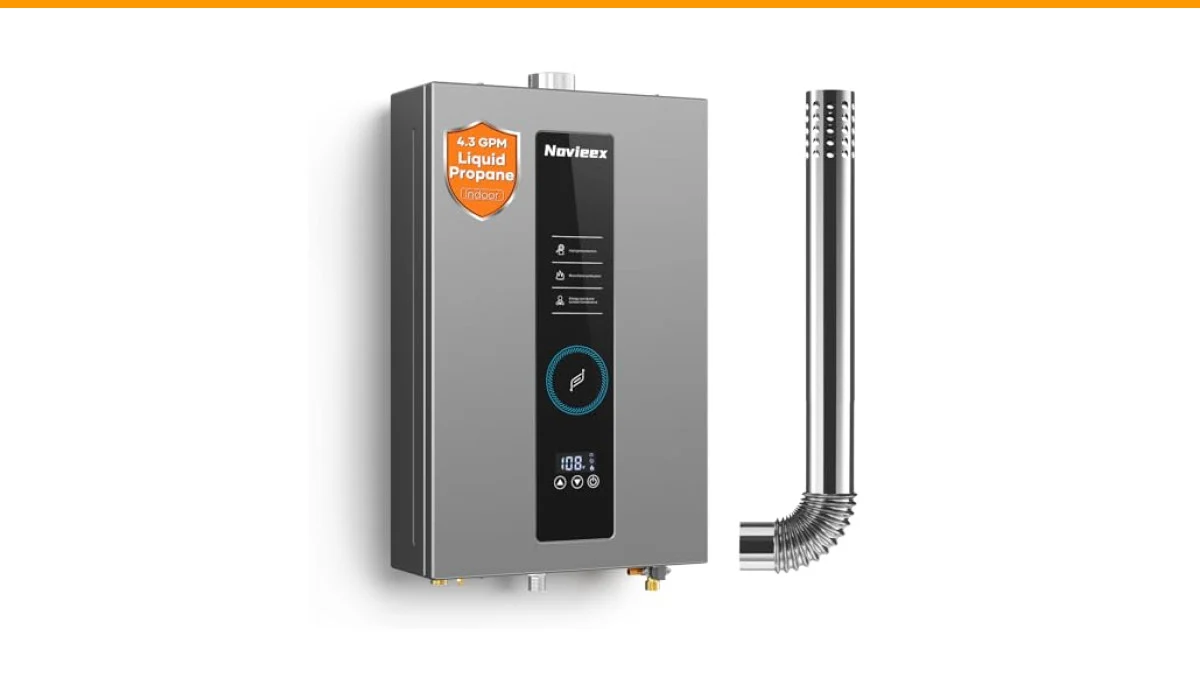
NOVIEEX
Novieex Propane Gas Tankless Water Heater Up to 4.3 GPM 100,000 BTU, Indoor | On-demand hot water for 2-4 points of use, with LED touchscreen, temperature control, freeze protection
- 【Note 】 This 4.3GPM propane gas model. Gas rated pressure: 11.24" w.c. (2.8 kPa), Gas Inlet & Cold Water Inlet & Hot Water Outlet:…
- 【Reliable Hot Water on Demand】 With 100,000 BTU power, this on demand water heater delivers up to 4.3 GPM instant hot water. You c…
- 【Precise Temperature Control】 Enjoy consistent water temperature with a wide adjustable range from 95°F to 149°F, ±1℉ temperature…
Bosch stopped making the AquaStar line years ago. The 125B, 125HX, 2400E, and 520HN models are all discontinued. That means every replacement part you buy is either new-old-stock or a third-party copy with questionable tolerances.
Repair costs have climbed fast. A new heat exchanger for a 125HX can run several hundred dollars, and that’s before labor. If your unit is over 12 years old, you’re throwing money at a machine with a shrinking support network.
AquaStar Discontinuation and Parts Availability

Baococo
18L Tankless Water Heater Propane with Digital Display 4.76 GPM 115425 BTU | Portable Instant Hot Water Heater with Overheating Protection, RV Tankless Water Heaters for Indoor and Camping
- Efficient & Energy-Saving: Built with cutting-edge, precision-engineered combustion technology, this propane tankless water heater…
- Reliable Technical Specifications: This portable propane water heater boasts a maximum heating output of 115,425 BTU/hour, with an…
- Safety Protection System: Safety is our top priority for outdoor and RV use. This instant propane water heater features six compre…
The 125B and 125HX share a lot of internal components, which helped owners keep them alive for a while. But water valves, PC boards, and burner assemblies are getting scarce. Some sellers list them at inflated prices because supply is thin.
Bosch still supports some legacy parts through authorized distributors, but the writing is on the wall. The 2400E and 520HN have even less aftermarket support. If you’re hunting for a discontinued control board on eBay, it’s time to replace.
Repair vs Replace: Cost Reality

Baococo
Tankless Water Heater Instant Propane Gas Water Heater 8L 2.11GPM | 40,824 BTU Portable Instant Hot Gas Water Heater with Digital Display, Overheating Protection for Indoor and Camping
- EFFICIENT & ENERGY-SAVING: Equipped with advanced combustion technology, our tankless water heater propane decreases consumption a…
- PRODUCT SPECIFICATION:The propane water heater boasts a maximum output power of 40824 BTU/hour, reaching temperatures as hot as 11…
- SECURITY PROTECTION: Our instant hot gas water heater comes with 6 safety protection settings, including overheat protection, dry…
A typical AquaStar repair runs $300 to $800 depending on the part and whether you DIY. A new comparable propane tankless heater costs $400 to $900. When you factor in the age of the unit and the risk of a second failure, replacement usually wins.
There’s another angle. Old AquaStars run at around 80% efficiency. Modern non-condensing units hit 82-85%, and condensing models reach 95%+. For off-grid users burning propane, that efficiency gap shows up in every refill.
What to Match When Replacing an AquaStar

VEVOR
VEVOR Tankless Water Heater Propane, 4.3Gal Instant Water Heater, 100000 BTU, Silver Gray, Smart Temperature Control, Multiple Security Protections, Indoor Use for Whole House
- Enjoy Instant Hot Water: This 4.3Gal, 100,000 BTU/h tankless water heater powered by propane, lets you and your family say goodbye…
- ±1℉ Precision Temperature Control: Smart sensors maintain the water temperature within ±1℉ of the set value, avoiding large fluctu…
- LED Display: Equipped with a large LED screen and a sensitive touch panel, it displays real-time information such as water tempera…
You can’t just buy any propane tankless heater and bolt it in. Three specs determine whether the swap works or turns into a remodel.
BTU, GPM, and Temperature Rise
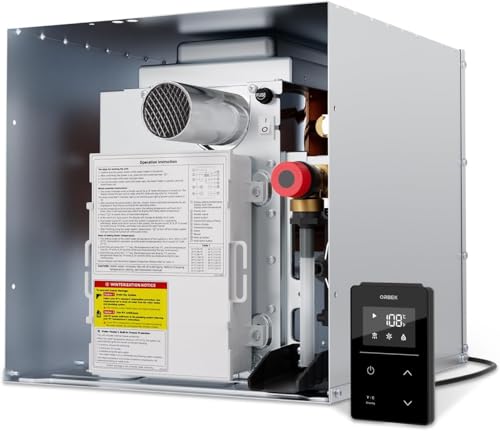
Orbek
ORBEK RV Tankless Water Heater, Propane, 12V DC, For RV Family & Camper | High-Altitude Performance, Continuous On-Demand Hot Water, Remote Temperature Control, Built for RV Travel, CSA Certified
- 𝐂𝐨𝐧𝐭𝐢𝐧𝐮𝐨𝐮𝐬 𝐎𝐧-𝐃𝐞𝐦𝐚𝐧𝐝 𝐇𝐨𝐭 𝐖𝐚𝐭𝐞𝐫: Equipped with a 60,000 BTU propane burner, the ORBEK RV tankless water heater delivers continuous…
- 𝐎𝐩𝐭𝐢𝐨𝐧𝐚𝐥 𝐑𝐕 𝐃𝐨𝐨𝐫 𝐏𝐚𝐧𝐞𝐥𝐬: Door panels are available separately in black and white for a coordinated RV appearance. Designed for sta…
- 𝐇𝐢𝐠𝐡-𝐚𝐥𝐭𝐢𝐭𝐮𝐝𝐞 𝐒𝐮𝐢𝐭𝐚𝐛𝐢𝐥𝐢𝐭𝐲 𝐌𝐨𝐝𝐞: Equipped with oxygen-free copper heat exchangers and brushless DC fans, it adapts to high altitude…
The 125B and 125HX were rated around 117,000 BTU and 4.3 GPM. The 2400E pushed closer to 6.3 GPM at higher BTU. Match your old unit’s BTU rating, or go slightly higher if you want more capacity.
Flow rate depends on temperature rise. A 4.3 GPM unit at 100,000 BTU handles a 45°F rise, which covers most of the U.S. in summer. In cold climates with 40°F groundwater, expect closer to 3 GPM. Size up if you live somewhere with frigid inlet water.
Venting and Gas Line Retrofit
AquaStars used category III stainless venting. Most modern non-condensing propane tankless heaters use the same category III vent, so you can often reuse the existing flue. Condensing units need PVC or CPVC venting, which means a new vent run.
Gas line sizing trips up a lot of swaps. The 125B ran fine on a 1/2-inch line in many installs. Higher-BTU replacements may need 3/4-inch. Check your gas line length and pressure before buying. A 100,000 BTU unit at 11.24 inches water column often works on 1/2-inch, but long runs need more.
Minimum Activation Flow
This was the AquaStar’s Achilles heel. Older units needed 0.5 to 0.75 GPM to fire the burner. Low-flow fixtures, especially kitchen aerators and some showerheads, wouldn’t trigger it. Modern units have improved, but activation flow still varies.
If you run a low-flow showerhead or a point-of-use fixture, check the minimum activation flow spec before buying. Some units now fire at 0.3 GPM or lower. That’s a real improvement over the old AquaStar behavior.
Top Bosch AquaStar Propane Alternatives
These five units cover the main replacement scenarios: indoor whole-house swaps, off-grid and rural propane setups, budget outdoor use, high-capacity upgrades, and RV replacements. For a deeper look at propane tankless options across categories, see this propane tankless guide.
Novieex Propane Gas Tankl…
The Novieex 4.3 GPM is the closest match to a legacy AquaStar 125B or 125HX for indoor use. It runs on propane at 100,000 BTU and delivers 4.3 GPM, which mirrors the old Bosch specs almost exactly. If you’re replacing a wall-mounted indoor unit and want to keep the same footprint, this is the one to look at first.
Who it’s for: homeowners with an existing indoor AquaStar who want a like-for-like swap without rethinking their whole plumbing layout. The 1/2-inch NPT connections match what most AquaStars used, so the water and gas hookups are straightforward. The 11.24-inch water column gas pressure rating is standard for residential propane.
What stands out is the temperature control. The AquaStar was known for temperature swings when someone flushed a toilet or opened a second tap. The Novieex holds within ±1°F across a 95°F to 149°F range. That’s a meaningful upgrade for anyone who dealt with the old Bosch’s temperamental output.
The trade-offs are real. This is a non-condensing unit, so efficiency lands around 82-85%, not the 95%+ you’d get from a condensing model. It’s also indoor-only, so it won’t work for an outdoor install. And availability is listed as scarce, so check stock before you commit.
- 100,000 BTU input with 4.3 GPM output
- ±1°F temperature control, 95°F to 149°F range
- Standard 1/2-inch NPT gas and water connections
- 110-120V AC power, 11.24-inch water column gas pressure
- Wall-mounted indoor design saves over 50% space vs tank units
Best for: Homeowners replacing an indoor AquaStar 125B or 125HX who want a direct, similar-spec swap.
18L Tankless Water Heater…
The Baococo 18L is a portable propane unit built for outdoor use. It pushes 115,425 BTU and 4.76 GPM, which is actually more capacity than the old AquaStar 125B. But it’s not an indoor whole-house replacement. This is for camping, RV travel, outdoor bathing, and pet washing.
Who it’s for: off-grid cabin owners, RVers, and anyone who needs hot water where there’s no indoor plumbing infrastructure. If you’re replacing an AquaStar at a hunting camp or a remote property, this unit fits that scenario. It’s lightweight and portable, so you can move it between locations.
The six safety protections are worth noting: overheat, dry combustion, antifreeze, low-flow ignition lockout, flame failure cutoff, and high water pressure relief. The low-flow ignition lockout is a smart feature. It prevents the burner from firing when there’s not enough water flow, which protects the heat exchanger.
Here’s the catch. The temperature range tops out at 113°F. That’s fine for outdoor showers and pet washing, but it’s lower than what you’d want for a whole-house system. And the 17°F minimum is unusual. It’s designed for cold-weather startup, but you’ll need to manage freeze protection carefully in winter.
- 115,425 BTU input with 4.76 GPM flow rate
- Portable outdoor design for camping and RV use
- Six safety protections including low-flow ignition lockout
- Temperature range 17°F to 113°F
- One-button shower head design reduces water waste
Best for: Off-grid users and campers who need portable propane hot water, not an indoor whole-house swap.
Tankless Water Heater Ins…
The Baococo 8L is the budget option in this group. At 40,824 BTU and 2.11 GPM, it’s less than half the capacity of a legacy AquaStar. That’s not a flaw if you understand what it’s for. This is a point-of-use or single-fixture heater, not a whole-house replacement.
Who it’s for: someone who needs hot water at one outdoor sink, a single shower, or a small cabin. If your AquaStar was oversized for your actual demand, this could work. But if you’re used to running a shower and a kitchen sink at the same time, you’ll feel the difference.
The six safety protections match the larger Baococo model, including the low-flow protection that prevents ignition below minimum working pressure. The 3.6 PSI minimum starting pressure is low, which helps with weak gravity-fed systems. The 116 PSI maximum is standard for residential plumbing.
The honest limitation is capacity. At 2.11 GPM, you can run one fixture comfortably. Two fixtures will stretch it. The 113°F maximum temperature is also lower than the 149°F you’d get from the Novieex. For outdoor use in warm climates, it’s fine. For cold-climate whole-house, it’s not enough.
- 40,824 BTU input with 2.11 GPM flow rate
- Lightweight portable design for outdoor use
- Six safety protections including dry combustion and antifreeze
- Minimum starting pressure 3.6 PSI, maximum 116 PSI
- Temperature range 17°F to 113°F
Best for: Budget-conscious buyers who need hot water at one or two outdoor fixtures, not a whole-house system.
VEVOR Tankless Water Heat…
The VEVOR 4.3Gal is a direct competitor to the Novieex for indoor whole-house use. It runs 100,000 BTU and 4.3 GPM, matching the AquaStar 125B specs. The difference is the feature set. VEVOR packs in more safety protections and a larger LED display.
Who it’s for: homeowners who want a like-for-like AquaStar replacement with a more modern control interface. The ±1°F precision temperature control is the headline feature. It uses smart sensors to hold temperature steady, which addresses the AquaStar’s known temperature fluctuation problem.
The safety list is long: leakage, flameout, dry burning, overheating, timeout, pipe damage, high-temperature lock, wind pressure, and anti-freeze protection. That’s more comprehensive than most units in this price range. The 1/2-inch NPT connector matches standard residential plumbing, and the indoor unit comes with a vent outlet for direct vent connection.
The trade-off is venting. This is a non-condensing unit, so it needs category III stainless venting. If your old AquaStar used the same vent type, you can often reuse it. If you’re switching from a condensing unit or installing fresh, factor in the vent cost. And like the Novieex, it’s indoor-only.
- 100,000 BTU input with 4.3 GPM flow rate
- ±1°F precision temperature control with smart sensors
- Nine safety protections including anti-freeze and wind pressure
- Standard 1/2-inch NPT connector with vent outlet
- Large LED display with touch panel controls
Best for: Homeowners who want an indoor AquaStar replacement with more safety features and a modern display.
ORBEK RV Tankless Water H…
The ORBEK RV is the only unit here built specifically for RV replacement. It runs on 12V DC power and 60,000 BTU propane. That’s lower BTU than the AquaStar, but RV water heaters don’t need the same capacity as whole-house units. The design priorities are different: altitude performance, freeze resistance, and easy installation in standard RV cutouts.
Who it’s for: RV owners replacing a tank-type water heater or an older tankless unit. The ORBEK fits standard 15×15, 15×18, and 18×18-inch RV water heater openings. Optional door panels in black and white are available separately for a coordinated look. If you’re upgrading from a 6-gallon tank unit, this is a natural step up.
The high-altitude mode is a standout feature. It uses oxygen-free copper heat exchangers and brushless DC fans to adapt to high altitudes, working at up to 9,800 feet. That matters if you camp in the Rockies or travel through high-elevation areas. Staged combustion technology keeps temperatures consistent and reduces cold spots.
Limitations? It’s RV-specific. You can’t use this as a whole-house replacement for an AquaStar. The 60,000 BTU output won’t keep up with a household’s simultaneous demand. And the temperature range tops out at 123°F, which is lower than the 149°F indoor units. For RV use, that’s fine. For home use, it’s not.
- 60,000 BTU propane burner with 12V DC power
- High-altitude mode works up to 9,800 feet
- Fits standard 15×15, 15×18, and 18×18-inch RV cutouts
- Built-in 150 PSI pressure-reducing valve
- Smart remote control adjusts 95°F to 123°F
Best for: RV owners who want a direct replacement for a tank-type or older tankless RV water heater.
How We Chose These Products
We started with the replacement scenario, not the product specs. The question was simple: if you have an aging AquaStar, which modern units actually work as replacements? That meant filtering out units that don’t match AquaStar’s BTU range, flow rate, or installation type.
We prioritized units with clear specs for gas pressure, connection sizes, and temperature range. Vague listings got skipped. We also looked for features that address AquaStar pain points: better temperature control, lower activation flow, and modern safety protections. Availability mattered too. A unit that’s out of stock doesn’t help anyone.
Buying Guide: What Really Matters
BTU and GPM get all the attention, but they’re not the whole story. Temperature rise determines actual performance. A 4.3 GPM unit at 100,000 BTU handles a 45°F rise. In cold climates with 40°F groundwater, you’ll get closer to 3 GPM at a comfortable shower temperature. Size up if you live somewhere cold.
Venting is the hidden cost. Non-condensing units use category III stainless venting, which many AquaStars already have. Condensing units need PVC venting, which means a new vent run and potentially a different wall penetration. If you want to reuse your existing vent, stick with non-condensing.
Gas line sizing can make or break the install. A 1/2-inch line works for 100,000 BTU at short runs. Longer runs or higher BTU units need 3/4-inch. Check your gas line length and pressure before buying. For a broader look at how different propane tankless models compare, see this Bosch propane heater guide.
Minimum activation flow matters more than most buyers realize. If you run low-flow fixtures, a unit that needs 0.5 GPM to fire won’t work. Look for units that activate at 0.3 GPM or lower. This was the AquaStar’s biggest weakness, and modern units have largely fixed it.
Warranty coverage on the heat exchanger is another differentiator. Most units offer 5 to 10 years on the heat exchanger and 1 to 2 years on parts. Check the warranty terms before buying. A longer heat exchanger warranty usually signals better build quality.
Installation and Retrofit Checklist
Before you buy, measure your existing gas line size and vent type. Check the water pressure at your inlet. Confirm the unit’s minimum activation flow matches your fixtures. These three checks prevent most installation surprises.
If you’re reusing the existing vent, verify it’s category III stainless and in good condition. A corroded vent needs replacement regardless of the heater. For gas lines, a 1/2-inch line at 20 feet can handle 100,000 BTU. At 50 feet, you may need 3/4-inch. When in doubt, consult a licensed plumber.
Professional installation costs vary by region, but expect $300 to $800 for a straightforward swap. If you need a new vent run or gas line upgrade, add another $200 to $500. DIY is possible if you’re comfortable with gas connections, but most manufacturers require professional installation for warranty coverage.
For those comparing different propane tankless brands, this non-condensing heater guide covers the trade-offs between venting types and efficiency ratings.
Propane Efficiency and Operating Cost
Non-condensing propane tankless heaters run at 80-85% efficiency. Condensing units hit 90-95%. The difference shows up in propane consumption. For a household using 40 gallons of hot water per day, a 10% efficiency gap means roughly 10-15 extra gallons of propane per year.
Off-grid users feel this more acutely. If you’re hauling propane or paying for delivery in a rural area, efficiency matters. But condensing units cost more upfront and need different venting. Run the math on your annual propane use before deciding.
Altitude derating is another factor for mountain users. Propane heaters lose about 4% of their rated BTU for every 1,000 feet above sea level. At 5,000 feet, a 100,000 BTU unit performs like 80,000 BTU. If you live at altitude, size up to compensate.
Frequently Asked Questions
Can I reuse my AquaStar’s venting with a new unit? Often yes, if the new unit is non-condensing and uses category III stainless venting. Check the vent diameter and condition first. Condensing units need PVC venting, so you’d need a new vent run.
Will a 1/2-inch gas line work for a 100,000 BTU replacement? Usually yes, if the run is under 20 feet. Longer runs may need 3/4-inch. Check your gas pressure at the inlet. The unit needs 11.24 inches water column for most 100,000 BTU models.
What’s the minimum activation flow I should look for? Aim for 0.3 GPM or lower if you use low-flow fixtures. Older AquaStars needed 0.5 to 0.75 GPM, which caused problems with efficient showerheads and kitchen aerators.
How long does a propane tankless heater last? Most last 15 to 20 years with annual maintenance. The heat exchanger is the limiting factor. Hard water shortens lifespan, so consider a water softener if your water is mineral-heavy.
Do I need a recirculation pump for instant hot water? Not required, but it reduces wait time at fixtures. A recirculation pump keeps hot water moving through the lines. It uses more propane but eliminates the cold-water sandwich at the tap.
Our Top Recommendation
The Novieex 4.3 GPM is our top pick for most AquaStar replacements. It matches the 125B and 125HX specs almost exactly: 100,000 BTU, 4.3 GPM, 1/2-inch NPT connections, and indoor wall-mount design. The ±1°F temperature control fixes the AquaStar’s biggest weakness. Just check availability before ordering.
If the Novieex is out of stock, the VEVOR 4.3Gal is a strong runner-up. It has the same BTU and GPM ratings, plus more safety protections and a larger display. The trade-off is a slightly higher price and the same non-condensing venting requirement.
For off-grid and portable use, the Baococo 18L offers more capacity than the AquaStar at a lower price point. It’s not an indoor whole-house unit, but for cabin and camping scenarios, it’s a better fit than trying to make an indoor unit work outdoors.
RV owners should skip the indoor units entirely. The ORBEK RV is purpose-built for 12V DC systems and standard RV cutouts. It won’t replace a whole-house AquaStar, but it’s the right tool for a completely different job.
Budget buyers with modest demand can look at the Baococo 8L. Just understand the 2.11 GPM limit. It’s a point-of-use heater, not a whole-house replacement. If you can live with one fixture at a time, it saves money upfront.


