Your energy bill shows up in January and it’s double what you expected. The furnace runs nonstop, the house still feels cold, and you start wondering if a small electric heater in the room you actually use would cost less than heating every square foot of the place.
A good eco room heater doesn’t promise magic. It does three things well: it converts nearly all the electricity it pulls into heat, it cycles off once your room hits the target temperature, and it uses a thermostat accurate enough that you’re not overheating the space by five degrees. Ceramic and infrared heaters both hit close to 100% efficiency at the point of use. The real savings come from heating one room instead of the whole house, and from not running the thing at full blast when you don’t need it.
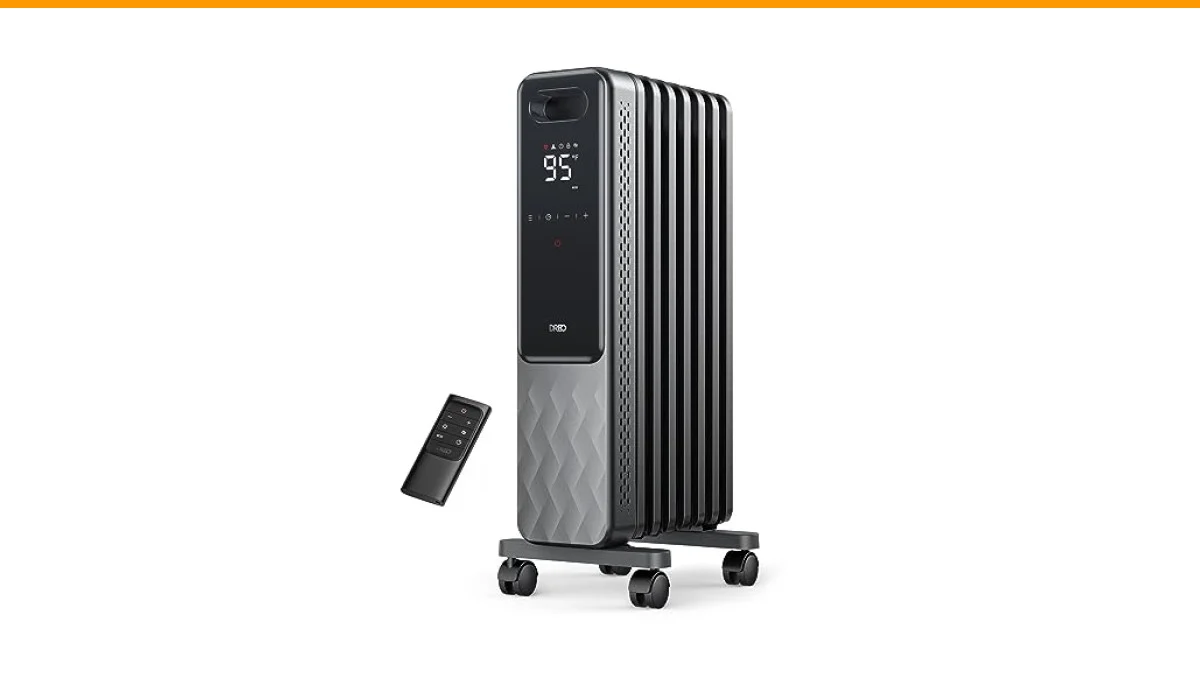
Below are five portable heaters worth considering, ranked by how well they balance efficiency, quiet operation, and safety. The DREO 25-inch model takes the top spot for large rooms, the compact DREO Atom One wins for desks and small spaces, and the JIBUFI rounds things out as the budget pick. We also dig into the math on what these actually cost to run per month, because ‘energy efficient’ gets thrown around loosely in this category.
Here’s a quick side-by-side of the specs that actually matter when you’re comparing these five.
| Features | DREO 1500W Space Heater | DREO Atom One | DREO 25 Inch | DREO 24 Inch Large Room | JIBUFI 17 Inch |
|---|---|---|---|---|---|
| Power Range | 1000W / 1500W ECO | 1500W with ECO | H1/H2/H3/ECO modes | 3 heat levels plus fan | 700W / 1000W / 1500W |
| Coverage | 270 sq ft | Small rooms, desks | 100-270 sq ft | Up to 250 sq ft | Small to mid rooms |
| Noise Level | 34 dB | 37.5 dB | 25 dB | 34 dB | Not specified |
| Thermostat Range | ECO auto-adjust | 41-95F, 1F steps | 41-95F, 1F steps | 41-95F, 1F steps | Smart thermostat |
| Best Use Case | Bedrooms, offices | Desks, small rooms | Large rooms, bedrooms | Large rooms | Budget buyers |

DREO Space Heaters for In…

DREO
DREO Space Heaters for Indoor Use with Thermostat, 1500W Electric Heaters | Fast Heating, Quiet Operation, 70° Oscillation, Remote Control, 12H Timer, ECO Mode, ETL-Certified Safety Heat for Large Room
- ETL-Certified Safety: Made of V0 flame-retardant materials with multiple safety features including built-in smart tip-over protect…
- Fast Indoor Ceramic Heater: Powerful 1500W PTC ceramic heating allows this space heater to heat up in seconds, suitable for warmin…
- Quiet Heating: 34dB - almost as quiet as a library. The fan wheel uses oblique airflow technology, which effectively reduces wind…
This is the mid-size DREO that fits most people’s needs without overthinking it. It’s a 1500W PTC ceramic heater rated for 270 square feet, which covers a typical bedroom, a home office, or a small living room. If you want one heater for one room and you don’t have unusual constraints, this is a sensible starting point.
The 70-degree oscillation is the standout feature here. DREO uses a trackball system rated for over 750,000 cycles, and the wide sweep genuinely pushes warm air into corners better than fixed-direction heaters. Combined with oblique airflow tech, it runs at 34 dB. That’s roughly library volume. You’ll hear it if you’re listening for it, but it won’t interrupt sleep or a phone call. The ECO mode toggles between 1000W and 1500W based on the ambient sensor, which is a real efficiency gain over heaters that just cycle on and off at full power.
Here’s the caveat: DREO explicitly warns against using this with an extension cord. That’s a real limitation if your only outlet is across the room from where you want the heat. You’ll need to rearrange furniture or pick a different spot. Also, the 12-hour timer is fine but the 24-hour auto-off without interaction is the kind of feature you forget exists until it saves you from a forgotten heater.
- 1500W PTC ceramic with 1000W ECO mode
- 70-degree oscillation rated for 750,000+ cycles
- 34 dB operation with oblique airflow design
- ETL-certified with tip-over, overheat, and V0 flame-retardant materials
- 6-foot flat cord, 12-hour timer, 24-hour auto power-off
Best for: Anyone who wants a dependable bedroom or office heater with quiet operation and doesn’t need the extra size of a tower unit.
DREO Space Heater, Portab…

DREO
DREO Space Heater, Portable Electric Heaters for Indoor Use with Thermostat | 70°Oscillation, Remote, ECO, 12H Timer, 5 Modes, Safe Quiet Room Heater for Bedroom, 1500W PTC Ceramic Heater for Office
- Faster Heat Than Ever: Powered by DREO Hyperamics Technology, Atom One space heater heats up more efficiently with up to 1500W wor…
- Shield360° Protection: DREO Room Heater Heat up your day and night without worries. ETL-listed Shield360° system provides tip-over…
- Save More on Energy Bills: ECO Mode adjusts the heat level automatically to reach your desired temperature while saving more on en…
The Atom One is the smallest heater in this lineup, and it’s built for a specific job: heating the space right around you, not the whole room. DREO markets it for floor, desk, or carry-around use. That’s accurate. It’s the kind of heater you put under your desk in a cold home office, or on the floor next to the couch while you read.
DREO’s Hyperamics tech pushes this to full heat almost immediately. The digital thermostat goes from 41 to 95 degrees in 1-degree increments, which is more precise than most heaters at this size. The 70-degree oscillation covers a wider arc than you’d expect from something this compact. And the brushless DC motor with nine aerodynamic blades keeps noise at 37.5 dB. It’s slightly louder than the mid-size DREO, but still quiet enough for a bedroom.
The honest downside: this heater is not going to warm a 250-square-foot room on its own. It’s a personal heater. If you buy it expecting whole-room performance, you’ll be disappointed. The Shield360 safety system (tip-over, overheat, enhanced plug, V0 materials) is thorough, but the trade-off for that compact size is limited reach.
- 1500W with Hyperamics fast-heat technology
- Digital thermostat 41-95F in 1-degree increments
- 37.5 dB with brushless DC motor
- 70-degree oscillation for wide personal coverage
- Shield360 protection: tip-over, overheat, enhanced plug
Best for: Desk workers, renters in small apartments, or anyone who wants targeted warmth for one person rather than a whole room.
DREO 25 Inch Electric Spa…

DREO
DREO 25 Inch Electric Space Heater for Indoor Use, Large Room, Thermostat | 11.5 ft/s Fast Heating, 25dB Quiet Operation, 70° Oscillation, Remote Control, Child Lock, Overheating & Tip-Over Protection
- The Ultimate Heating Experience: DREO's upgraded 25" space heaters for indoor use brings 11.5 ft/s fast heat thanks to its new hyp…
- Warm Your Nights in Absolute Quietness: DREO's new airflow design brings down noise as low as 25dB, making this space heater for b…
- Unbreakable Safety: This room heater for indoor is fully packed to safely warm up your winter. Built with V0 flame retardant mater…
This is the best eco room heater in this group for larger spaces. The 25-inch tower design uses an extended impeller to double the heat range, pushing air at 11.5 feet per second. DREO rates it for 100 to 270 square feet. In practice, that means it handles a master bedroom, a finished basement, or an open living area without straining.
What separates this from the other DREO models is the noise floor. At 25 dB, it’s the quietest heater here by a noticeable margin. That’s quieter than a whisper, quieter than most refrigerators. If you’re sensitive to fan noise at night, this is the one to pick. The four modes (H1, H2, H3, ECO) give you real control, and the fan-only mode is a nice bonus for summer air circulation. The 1-degree thermostat precision in ECO mode means it’s not constantly overshooting and wasting power.
The trade-off is size and price. A 25-inch tower takes up more floor space than a compact unit, and it costs more than the smaller DREO models. It also has a child lock, which sounds minor until you have a toddler who thinks buttons are toys. If you don’t need the extra coverage or the near-silent operation, you’re paying for features you won’t use.
- 11.5 ft/s airflow with extended impeller design
- 25 dB operation, quietest in this lineup
- Four modes: H1, H2, H3, ECO, plus fan-only
- 41-95F thermostat with 1-degree precision
- Child lock, 45-degree tip-over protection, V0 flame retardant
Best for: Bedrooms and large rooms where quiet operation matters as much as heat output.
DREO Space Heater for Lar…

DREO
DREO Space Heater for Large Room, 24'' Electric Heaters for Indoor Use ECO | PTC Ceramic with Thermostat and Remote, 70° Oscillation, 8 Safe Protection Tower, Quiet, 12H Timer, Bedroom, Office, Silver
- Twice the heat power: With dual DC motors, this DREO space heater for indoor use doubles airflow at 10ft/s, heats up in 2s, plus a…
- Worry-free warmth: With child-lock, safety plug, overheat, tip-over protection and cool-touch housing, this ETL-listed electric he…
- Energy-efficient heating: Save up to 40% on energy with ECO mode, along with precise temp control (41-95°F) in 1°F increments, 3 h…
This 24-inch DREO takes a different approach: dual DC motors that double airflow to 10 feet per second, paired with a heating plate that’s 25% larger than standard. The result is a 2-second heat-up and coverage up to 250 square feet. It’s built for people who want fast, aggressive heating in a large room.
The energy story here is the strongest of the group on paper. DREO claims ECO mode saves up to 40% on energy compared to running at full power. That’s a marketing number, but the underlying logic holds: precise temperature control in 1-degree increments means the heater isn’t cycling on and off in wide swings. Three heat levels plus a fan mode give you flexibility to match output to conditions instead of always running at 1500W.
One thing to know: this heater is louder than the 25-inch model at 34 dB. That’s still quiet, but if you’re choosing between the two for a bedroom, the 25-inch wins on noise. This one is better suited to living rooms or basements where a little fan sound doesn’t matter. The 12-hour timer is standard, and the child lock plus cool-touch housing make it safer around kids and pets than older exposed-element heaters.
- Dual DC motors for 10 ft/s airflow
- 25% larger heating plate, 2-second heat-up
- Up to 40% energy savings in ECO mode
- 250 sq ft coverage, 70-degree oscillation
- Child lock, cool-touch housing, ETL-listed
Best for: Large rooms where you want fast heat-up and don’t mind a slightly higher noise floor.
JIBUFI 17 Inches Space He…
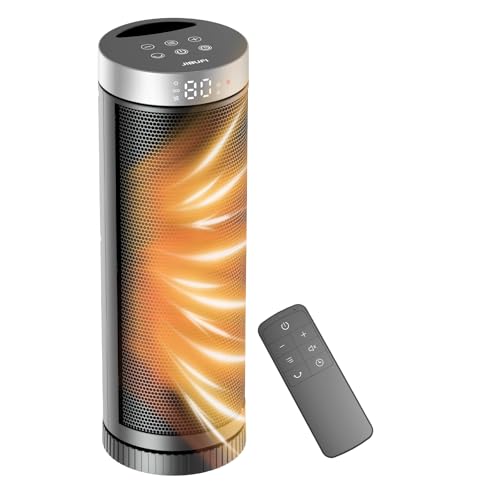
The JIBUFI is the budget option, and it earns its spot by offering three distinct power settings (700W, 1000W, 1500W) instead of the usual two. That 700W setting is genuinely useful. It’s enough to take the chill off a small room without pulling full power, which matters if you’re trying to keep your energy use low during mild cold snaps.
PTC ceramic heating brings warmth in about 3 seconds, and the smart thermostat adjusts output automatically. The remote control is a convenience you don’t realize you want until you’re under a blanket and don’t want to get up. The 1-12 hour timer and 24-hour auto-off are solid safety features. ETL certification and flame-retardant materials round out the safety package.
Where it falls short: the noise level isn’t specified, which usually means it’s not a selling point. The remote requires two AAA batteries that aren’t included, which is a small annoyance. And while the feature list is impressive for the price, the build quality won’t match the DREO models. This is a heater you buy when budget is the primary constraint, not when you want the best of everything.
- Three power settings: 700W, 1000W, 1500W
- PTC ceramic with 3-second heat-up
- Smart thermostat with 1-12 hour timer
- Remote control included (2 AAA batteries not included)
- ETL-certified with tip-over and overheat protection
Best for: Budget-conscious buyers who want flexibility from a low-wattage setting and don’t need premium build quality.
How We Chose These Products
We started with the features that actually affect how much you’ll pay to run a heater and how safe it is to leave unattended. Thermostat accuracy matters more than wattage for efficiency. A 1500W heater with a precise thermostat that cycles off at the right temperature uses less power over a month than a 1000W heater that runs constantly because it can’t hold a steady temp. So we weighted thermostat precision heavily.
Safety certifications were non-negotiable. Every heater here is ETL-listed with tip-over and overheat protection. We also looked at flame-retardant materials (V0 rating) and whether the heater has a child lock. Noise levels got their own column because a heater you can’t sleep next to is a heater you won’t use, and an unused heater saves zero dollars. Finally, we checked whether the manufacturer warns against extension cords, because that affects placement in real rooms.
We did not test these units in a lab. The performance notes come from the manufacturer specs and from patterns that show up consistently across user feedback in this category. Where a spec is missing (like the JIBUFI noise level), we say so rather than guessing.
What Makes a Space Heater Actually Eco-Friendly
Most heaters sold as ‘eco-friendly’ are just electric heaters with a marketing label. Electric resistance heating is 100% efficient at the point of use no matter what you call it. Every watt that goes in comes out as heat. The efficiency question isn’t about conversion. It’s about how much heat you waste by overheating a room, and how much electricity you draw from the grid to do it.
Energy Efficiency vs. Greenwashing
A heater with a precise thermostat and an ECO mode that lowers wattage when the room is near target is genuinely more efficient in practice than a heater that blasts at 1500W until you manually turn it off. That’s not greenwashing. It’s a real difference in kilowatt-hours consumed.
What is greenwashing: claims about ‘sustainable materials’ with no certification, vague references to ‘eco technology’ that just means a lower wattage setting, and heaters marketed as ‘ENERGY STAR certified’ when ENERGY STAR doesn’t actually certify space heaters. It certifies whole-home heat pumps and some room air conditioners, but not portable electric heaters. If you see that claim on a heater listing, be skeptical.
Genuine eco-credentials to look for: RoHS compliance (restricts hazardous substances in electronics), V0 flame-retardant materials (safer if something goes wrong, which reduces waste from fires), and recyclable housing materials. These are verifiable. ‘Eco mode’ alone is not.
Wattage, Thermostats, and ECO Mode Explained
Wattage determines how fast a heater warms a room, not how much it costs to run per hour of actual use. A 1500W heater running for 20 minutes uses the same electricity as a 750W heater running for 40 minutes. The difference is speed.
ECO mode is the feature that actually saves money. It works by lowering the wattage (or cycling the heater off more aggressively) once the room approaches your target temperature. A heater in ECO mode might run at 1000W instead of 1500W for most of its cycle, which cuts power draw by a third during that period. Over a month, that adds up.
Thermostat cycling is the other half of the equation. A heater with a 1-degree thermostat accuracy will cycle off sooner and stay off longer than one with a 5-degree swing. The tighter the thermostat, the less you overshoot your target temp, and the less wasted heat you pay for.
Real Running Costs: What You’ll Pay Per Month
Here’s the math competitors skip. Electricity is billed in kilowatt-hours (kWh). One kWh equals 1,000 watts running for one hour. A 1500W heater running at full power for one hour uses 1.5 kWh.
The U.S. average residential electricity rate is around 16 cents per kWh, but it varies widely. In Louisiana it’s closer to 11 cents. In California or Hawaii, it can be 30 cents or more. Check your own bill for the exact rate.
At 16 cents per kWh, a 1500W heater running at full power costs about 24 cents per hour. If you run it 8 hours a day, that’s $1.92 per day, or roughly $58 per month. A 1000W heater at the same usage costs about 16 cents per hour, or $38 per month.
But here’s where ECO mode changes the picture. A heater in ECO mode doesn’t run at full power the whole time. It cycles. Real-world usage might be 50-60% of full-power draw once the room is warm. That brings the 1500W heater down to roughly $29-35 per month for 8 hours of daily use. The savings come from cycling, not from the heater being magically more efficient.
Compare that to heating a whole house with a furnace. A typical gas furnace costs $100-200 per month in winter depending on climate and home size. Running one efficient space heater in the room you actually use can cut that significantly if you lower the thermostat elsewhere. That’s the real eco play: zone heating, not heater efficiency.
How to Choose the Right Eco Heater
Room size drives everything. A 1500W heater covers roughly 150-270 square feet depending on insulation and ceiling height. A 700-1000W heater handles 50-100 square feet. If you buy a small heater for a large room, it runs constantly and never reaches target temp, which wastes more energy than buying the right size.
Noise matters more than people expect. If the heater is going in a bedroom, look for 35 dB or lower. The DREO 25-inch at 25 dB is the quietest here. If it’s going in a living room or workshop, 40 dB is fine.
Safety features are not optional if you have kids or pets. Tip-over protection, overheat shutoff, cool-touch housing, and a child lock are the four to check. Every heater in this roundup has the first two. The DREO 25-inch and 24-inch models add child lock and cool-touch housing.
Placement rules: keep heaters at least 3 feet from curtains, bedding, and furniture. Never use an extension cord unless the manufacturer explicitly allows it. DREO warns against extension cords on all their models. Plug directly into a wall outlet. Don’t put a heater in a bathroom unless it’s rated for damp locations, and none of these are.
For more on matching heater type to room size, see our guide to the best space heater for large room setups.
Safety and Maintenance Tips
Clean the intake grille every two to four weeks during heavy use. Dust buildup restricts airflow, which makes the heater work harder and run longer to hit the same temperature. That’s wasted electricity. A vacuum brush attachment or a can of compressed air handles it in under a minute.
Check the cord and plug monthly for signs of heat damage. If the plug feels warm to the touch while running, stop using the heater and inspect the outlet. Warm plugs usually mean a loose connection or an overloaded circuit.
Don’t run a space heater unattended in a room with pets that chew cords. The V0 flame-retardant materials help if something goes wrong, but they don’t prevent the initial incident. Keep cords tucked behind furniture or under a cord cover.
Replace the heater if the tip-over switch stops working. You can test it by gently tilting the heater while it’s on. It should shut off before it reaches a 45-degree angle. If it doesn’t, the safety feature has failed and the heater isn’t safe to use.
Frequently Asked Questions
Is a 1500W heater expensive to run all night?
At 16 cents per kWh, running a 1500W heater at full power for 8 hours costs about $1.92. In ECO mode with cycling, it’s closer to $1.00-1.20 per night. That’s $30-36 per month. Compare that to heating the whole house overnight and it’s usually cheaper, but it’s not free.
Do ceramic heaters use less electricity than infrared?
No. Both convert nearly 100% of the electricity they draw into heat. A 1500W ceramic heater and a 1500W infrared heater use the same power. The difference is how the heat feels and how long it lingers. Infrared heats objects and people directly, so it can feel warmer at lower wattage, but the room air stays cooler.
Can I use a space heater in a bedroom with a pet?
Yes, with precautions. Keep the heater at least 3 feet from bedding and pet beds. Choose a model with cool-touch housing and tip-over protection. Don’t leave it running when you’re not in the room if your pet is prone to knocking things over. The DREO 25-inch and 24-inch models have child locks that also help with curious pets.
What’s the difference between ECO mode and just turning the heater down?
ECO mode adjusts automatically based on the thermostat reading. Turning it down manually means you have to guess and adjust. ECO mode responds to the actual room temperature, so it maintains comfort while using the minimum power needed. It’s more consistent than manual adjustment and saves more over time.
Are space heaters safe to leave on overnight?
Modern heaters with tip-over and overheat protection are designed for overnight use. The DREO models have 12-hour timers and 24-hour auto-off. That said, follow the manufacturer’s placement rules, don’t use extension cords, and keep the heater away from anything flammable. If you’re a heavy sleeper or have kids who wander at night, a timer that shuts the heater off after a few hours adds peace of mind.
Our Top Recommendation
The DREO 25-inch tower is the best eco room heater in this group for most people. It’s the quietest at 25 dB, it covers up to 270 square feet, and the four-mode system with 1-degree thermostat precision gives you real control over power draw. The child lock and 45-degree tip-over protection make it safer around kids and pets than most competitors. It costs more than the smaller models, but the combination of quiet operation and efficient cycling makes it the one you’ll actually use every night.
If you need something for a desk or a small room, the DREO Atom One is the better fit. It’s compact, precise, and quiet enough for a home office. The 41-95F thermostat range in 1-degree increments is unusually good for a heater this size.
For large rooms where fast heat-up matters more than whisper-quiet operation, the DREO 24-inch with dual DC motors is the pick. The 2-second heat-up and 250-square-foot coverage handle open spaces well, and the ECO mode claim of up to 40% energy savings is backed by the same thermostat logic as the other DREO models.
On a tight budget, the JIBUFI delivers three power settings including a useful 700W low mode, plus a remote and smart thermostat, at a price that undercuts the DREO lineup. It won’t match the build quality or the noise performance, but it covers the essentials.
One more thing worth considering: if you’re heating a large room regularly, a wall-mounted ceramic heater or a convection panel heater might be more efficient than a portable unit. They distribute heat more evenly and don’t take up floor space. For small rooms, a compact portable heater is usually the better choice. You can read more about bedroom heater options if that’s your primary use case.
The real eco win isn’t the heater itself. It’s using one to heat the room you’re in while lowering the thermostat for the rest of the house. A $60 heater that lets you drop your furnace setting by 5 degrees can save more per month than any efficiency feature on the heater’s spec sheet.