You’ve framed the walls, wired the heater, and picked the cedar. Now comes the part that trips up a lot of DIY sauna builders: the glass. A sauna window or door isn’t like a regular window. It lives in a room that swings between 160°F and 200°F, then gets hit with a cold bucket of water. Pick the wrong glass and you’re looking at a safety hazard, not a design feature.
The right glass for a sauna balances three things: safety, heat retention, and how much light you want inside the room. Tempered glass is the only safe option for the hot zone. After that, you’re choosing between clear, tinted, or dual pane, and matching the glass area to your heater’s power. Get those decisions right and the sauna feels open and bright without costing a fortune to run.
This guide covers the actual physics and costs behind sauna glass, then reviews five products that solve specific problems: two prehung glass doors, a pair of red light therapy glasses, a 20-minute sand timer, and a thermometer-hygrometer combo. The PROSAUNAS doors are the main event for anyone building or upgrading a sauna. The accessories matter for the session itself.
Here’s a quick spec comparison before the full reviews.
| Features | PROSAUNAS Clear Door | PROSAUNAS Tinted Door | Mito Red Light Glasses | SuLiao Sand Timer | GLOBOTECH Thermometer |
|---|---|---|---|---|---|
| Material & Build | 8mm tempered glass, Aspen frame | 8mm tempered glass, Thermo-Aspen frame | Lightweight anti-scratch plastic lenses | Wood, glass, white sea sand | Aluminum casing, glass window |
| Key Specification | 24×73 inch prehung, left hang | 24×73 inch prehung, left hang | 600nm-900nm attenuation | 20 minute fixed interval | 70-250°F, 0-100% RH |
| Main Feature | Frameless clear view | Grey tinted privacy | IR3 Dark 80% reduction | 360-degree rotating wall mount | Color-coded sauna zones |
| Installation | Prehung, no framing needed | Prehung, no framing needed | Wear like normal glasses | Two screws, wall mount | Lanyard, no tools needed |
| Best Use Case | Bright traditional sauna | Lower-glare sauna room | Red light therapy sessions | Timing sauna rounds | Monitoring heat and humidity |
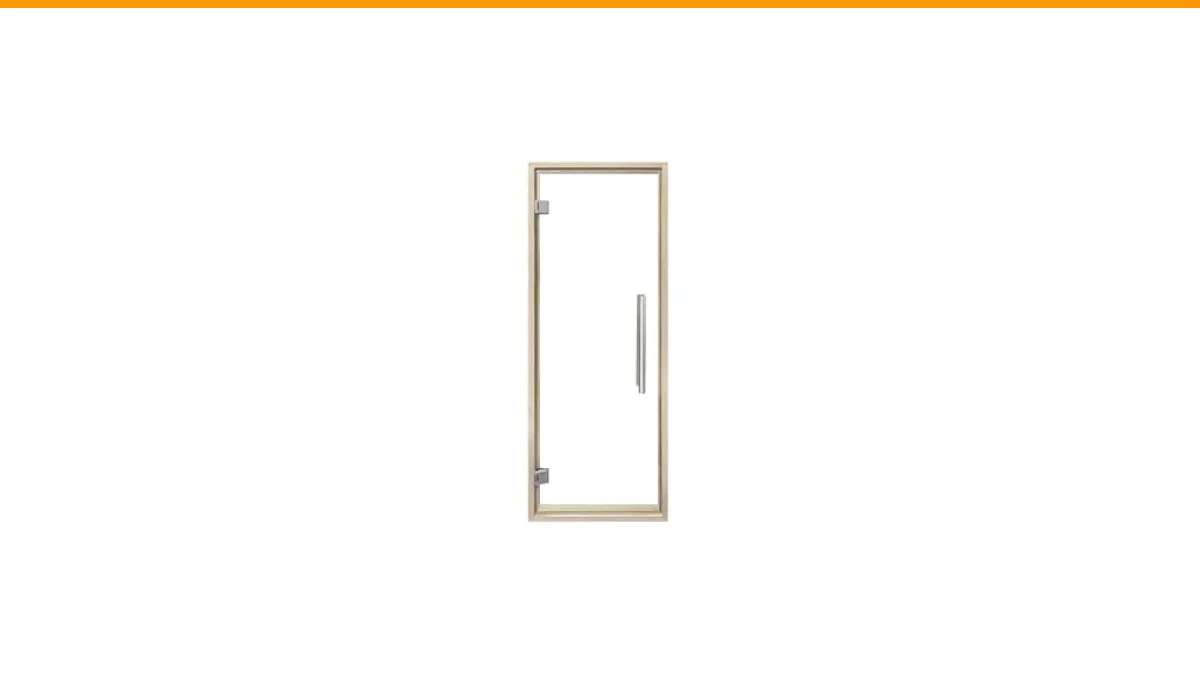
PROSAUNAS Clear Glass Door

PROSAUNAS
PROSAUNAS Clear & Tinted Glass Sauna Door, Prehung Tinted Glass Sauna Door (Left Hanging, Clear - Aspen Frame 24x73)
- MODERN FRAMELESS CLEAR GLASS DESIGN – Elegant 8mm clear tempered safety glass creates a sleek, contemporary sauna appearance while…
- PRE-HUNG FOR EASY INSTALLATION – Door comes pre-hung on a pre-assembled frame for faster, simpler, and more precise installation.
- PREMIUM ASPEN WOOD FRAME – Crafted from natural Grade A Aspen wood for durability, lightweight performance, and a beautiful light…
This is a prehung sauna door with an 8mm tempered glass panel and a Grade A Aspen wood frame. It’s built for someone finishing a custom sauna build who wants maximum light and a clean, frameless look. The 24×73 inch size fits most standard sauna wall openings without custom framing.
The Aspen frame is the standout detail. Aspen is naturally water-repellant, so it handles the constant swing between dry heat and steam without warping or cracking the way some softer woods do. The prehung design saves a full day of installation work. You slide the pre-assembled frame into the rough opening, shim it, and secure it. No separate hinge mortising, no glass setting. For a DIY builder, that’s a real advantage.
The trade-off is the clear glass itself. It looks fantastic and lets in every bit of light, but it also shows every water spot and fingerprint. You’ll be wiping it down more often than a tinted or frosted option. And because it’s a single pane of 8mm glass, it offers almost no insulation value. In a small sauna with a properly sized heater, that’s fine. In a larger room or a cold climate, you’ll notice the heat loss.
- 8mm tempered safety glass meets sauna safety requirements
- Prehung on a pre-assembled frame for faster installation
- Grade A Aspen wood is naturally water-repellant
- Full clear glass maximizes natural light
- Left-hanging configuration (check your swing direction)
Best for: The DIY sauna builder who wants a bright, modern look and values easy installation over privacy or insulation.
PROSAUNAS Tinted Glass Door

PROSAUNAS
PROSAUNAS Clear & Tinted Glass Sauna Door, Prehung Tinted Glass Sauna Door (Left Hanging, Tinted - Thermo-Aspen Frame 24x73)
- MODERN FRAMELESS TINTED GLASS DESIGN – Elegant grey tinted 8mm tempered safety glass creates a sleek, contemporary sauna appearanc…
- PRE-HUNG FOR EASY INSTALLATION – Door comes pre-hung on a pre-assembled frame for faster, simpler, and more precise installation.
- PREMIUM THERMO-ASPEN FRAME – Crafted from thermally modified Grade A Aspen wood for enhanced durability, lightweight performance,…
This is the same prehung door platform as the clear version, but with grey tinted 8mm tempered glass and a thermally modified Aspen frame. It suits anyone who wants the light but not the glare, or who wants a bit more privacy from the rest of the house.
The Thermo-Aspen frame is the upgrade here. Thermal modification cooks the wood at high heat, which changes its cell structure. The result is a frame that’s more dimensionally stable and more resistant to moisture than regular Aspen. It’s also a more eco-friendly process since it uses heat instead of chemicals. In a sauna environment, that stability translates to a longer-lasting door that’s less likely to swell or stick.
The tinted glass cuts glare and hides water spots better than clear glass. That’s a practical win for daily use. The downside is that it darkens the room slightly. If your sauna is already small or has limited natural light, the tint can make it feel a bit closed in. It’s a trade-off between visual comfort and brightness. Also, like the clear version, it’s a single pane with minimal R-value.
- Grey tinted 8mm tempered glass reduces glare
- Thermo-Aspen frame is thermally modified for stability
- Prehung for simplified installation
- Water-resistant and low maintenance
- Left-hanging only in this listing
Best for: Sauna owners who want a modern tinted look, better privacy, and a frame that holds up to heavy moisture cycles.
Mito Red Light Glasses

Mito Red Light
Mito Red Light Glasses - Eye Protection for Red Light Therapy (600nm-900nm) - Goggles for IR3 Dark
- Eye Protection for Red Light Therapy: Red Light Therapy Glasses designed to attenuate commonly used wavelengths in red light thera…
- Reduces Brightness & Intensity of Red Light Therapy: Red light eye protection helps shield your eyes from brightness during sessio…
- Balanced & Targeted Attenuation: It's important to use eye protection designed for both red and near-infrared light. These wavelen…
These are eye protection glasses designed for red light therapy sessions, not for sitting in a hot sauna. They attenuate wavelengths between 600nm and 900nm, which covers the red and near-infrared range most therapy devices use. If you use a red light panel or sauna hybrid that emits those wavelengths, these protect your eyes from the brightness.
What sets them apart is the targeted attenuation. Regular sunglasses block visible light but don’t specifically address the near-infrared range. These glasses are tuned for both. The IR3 Dark version reduces brightness by about 80%, which is enough for most home users. If you have a high-power commercial panel, the IR5 Extra Dark option cuts 95%. The frame is lightweight and anti-scratch, so you can wear them for a 20-minute session without discomfort.
One limitation: they’re not a substitute for closing your eyes or looking away from the panel. They reduce perceived brightness and eye strain, but they don’t make it safe to stare directly into a high-power light source. Also, the IR3 and IR5 versions are separate products, so you need to know which one fits your device before ordering.
- Attenuates 600nm to 900nm wavelengths
- IR3 Dark reduces brightness by roughly 80%
- Lightweight, anti-scratch, glasses-style frame
- Allows visible light through for safety
- Not a replacement for avoiding direct stare
Best for: Red light therapy users who want comfortable, targeted eye protection without bulky goggles.
SuLiao 20-Minute Sand Timer

SuLiao
20 Minute Sauna Sand Timer, Sauna Hourglass, Hear Resistant Sand Clock 20 Min, Wooden White Sand Watch, Reloj De Arena, Rotating Wood Hour Glass, Sandglass SPA Room
- suana para kit swimming room shower resistant thermometer giant large heat big heater small watch extra hour mount timeing cedar g…
- Multifunctional timing purpose.The sauna sand timer is designed to withstand the hot and steamy environment of a sauna room.Enjoy…
- ROTATING SAUNA HOURGLASS.The sauna sand clock Made of wood, clear glass and white sea sand.The bathroom hourglass can be rotated 3…
This is a wall-mounted 20-minute sand hourglass made from wood, clear glass, and white sea sand. It’s for anyone who wants a simple, no-battery way to track sauna rounds. The 20-minute interval matches the standard recommended sauna session length.
The rotating mount is the clever part. Two screws hold the bracket to the wall, and the hourglass spins 360 degrees. You flip it without touching the hot glass or reaching for a timer. The wood and glass construction handles the heat and steam without fogging up or warping. It’s also accurate to within about 10%, which is fine for sauna use. You’re not timing a chemical reaction.
The obvious limitation is that it only does 20 minutes. If you want 15 or 30, you’re out of luck. The sand also moves slower in high humidity, so the actual time can drift a bit on very steamy days. And it’s a decorative piece as much as a functional one. If you want precise digital timing, this isn’t it. If you want a durable, attractive timer that fits the sauna aesthetic, it works.
- Fixed 20-minute sand interval
- Rotates 360 degrees on a two-screw wall mount
- Wood, glass, and sea sand construction
- No batteries or electronics
- Accuracy within roughly 10%
Best for: Sauna users who want a simple, attractive, wall-mounted timer for standard 20-minute sessions.
GLOBOTECH Sauna Thermometer

GLOBOTECH
GLOBOTECH Sauna Thermometer Hygrometer with Lanyard, 70-250°F, 20-120°C | aluminum & glass construction Fast-response bimetallic coil Compact & lightweight Suitable for steam, dry & infrared saunas
- Dual Scale & Color-Coded Optimal Zones for All Sauna Types】 This 2-in-1 sauna thermometer hygrometer combo displays 70-250°F / 20-…
- 【Manual Calibration Screws – Accurate & Durable】 Unlike cheap sealed units, our analog sauna thermometer includes two rear calibra…
- 【Hanging Lanyard & No Battery – True Portable Design】 Designed as a hanging sauna thermometer with lanyard , you can mount it anyw…
This is a 2-in-1 analog thermometer and hygrometer with a hanging lanyard. It reads 70-250°F (20-120°C) and 0-100% relative humidity. It’s for anyone who wants to know exactly what’s happening inside their sauna without relying on guesswork or a phone app.
The color-coded dial is the feature that earns its place. It marks the optimal zones for steam sauna, dry sauna, and infrared sauna. You glance at the needle and know if you’re in the right range. The manual calibration screws are a rare find at this price point. Most cheap analog units are sealed, so when they drift, you throw them away. This one has two rear screws for temperature and humidity adjustment, which means it can stay accurate for years.
The aluminum casing and glass window resist rust and condensation, which is more than most plastic units can claim. The lanyard makes it portable for tent saunas or easy to hang on a wall. The trade-off is that it’s analog, not digital. You won’t get a Bluetooth log or a phone alert. It’s a mechanical tool. For sauna use, that’s usually enough. It also doesn’t come with a mounting bracket, just the lanyard, so wall mounting requires a hook or nail.
- Dual scale: 70-250°F and 0-100% RH
- Color-coded zones for steam, dry, and infrared
- Two rear calibration screws for temp and humidity
- Aluminum casing with glass window
- Hanging lanyard, no batteries required
Best for: Sauna owners who want a durable, accurate, no-battery way to monitor temperature and humidity in any sauna type.
Why Tempered Glass Is Non-Negotiable
Regular glass shatters into sharp shards. Tempered glass breaks into small, blunt pebbles. That difference matters in a sauna because of thermal shock. When you throw water on hot rocks, the temperature in the room can swing 50 degrees in seconds. A cold draft from an open door hits the glass. Regular glass can’t handle that stress and cracks. Tempered glass can.
Tempered glass is also about four times stronger than annealed glass of the same thickness. It’s the only glass rated for sauna use by building codes in most regions. If you’re building a custom sauna, check your local code. But the short version is: don’t use anything else. The 8mm thickness in the PROSAUNAS doors is a common sauna spec because it balances strength with weight.
Glass Types Compared
Clear glass gives you maximum light and a clean look. It also shows every water spot and offers zero privacy. Bronze or grey tinted glass cuts glare and hides spots better, but darkens the room. Mirrored glass reflects heat back into the sauna, which can help efficiency, but it’s harder to see through and can feel claustrophobic in small rooms. Dual pane glass adds an air gap for insulation, which raises the R-value from about 1 to 3 or 4. That reduces heat loss, but it also adds weight and cost.
For most home saunas, single pane tempered glass is fine. The heater is sized for the room, and the glass area is usually small. Dual pane makes more sense in cold climates or in saunas with large glass walls. Expect to pay two to three times more per square foot for dual pane. A single pane tempered sauna window runs roughly $20 to $40 per square foot. Dual pane can hit $60 to $100. Tinted and mirrored options sit in between.
Single Pane vs. Dual Pane
Single pane is lighter, cheaper, and easier to install. It offers almost no insulation, so the heater works a bit harder. In a 4×6 foot sauna with a 6kW heater, the difference is negligible. In a 8×10 foot sauna with a 9kW heater, a large single-pane window can noticeably increase heat-up time and energy use.
Dual pane solves the efficiency problem. The sealed air gap reduces heat transfer, so the room holds temperature better. The downside is weight. A dual pane door can weigh twice as much as single pane, which means heavier hinges and a sturdier frame. It also costs more upfront. If you live in a cold climate and plan to use the sauna year-round, dual pane pays for itself over a few years in energy savings. If you’re in a mild climate and use the sauna a few times a week, single pane is the practical choice.
Sizing Glass to Your Heater
Heater sizing follows room volume, not floor area. Measure length x width x height in feet. That gives you cubic feet. A 6x6x7 sauna is 252 cubic feet. A 6kW heater handles roughly 200 to 300 cubic feet in a well-insulated room. Now subtract for glass. Every square foot of single-pane glass adds about 10% to the effective room volume because it loses heat so fast. A 4-square-foot window in that 252-cubic-foot room pushes the effective volume to around 292 cubic feet. That’s still within a 6kW heater’s range, but it’s close.
If you want a large glass wall, you need a bigger heater. A 12-square-foot glass wall in the same room adds 120 cubic feet of effective volume, pushing the total to 372. That needs an 8kW heater. The rule of thumb: keep glass area under 15% of total wall area unless you upsize the heater. And always round up on heater size rather than down. A slightly oversized heater recovers faster and runs less often.
Framing Options: Aluminum vs. Wood
Anodized aluminum frames resist moisture and won’t rot, warp, or need refinishing. They’re the standard for commercial saunas and glass wall systems. The downside is they look industrial and can feel cold. Wood frames, like the Aspen and Thermo-Aspen in the PROSAUNAS doors, match the sauna interior and feel warmer. Aspen is naturally water-repellant. Thermo-Aspen is even more stable. The trade-off is maintenance. Wood frames need occasional oiling or sealing to stay in good shape, especially near the floor where moisture pools. Aluminum needs nothing.
Preventing Fogging and Condensation
Fogging happens when warm, moist air hits a cooler glass surface. The fix is to keep the glass warm. In a sauna, that means good air circulation. A small vent near the heater and another near the floor creates a convection loop that keeps air moving. That reduces condensation on the glass. Leaving the door slightly ajar for the first few minutes of heat-up also helps. For dual pane glass, the sealed air gap keeps the inner pane warmer, so it fogs less. If you have single pane, a squeegee kept nearby is a simple solution. Wipe the glass down after each session before the moisture dries and leaves spots.
Installation Tips and Common Mistakes
The biggest mistake is ordering the wrong swing direction. Sauna doors are left-hanging or right-hanging. Measure your opening and decide which way you want the door to open before you order. Another common error is framing the rough opening too tight. Prehung doors need a small gap around the frame for shimming and for wood movement. A quarter inch on each side is typical. Also, don’t set the door directly on a concrete floor. Use a threshold or a treated sill plate to keep moisture from wicking into the wood frame. Finally, check the heater clearance. Glass doors and windows near the heater need at least 12 inches of clearance unless the manufacturer says otherwise.
When Glass Hurts Efficiency
Glass is a terrible insulator. A single pane of 8mm glass has an R-value of about 1. A typical insulated wood wall has an R-value of 10 or more. Every square foot of glass you add to a sauna is a square foot of heat loss. In a small sauna with a properly sized heater, that loss is manageable. In a large sauna with a big glass wall, the heater runs longer and uses more energy. The trade-off is light and openness. If you want a bright, modern sauna, glass is worth it. If you want maximum efficiency, keep the glass area small and use dual pane. You can also consider a smaller home sauna where the heater is sized for the glass load from the start.
How We Chose These Products
We started with the core safety requirement: tempered glass. Any product that didn’t meet that standard was out. For the doors, we looked at frame material, prehung vs. custom, and glass type. The PROSAUNAS doors made the cut because they combine 8mm tempered glass with a prehung frame and a wood species that handles moisture well. The accessories were chosen for practical value in a sauna session: eye protection for red light users, a simple timer, and an accurate thermometer-hygrometer.
We also weighed the trade-offs. No product here is perfect. The clear door shows spots. The tinted door darkens the room. The glasses only work for specific wavelengths. The timer only does 20 minutes. The thermometer is analog. But each one solves a real problem well, and none of them have a fatal flaw for their intended use. We avoided products with vague specs or no clear use case.
Buying Guide: What Really Matters
Start with safety. Tempered glass is the only option. If a listing doesn’t say tempered, assume it’s not. Next, decide on glass type. Clear for maximum light, tinted for glare reduction, mirrored for heat reflection, dual pane for efficiency. Then match the glass area to your heater. Keep glass under 15% of wall area unless you upsize the heater. Finally, choose a frame material. Aluminum is low maintenance. Wood looks better and matches the sauna but needs occasional care.
For accessories, think about what you actually need. A timer helps you avoid overstaying. A thermometer-hygrometer tells you if the room is in the right range. Eye protection matters if you use red light therapy. None of these are mandatory, but they make sessions more consistent. If you’re looking for other sauna accessories, a hygrometer range guide can help you dial in humidity.
Our Top Recommendation
The PROSAUNAS Clear Glass Door is the best overall choice for most home sauna builds. It meets the safety requirement with 8mm tempered glass, installs easily thanks to the prehung frame, and the Aspen wood holds up to moisture. The clear glass maximizes light, which makes a small sauna feel bigger. If you want less glare or more privacy, the tinted version with the Thermo-Aspen frame is the better runner-up. It costs a bit more but adds stability and reduces spots. For accessories, the GLOBOTECH thermometer-hygrometer is the most useful add-on because it works in any sauna type and never needs batteries.
Frequently Asked Questions
Can I use regular glass in a sauna if it’s thick enough?
No. Thickness doesn’t solve thermal shock. Regular glass can shatter from the temperature swing. Tempered glass is the only safe option, and it’s required by code in most areas.
How do I stop my sauna window from fogging up?
Improve air circulation with a vent near the heater and one near the floor. Dual pane glass fogs less because the inner pane stays warmer. A squeegee after each session also helps.
Does a glass door make my sauna less efficient?
Yes, slightly. Single pane glass has an R-value around 1. Keep the glass area small or use dual pane if efficiency is a priority. A properly sized heater handles the loss.
What size heater do I need with a glass wall?
Add 10% to your room’s cubic footage for every square foot of single-pane glass. Then choose a heater rated for that effective volume. Round up rather than down.
For more sauna setup help, this infrared sauna eye protection guide covers another safety detail worth knowing.