Your furnace kicks on every twenty minutes and the bill keeps climbing. A propane fireplace can carry part of that load, but only if you pick the right BTU rating for the room you’re actually trying to heat.


A good propane heater does three things well. It matches its output to your square footage, it holds a steady temperature instead of blasting and quitting, and it runs safely without a chimney. Ventless models hit 99.9% efficiency because no heat escapes up a flue. That number sounds great until you learn ventless units also dump moisture and require oxygen sensors by law.
Below are five ventless stoves and inserts worth your time, ranked by how well they heat real rooms. We’ll also cover propane cost per hour, whether one of these can replace your furnace, and the clearance rules nobody mentions until inspection day.
Here’s a quick spec comparison before the full reviews.
| Features | Duluth Forge QSN250T | Bluegrass Panorama BTSD23RT | Duluth Forge FDSR25 | Duluth Forge FDF400RT-ZC | ProCom QNSD250RT |
|---|---|---|---|---|---|
| BTU Output | 25,000 BTU | 23,000 BTU | 26,000 BTU | 32,000 BTU | 25,000 BTU |
| Room Size | Up to 1,100 sq ft | Up to 1,100 sq ft | Up to 1,200 sq ft | Up to 1,500 sq ft | Up to 1,100 sq ft |
| Fuel Type | Natural gas only | Dual fuel | Dual fuel | Dual fuel | Dual fuel |
| Controls | Thermostat dial | LCD remote | Thermostat remote | Remote on/off | Thermostat remote |
| Best Use Case | Single-room NG heat | Corner three-sided view | Freestanding zone heat | Whole-floor insert heat | Budget zone heater |
Duluth Forge Ventless Nat…
Duluth Forge
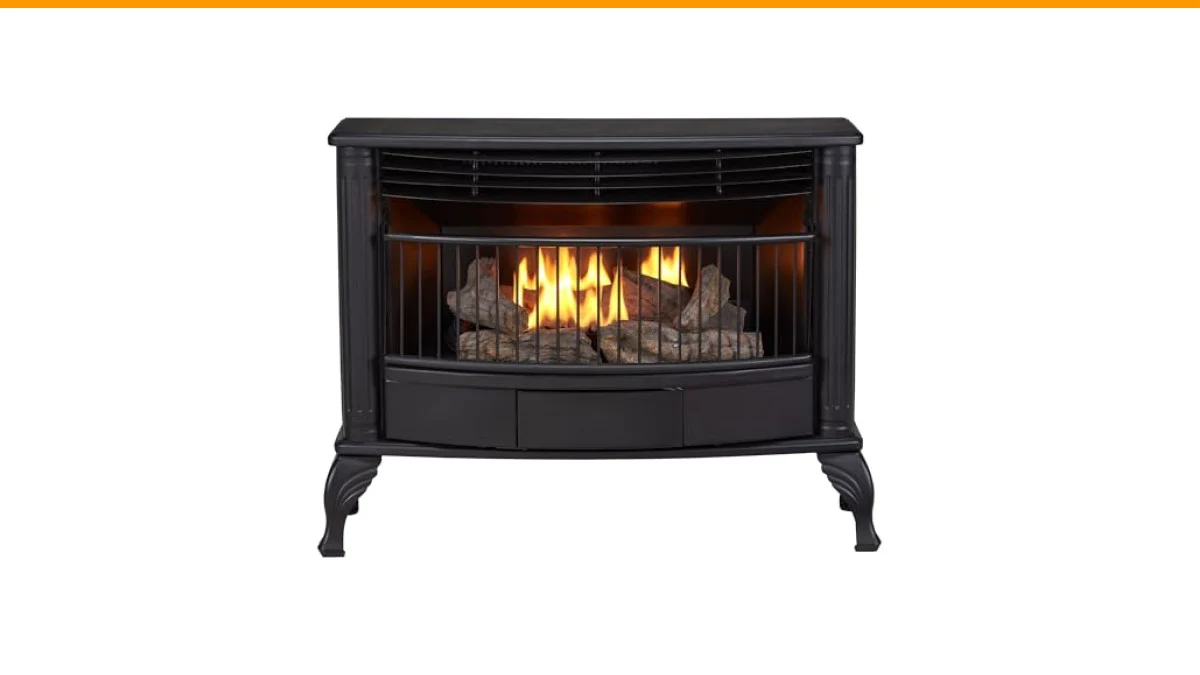
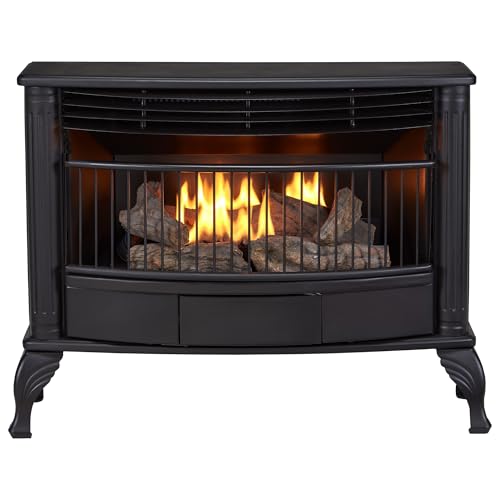
Duluth Forge Ventless Natural Gas Stove - 25,000 BTU, T-Stat Control, Black Finish - Model# QSN250T
- POWERFUL HEATING: Delivers 25,000 BTUs of heat to warm up to 1,100 square feet; operates on Natural Gas.
- THERMOSTAT CONTROL: Variable heat settings automatically cycle the stove on and off to maintain your desired room temperature.
- REALISTIC FLAME DISPLAY: Dual burner creates two rows of real flames around five hand-painted ceramic fiber logs, with a large vie…
This is the natural gas specialist in the group. The QSN250T runs on NG only, so it’s built for homes already plumbed for gas. Renters and rural propane users should skip it. Everyone else gets a 25,000 BTU stove that warms roughly 1,100 square feet.
What sets it apart is the thermostat dial. You set a temperature, and the burner cycles on and off to hold it. That’s a real difference from manual flame knobs that just run until you turn them down. The dual burner creates two rows of flame around five ceramic logs, and the viewing window is wide enough to actually enjoy the fire instead of squinting at it.
The trade-off is fuel inflexibility. No propane conversion means no backup if your gas line ever needs service. Installation is also simpler than most because the unit ships largely pre-assembled, but you still need a licensed gas connection. It’s a solid single-room heater, not a whole-home solution.
- 25,000 BTU output heats up to 1,100 sq ft
- Thermostat control auto-cycles to hold temperature
- Five hand-painted ceramic fiber logs
- Oxygen Depletion Sensor with automatic shut-off
- Battery-assisted Piezo ignition, no standing pilot needed
Best for: Homeowners with existing natural gas lines who want dependable single-room heat with set-and-forget temperature control.
Bluegrass Living Panorama…
Bluegrass Living
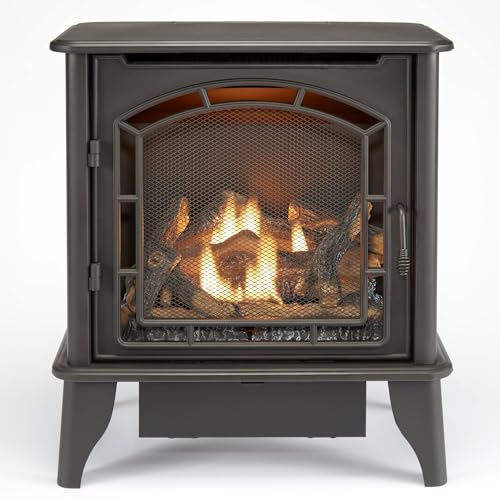
Bluegrass Living Panorama Vent Free Dual Fuel 3-Sided Gas Stove - 23,000 BTU, Remote Control, Black Finish - Model# BTSD23RT
- DUAL FUEL TECHNOLOGY: Patented system allows operation with either Natural Gas or Liquid Propane, offering flexible installation o…
- REALISTIC FLAME PRESENTATION: U-Burner chassis and hand-painted ceramic fiber logs produce a lifelike, two-row flame effect. Three…
- REMOTE CONTROL FUNCTIONALITY: Includes a thermostat remote with LCD screen to adjust temperature, mode, and flame. Easy-to-use int…
Three-sided viewing is the hook here, and it’s not just a gimmick. The Panorama BTSD23RT shows flame from the front and both sides, which makes it work as a room divider or corner centerpiece. At 23,000 BTU it covers about 1,100 square feet, though the lower output means it’s better suited to open floor plans than closed bedrooms.
Dual fuel capability stands out. A patented system lets you run natural gas or liquid propane without swapping parts. That flexibility matters if you move or if propane delivery is cheaper in your area. The included LCD remote handles temperature, flame height, and mode, and it displays current room temp so you’re not guessing.
One honest caveat: the three-sided design limits placement. You need clearance on multiple sides, so it won’t tuck into a tight alcove. The 66-pound build is manageable for two people, but this is indoor-only. Don’t plan on using it on a covered porch.
- 23,000 BTU, dual fuel (NG or LP)
- Three-sided U-burner flame view
- LCD thermostat remote with room temp display
- 99.9% efficient, no chimney or duct
- Oxygen Depletion Sensor and auto shut-off
Best for: Open-concept living rooms where the fireplace is meant to be seen from multiple angles, not just one wall.
Duluth Forge Dual Fuel Ve…
Think of the FDSR25 as the middle child that outperforms both siblings. It pushes 26,000 BTU across 1,200 square feet, runs on either fuel, and includes a thermostat remote. For a freestanding stove, that’s a strong combination. The matte black finish blends into most decor without demanding attention.
Six ceramic logs sit inside, and the dual precision-ported burner spreads flame evenly rather than concentrating it in one spot. The remote lets you set a target temperature and forget it. That’s the feature that separates a heater from a fireplace you babysit. Battery-assisted Piezo ignition means you’re not holding a match to a pilot light in January.
Where it falls short: the remote requires four AA and two AAA batteries, which are included but add ongoing cost. The matte finish also shows dust more than glossy alternatives. And like every ventless unit here, it adds moisture to the air, so a dry climate might need a dehumidifier running nearby.
- 26,000 BTU, highest output in the freestanding group
- Dual fuel with patented technology
- Thermostat remote controls temperature and log set
- Six hand-painted ceramic fiber logs
- Built-in ODS shuts down on low oxygen or CO detection
Best for: Anyone who wants maximum freestanding heat output with remote convenience and doesn’t mind a slightly higher upfront cost.
Duluth Forge Dual Fuel Ve…
The FDF400RT-ZC is the powerhouse. At 32,000 BTU it heats up to 1,500 square feet, which puts it in a different class than the stoves above. This is a fireplace insert, meaning it drops into an existing firebox or a zero-clearance enclosure. It’s the pick for whole-floor supplemental heat, not a single chilly den.
Zero-clearance construction lets you install it against or recessed into any wall with gas access. That opens up placement options a traditional masonry fireplace can’t match. The mesh double doors and sprayed brick liner give it a finished look without extra trim work. Six ceramic logs sit behind the glass, and the remote handles on/off plus manual flame adjustment.
The limitation is scale. At 15.6 inches high and 29.1 inches wide, it needs a real opening. You also need 42 inches minimum from the top of the fireplace to the ceiling. That rules out low basement ceilings. Installation is a professional job, and the 69.5-pound weight means you’re not doing this alone on a Saturday.
- 32,000 BTU heats up to 1,500 sq ft
- Zero-clearance firebox installs in most walls
- Remote control with LCD screen and flame adjustment
- Six ceramic logs, iron grate, mesh double doors
- 42-inch minimum ceiling clearance required
Best for: Homeowners heating a large open floor or finished basement who want insert-level output without building a masonry chimney.
ProCom Ventless Dual Fuel…
ProCom
ProCom Ventless Dual Fuel Gas Stove - 25,000 BTU, Remote Control, Black Finish - Model# QNSD250RT
- TECHNOLOGY & STYLE: 25,000 BTU patented Dual Fuel Technology using Natural Gas or Propane Gas to heat up to 1,100 sq. ft.; 5 impro…
- DEPENDABLE SPACE HEATER WITH REMOTE CONTROL: Remote control on the gas fireplace automatically cycles the room heater on and off t…
- ECONOMICAL ROOM HEATER: 99.9% efficient with vent free gas burner; No outside duct or chimney needed for the Natural Gas and Propa…
ProCom’s QNSD250RT delivers 25,000 BTU across 1,100 square feet on either natural gas or propane. Five ceramic logs sit inside a space-saving frame, and the thermostat remote cycles the burner to hold your set temperature. For buyers who want dual fuel flexibility without paying for three-sided glass or insert-level output, this is the straightforward option.
The 49.8-pound build is the lightest here, which makes repositioning easier if you change your mind about placement. Dimensions run 25 inches high, 33.5 inches wide, and 13 inches deep, so it fits against a wall without eating floor space. Battery-assisted Piezo ignition and the oxygen depletion sensor round out the safety package.
Availability is the catch. This model currently shows as unavailable on Amazon, so you may need to check back or look at the Duluth Forge FDSR25 as a direct substitute. The specs are close, and the Duluth unit adds one more log and a touch more output.
- 25,000 BTU, dual fuel (NG or LP)
- Thermostat remote auto-cycles for steady heat
- Five realistic logs in a space-saving frame
- Lightest unit at 49.8 lbs
- ODS and Piezo ignition standard
Best for: Budget-conscious buyers who want dual fuel capability and remote control in a compact footprint, and who can wait for restock.
How to Choose a Propane Fireplace for Heating
Most buying guides throw specs at you and call it a day. That’s useless when you’re standing in a cold room trying to decide between 23,000 and 32,000 BTU. Here’s what actually drives the decision.
Vented vs Ventless: Which Heats Better
Ventless wins on efficiency, full stop. Every BTU stays in the room because there’s no flue to lose heat up. Vented units send 20% to 30% of their heat outside, which is why they need less clearance and produce a more realistic fire. Ventless models also add moisture to the air, roughly a gallon of water per gallon of propane burned. Dry climates may need a dehumidifier. Humid climates might appreciate the bump.
State and local codes matter here. Some jurisdictions restrict ventless heaters in bedrooms or bathrooms. Check with your local building department before you buy, not after.
BTU Output and Room Size Chart
Use this rough guide for moderate climates with average insulation.
- 20,000 BTU: up to 900 sq ft
- 23,000 BTU: up to 1,100 sq ft
- 25,000 BTU: up to 1,100 sq ft
- 26,000 BTU: up to 1,200 sq ft
- 32,000 BTU: up to 1,500 sq ft
Cold climates need more. Poor insulation needs more. High ceilings need more. If you’re borderline, size up rather than down. A heater running at 70% capacity on a mild day beats one that maxes out and still leaves you cold in February.
Efficiency Ratings and Thermostat Controls
All five units here claim 99.9% efficiency, which is standard for ventless. The real differentiator is the control system. Manual flame knobs force you to adjust constantly. Thermostat remotes cycle the burner automatically, which uses less fuel over a heating season. That’s where your savings live, not in the efficiency rating.
If you want to compare broader heating options beyond propane, our fireplace heating guide covers wood, gas, and electric alternatives side by side.
Real Operating Costs: Propane vs Electric vs Wood
Propane cost per hour depends on your local price and the unit’s BTU rating. At an average $2.50 per gallon, a 25,000 BTU heater burns roughly 0.27 gallons per hour. That’s about 68 cents per hour, or roughly $1.60 per day if you run it four hours. A full month of evening use lands near $50.
Electric resistance heat costs more per BTU in most markets. A 1,500-watt space heater runs about 15 cents per hour at average rates, but it only produces around 5,100 BTU. You’d need five of them to match a 25,000 BTU propane stove, which flips the math hard in propane’s favor.
Wood is cheaper per BTU if you have free or low-cost access. Otherwise, the labor and storage overhead rarely beat propane for convenience. Zone heating with a propane stove also lets you lower your central thermostat by several degrees, which cuts the furnace bill even when the stove is running.
Can a Propane Fireplace Be Your Primary Heat Source?
In a single room, yes. For an entire house, usually no. Ventless heaters are rated for supplemental zone heating, not whole-home duty. Code limits, moisture output, and oxygen consumption all cap how long you can run one continuously.
Some homeowners do use a large insert like the 32,000 BTU Duluth Forge as a primary source in a well-insulated open floor plan. That works if the layout is open and the climate is moderate. It fails in closed-floor-plan homes where heat can’t circulate.
Check your local codes before relying on any ventless unit as primary heat. Some states restrict it outright. Others allow it with ventilation requirements. A quick call to your building department saves a lot of regret.
Safety, Ventilation, and Clearance Requirements
Every unit here includes an Oxygen Depletion Sensor that shuts the burner down if oxygen drops or carbon monoxide rises. That’s a legal requirement for ventless heaters, not a bonus feature. It works, but it’s a backup, not a substitute for common sense.
Follow the clearance specs. The insert needs 42 inches from the top of the firebox to the ceiling. Freestanding stoves need side and rear clearance from walls and furniture. Three-sided models need clearance on all visible sides.
Ventless heaters consume oxygen and produce moisture. Crack a window occasionally if the room feels stuffy. A CO detector on the same floor is cheap insurance. If you’re comparing vented and vent-free options more broadly, our gas fireplace comparison breaks down the trade-offs.
Installation: Costs, Permits, and What to Expect
Ventless units skip the chimney, which saves thousands. But you still need a gas line, and that’s licensed work in most jurisdictions. A plumber or HVAC tech typically charges $200 to $600 to run a line and connect the unit, depending on distance from your existing supply.
Permits vary by municipality. Some require one for any gas appliance installation. Others only require it for new lines. Budget $50 to $200 for the permit if it’s needed. DIY installation is possible for the unit itself if you’re handy, but the gas connection should be professional.
For inserts, add the cost of modifying your existing firebox or building a zero-clearance enclosure. That can run $500 to $1,500 depending on the scope.
Maintenance and Power Outage Performance
Ventless heaters need annual cleaning. Dust and pet hair clog the burner ports and reduce efficiency. A soft brush and vacuum handle most of it. Check the ODS sensor annually and replace batteries in the remote and ignition system before each heating season.
Power outages are where these units shine. Battery-assisted Piezo ignition means you can light the burner without electricity. The thermostat remote won’t cycle automatically without power, but you can run the unit manually. That makes a propane stove a legitimate emergency heat source, which is more than you can say for most electric alternatives.
For more on pairing a fireplace with your existing heat setup, see our propane fireplace picks.
Frequently Asked Questions
Do ventless propane heaters really produce carbon monoxide?
They produce trace amounts during normal combustion. The ODS sensor shuts the unit down before levels become dangerous. That said, proper ventilation and a working CO detector are non-negotiable. Never run a ventless heater in a sealed room for extended periods.
How long does a 20-pound propane tank last on a 25,000 BTU heater?
Roughly 8 to 10 hours at full output. That’s fine for occasional use, but most homeowners connect to a larger tank or a natural gas line for regular heating. A 100-pound tank extends runtime to about 40 hours.
Can I install a ventless fireplace in a bedroom?
Some states allow it, others prohibit it. The concern is oxygen depletion during sleep. Check your local code. If it’s allowed, size the unit conservatively and keep a window cracked.
What’s the difference between dual fuel and single fuel?
Dual fuel units run on natural gas or liquid propane without modification. Single fuel models are locked to one or the other. Dual fuel costs a bit more upfront but gives you flexibility if your situation changes.
Our Top Recommendation
The Duluth Forge FDSR25 takes the top spot. It balances output, fuel flexibility, and remote control better than anything else here. At 26,000 BTU and 1,200 square feet, it handles most living rooms and open spaces without maxing out. The thermostat remote means you set it and forget it, which saves fuel over a season.
If you need more reach, the Duluth Forge FDF400RT-ZC insert pushes 32,000 BTU across 1,500 square feet. It’s the right call for large open floors or finished basements. For a tighter budget or a smaller room, the Bluegrass Panorama’s three-sided view adds visual appeal without sacrificing much heating capacity.
Skip the ProCom unless you find it in stock at a good price. The Duluth FDSR25 outperforms it on nearly every spec for similar money.
Final Verdict
Propane fireplaces work as supplemental heat, and they work well when sized correctly. Match BTU to square footage, choose dual fuel if you want flexibility, and prioritize thermostat control over manual knobs. Ventless efficiency keeps nearly all the heat indoors, and battery ignition keeps you warm when the power grid doesn’t.
For most buyers, the Duluth Forge FDSR25 is the safest bet. It’s not the cheapest or the most powerful, but it’s the one most people will be happy with five years from now. Check the current price on Amazon and confirm your fuel type before ordering. That one detail trips up more buyers than anything else.


