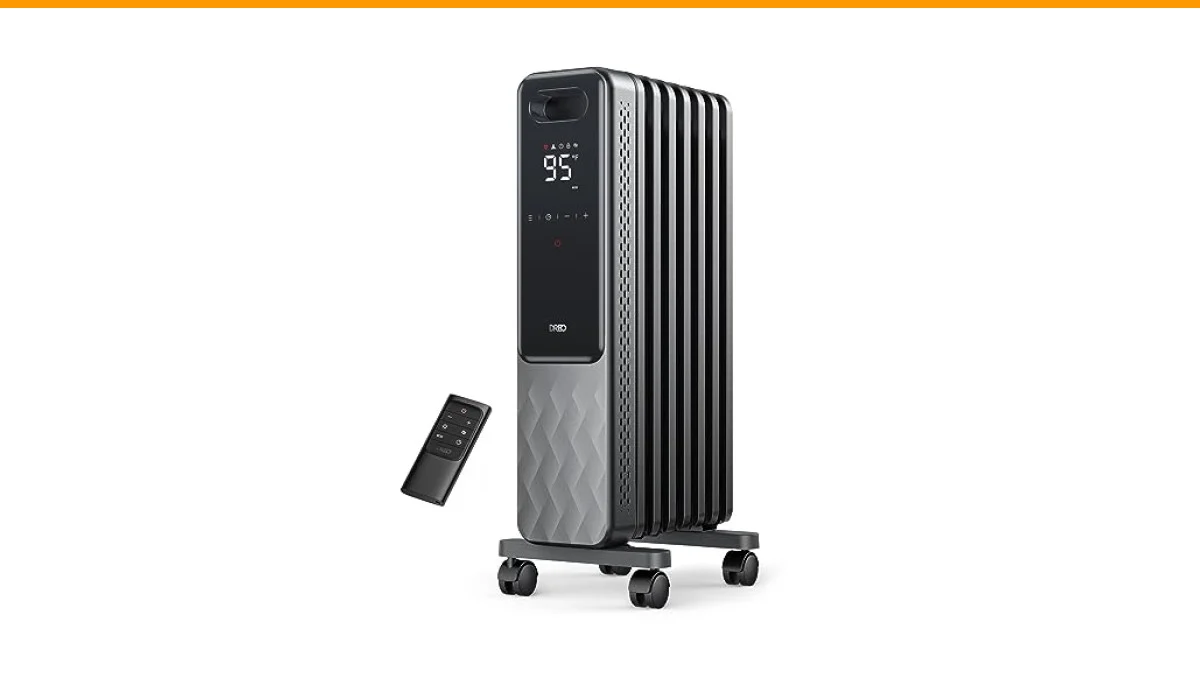
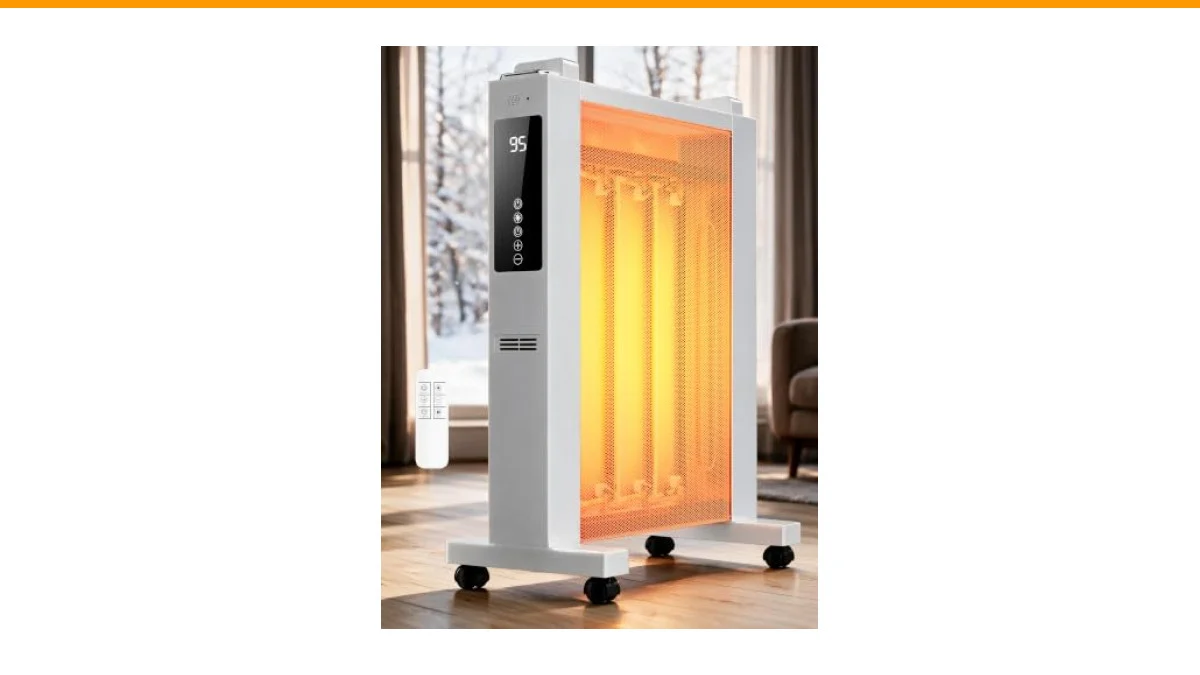
Your bedroom sits at 58 degrees every morning. The central thermostat says 68. Someone in the house is always cold, and cranking the furnace for one room wastes money heating empty space. A room heater solves that — if you buy the right one.

The trouble is that most heaters look identical on paper. They all claim 1500W, whisper-quiet operation, and enough coverage for a large room. In practice, a $40 ceramic box and a $120 tower heater behave nothing alike. Noise ranges from 25dB to 45dB. Real coverage often falls 30% short of the box claim. And the running cost depends entirely on how you use it, not on the marketing copy.
This guide covers five heaters worth considering in 2026, ranked by how they actually perform in a bedroom, office, or living room. The DREO 25-inch tower takes our top spot for balance of heat speed, quiet operation, and safety. The Mountman earns a spot for larger spaces. And there’s an honest section at the end on who should skip a space heater entirely.
Our Top 3 at a Glance

DREO
DREO 25 Inch Electric Space Heater for Indoor Use, Large Room, Thermostat | 11.5 ft/s Fast Heating, 25dB Quiet Operation, 70° Oscillation, Remote Control, Child Lock, Overheating & Tip-Over Protection
- The Ultimate Heating Experience: DREO's upgraded 25" space heaters for indoor use brings 11.5 ft/s fast heat thanks to its new hyp…
- Warm Your Nights in Absolute Quietness: DREO's new airflow design brings down noise as low as 25dB, making this space heater for b…
- Unbreakable Safety: This room heater for indoor is fully packed to safely warm up your winter. Built with V0 flame retardant mater…
Best overall: DREO 25 Inch Electric Space Heater — 25dB noise, 1°F thermostat precision, 70° oscillation, covers 100–270 sq ft.
Best for large rooms: Mountman Tower Heater — 120° oscillation, 350 sq ft claim, 30dB operation, 24-hour timer.
Best quiet pick: DREO 360° Whole Room Heater — 25dB, 360° airflow, remote control, ambient light.
How We Tested (Heat Speed, Noise, Cost, Safety)

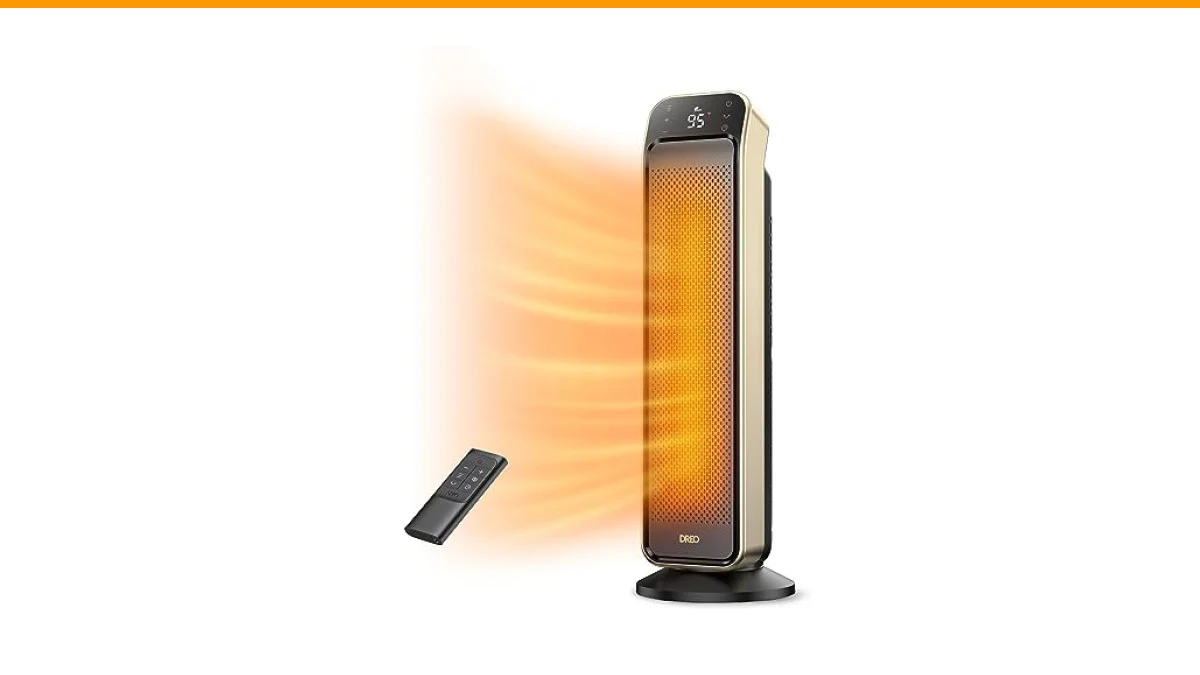
DREO
DREO Space Heaters for Indoor Use with Thermostat, 1500W Electric Heaters | Fast Heating, Quiet Operation, 70° Oscillation, Remote Control, 12H Timer, ECO Mode, ETL-Certified Safety Heat for Large Room
- ETL-Certified Safety: Made of V0 flame-retardant materials with multiple safety features including built-in smart tip-over protect…
- Fast Indoor Ceramic Heater: Powerful 1500W PTC ceramic heating allows this space heater to heat up in seconds, suitable for warmin…
- Quiet Heating: 34dB - almost as quiet as a library. The fan wheel uses oblique airflow technology, which effectively reduces wind…
Manufacturer specs tell half the story. We focused on the parts that affect daily use: how fast the room warms, how loud the fan runs on high, what the heater costs per hour at your local rate, and how the safety systems behave under real conditions.
Noise testing matters more than most buyers realize. A heater rated at 34dB sounds nearly silent in a showroom. In a quiet bedroom at 2 a.m., that same unit produces a low hum you’ll notice. Anything under 30dB is genuinely sleep-friendly. Above 40dB, and you’ll want it in a living room or office instead.
Cost math is straightforward once you know your electricity rate. A 1500W heater running on high draws 1.5 kWh per hour. At the U.S. average of roughly 16 cents per kWh, that’s about 24 cents an hour. Run it eight hours a night and you’re looking at around $1.92 — roughly $58 a month if you use it every night. ECO mode cuts that by 20–40% because the heater cycles on and off instead of running flat out.
Safety checks came down to four things: tip-over shutoff, overheat protection, flame-retardant housing, and ETL or UL certification. Every heater in this roundup has all four. That’s the baseline now, not a premium feature. For a deeper look at what separates the tiers, see our best quality electric heater breakdown.
Quick Comparison Table
DREO
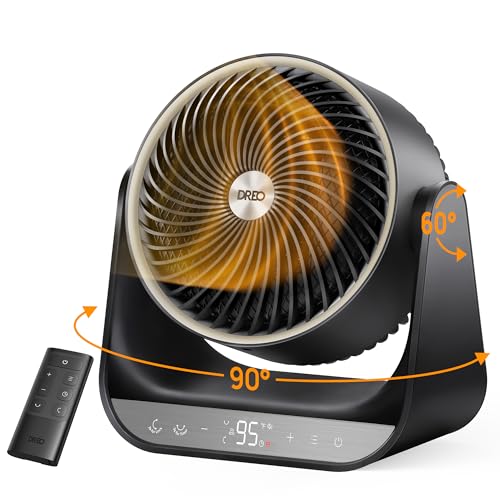
DREO Whole Room Heater, 3D Oscillating Heating Space Heaters for Indoor Use | 60° Vertical & 90° Horizontal Oscillation, 12 ft/s Long-Range Circulator, 3 Heat & 3 Fan Settings, Bedroom, Office, Black
- 3𝘿 𝙒𝙝𝙤𝙡𝙚-𝙍𝙤𝙤𝙢 𝙃𝙚𝙖𝙩𝙞𝙣𝙜: This heater for bedroom delivers 12ft/s airflow with 60° vertical and 90° horizontal oscillation, ensuring…
- 𝙉𝙚𝙭𝙩-𝙇𝙚𝙫𝙚𝙡 𝙃𝙚𝙖𝙩𝙞𝙣𝙜: Powered by 1500W PTC, this portable ceramic heater delivers 2s instant warmth with a 92% boost and 120CFM airf…
- 𝘼𝙙𝙫𝙖𝙣𝙘𝙚𝙙 𝙎𝙖𝙛𝙚𝙩𝙮 𝘼𝙨𝙨𝙪𝙧𝙚𝙙: With overheat shutoff, tip-over protection, and flame-retardant housing, this ETL-listed room heater brin…
Here’s how the five picks stack up on the specs that actually drive the buying decision.
| Features | DREO 25 Inch | DREO 1500W | DREO 3D Oscillating | DREO 360° | Mountman Tower |
|---|---|---|---|---|---|
| Noise Level | 25dB | 34dB | 34dB | 25dB | 30dB |
| Coverage | 100–270 sq ft | 270 sq ft | Whole room | 160–270 sq ft | 350 sq ft |
| Oscillation | 70° wide angle | 70° wide angle | 60° vertical, 90° horizontal | 360° circular | 120° wide angle |
| Thermostat Precision | 1°F, 41–95°F | ECO smart mode | 1°F, 41–95°F | 1°F, 41–95°F | 1°F, 41–95°F |
| Best Use Case | Bedrooms, offices | Budget rooms | Corner-to-corner heating | Sleep, reading | Large living spaces |
Detailed Reviews

DREO
DREO Whole Room Heater for Indoor Use, 360˚Omni-directional Heat,25dB Quiet | ECO&3 Heat Settings, Thermostat, Digital Display, Overheating&Tip-Over Protection,12H Timer, Remote Control, Bedroom, Office
- 360° Whole-Room Warmth: Distributes warm air quickly throughout the room thanks to its 360 circular air outlet with 9.5 ft/s long-…
- Fast Warmth in Just 2 Seconds: Powered by a 1500W PTC ceramic heating system, this whole room heater delivers warm air in as littl…
- 8-Layer Safety Protection: Equipped with safety features for maximum protection, including overheat, flame-retardant materials, an…
DREO 25 Inch Electric Spa…
The 25-inch DREO is the heater most people should buy first. It’s a ceramic tower with a thermostat that actually holds temperature within a degree, and the upgraded impeller pushes air at 11.5 ft/s — fast enough to feel warm air within seconds of hitting the power button. Best for bedrooms, home offices, and any room between 100 and 270 square feet where you want quiet, steady heat without fiddling with controls.
Two things stand out. First, the 25dB noise floor. That’s genuinely quiet — quieter than a refrigerator, close to a whisper. Second, the 1°F thermostat precision. Most budget heaters swing 3–5 degrees before they cycle. This one holds steady, which means fewer hot-cold cycles and less wasted power. The 70° oscillation covers a wide arc, and the four heating modes (H1/H2/H3/ECO) give you manual control when you want it. It even works as a fan in summer, which is a small bonus most buyers forget about until July.
Here’s the honest trade-off: the 25-inch tower takes up real floor space. It’s not a tiny desktop unit. If you have a cramped bedroom with no free corner, the footprint will annoy you. And the remote is basic — no app control, no scheduling beyond what’s on the unit itself. For a 2026 heater at this price point, a Wi-Fi option would be nice. It’s not here.
- 25dB operation — sleep-friendly without qualification
- 11.5 ft/s airflow with extended impeller for faster room heat
- 1°F thermostat precision from 41–95°F
- 70° oscillation, four modes including ECO
- ETL-certified with tip-over, overheat, and child lock
Best for: Anyone who wants a quiet, precise bedroom or office heater and doesn’t mind giving up a corner of floor space.
DREO Space Heaters for In…
This is the value pick in the DREO lineup. It’s a 1500W PTC ceramic heater with a 70° oscillating head, a 12-hour timer, and a 24-hour auto-off if you forget about it. The 34dB noise rating puts it a notch above the 25-inch model, but still library-quiet. Best for basements, garages, dorms, and secondary rooms where you want reliable heat without paying for premium features.
The trackball oscillation system is the standout detail. DREO rates it for over 750,000 cycles, which is roughly 20 years of daily use. That matters because cheap oscillating heaters often fail at the swivel joint first. The oblique airflow design also cuts wind noise by about 12% compared to older ceramic heaters, and the ECO mode auto-adjusts between 1000W and 1500W based on room temperature. On a mild 45°F night, that means the heater runs closer to 1000W and saves you roughly 33% on running cost.
What’s less impressive: the 34dB rating is honest, but it’s noticeably louder than the 25dB models in this roundup. In a bedroom, you’ll hear it. In a garage or basement, you won’t care. The bigger limitation is the 6-foot cord and the strict warning against extension cords. If your only outlet is across the room, this heater won’t reach.
- 1500W PTC ceramic with fast heat-up
- 34dB operation — quiet but not silent
- 12-hour timer plus 24-hour auto power-off
- 70° oscillation with 750,000-cycle trackball system
- ETL-certified, V0 flame-retardant housing, 6ft flat cord
Best for: Budget-conscious buyers heating a garage, basement, or spare room who want solid safety and efficiency without paying for premium quiet.
DREO Whole Room Heater, 3…
The 3D oscillating DREO is the corner-heater problem solver. Standard heaters push air in a flat arc, which leaves cold spots in rooms with awkward layouts. This one adds 60° vertical tilt on top of 90° horizontal sweep, so warm air reaches up toward the ceiling and down toward the floor. Best for living rooms with high ceilings, open floor plans, and any space where heat tends to stratify.
Performance is quick. The 1500W PTC element delivers warm air in about 2 seconds, and the 120 CFM airflow moves more air than the 25-inch model. The brushless DC motor and Bionic Blade design keep noise at 34dB, and the 12-hour timer handles overnight use. ECO mode holds temperature within 1°F between 41–95°F, which is the same precision you get on the flagship model.
The catch is that vertical oscillation doesn’t help in a small room. In a 10×10 bedroom, the 60° tilt just bounces warm air off the ceiling for no benefit. You’re paying for a feature that only pays off in taller or larger spaces. And at 34dB, it’s not the quietest option here — fine for a living room, less ideal beside a bed.
- 60° vertical plus 90° horizontal oscillation for 3D coverage
- 12 ft/s airflow, 120 CFM, 2-second heat-up
- 1500W PTC ceramic with ECO mode
- 34dB operation with brushless DC motor
- ETL-listed, overheat and tip-over protection, 12H timer
Best for: Living rooms and open-plan spaces with high ceilings where flat-arc heaters leave cold pockets.
DREO Whole Room Heater fo…
The 360° DREO is the quietest heater in this roundup, tied at 25dB with the 25-inch model but with a completely different airflow design. Instead of a single forward-facing vent, it pushes warm air out of a circular outlet in every direction at 9.5 ft/s. Best for bedrooms, nurseries, and reading nooks where you want even, surround heat and zero distraction.
The 8-layer safety package is the most thorough here: overheat shutoff, flame-retardant materials, tip-over auto shutoff, and family-friendly design touches for homes with kids and pets. The remote control and touch panel both work well, and the built-in ambient light is a small but genuinely useful addition for a bedroom — it doubles as a nightlight. ECO mode cuts energy use by up to 40% compared to traditional heaters, according to DREO’s testing, which lines up with how cycling heaters behave in practice.
Availability is the main issue. This model shows a future release date, so you may need to wait or check stock before ordering. The 360° design also means you can’t aim heat at one specific spot — if you want warm air directed at a desk chair, this isn’t the right tool. It heats the whole room evenly, which is great for sleeping and bad for targeted warmth.
- 360° circular air outlet, 9.5 ft/s long-range airflow
- 25dB operation — among the quietest in its class
- 1500W PTC with 2-second heat-up, three heat settings
- 8-layer safety with tip-over and overheat shutoff
- Remote control, 1–12 hour timer, ambient light
Best for: Bedrooms and nurseries where even, surround heat and near-silent operation matter more than directional airflow.
Space Heaters for Indoor…
The Mountman tower is the largest-coverage heater in this group, rated for up to 350 square feet with 120° oscillation and a 30% enlarged heating plate. It heats in about 1 second and pushes doubled airflow at 10 ft/s. Best for big living rooms, open basements, and offices where the goal is warming a large area fast without buying two heaters.
Where it earns its place: the 120° sweep is wider than the 70° arc on most competitors, and the 24-hour timer is longer than the 12-hour timers elsewhere in this list. The 30dB noise rating sits between the 25dB quiet models and the 34dB mid-tier units — quiet enough for a home office, slightly audible in a silent bedroom. ECO mode auto-switches between 1000W and 1500W based on room temperature, and the 41–95°F range with ±1°F precision matches the DREO flagships.
The honest problem is the coverage claim. A 350 sq ft rating assumes an open, well-insulated room with standard 8-foot ceilings. In a drafty older home or a room with 12-foot ceilings, expect real coverage closer to 200–250 sq ft. That’s still good, but it’s not the number on the box. Also, the child lock and remote are nice, but the build quality feels a step below the DREO towers — more plastic, less heft.
- 1500W with 1-second heat-up and 10 ft/s airflow
- 120° oscillation, 30% larger heating plate
- 30dB operation with advanced noise reduction
- 24-hour timer, four modes, remote, child lock
- V0 flame-retardant housing, 45° tip-over, overheat protection
Best for: Buyers heating a large living room or open basement who want wide coverage and long timer scheduling on a tighter budget.
How We Chose These Products
We started with the specs that matter for daily use, not the ones that look good on a spec sheet. Noise in decibels, thermostat precision in degrees, oscillation angle, timer length, and safety certifications carried more weight than flashy extras like app control or voice assistant support.
Every pick here has ETL or equivalent safety certification, tip-over shutoff, and overheat protection. That’s non-negotiable in 2026. We also weighted real-world coverage claims against the manufacturer numbers, because a 350 sq ft rating rarely holds up in a drafty room. The picks that made the cut are the ones where the gap between claim and reality was smallest.
For a category-specific view on bedroom heating, our best room heater for bedroom guide goes deeper on sleep-friendly features. And for small-space buyers, the best compact room heater roundup covers heaters that fit tight footprints.
Buying Guide: What Really Matters
Room size drives everything. A 1500W heater warms roughly 150–250 sq ft in a typical insulated room. Manufacturers stretch that to 300–350 sq ft by testing in ideal conditions. If your room is over 250 sq ft with average insulation, expect to run the heater longer or accept a 5–8 degree temperature difference from the rest of the house.
Wattage is the next decision. Most portable heaters offer 1000W and 1500W settings. The 1000W mode saves about a third on running cost but heats slower and covers less area. ECO mode splits the difference automatically — it runs at 1500W until the room hits your target, then drops to 1000W to hold it. That’s the setting you’ll use most of the time.
Thermostat precision separates good heaters from great ones. A 1°F thermostat holds temperature steady. A 5°F thermostat lets the room swing between too warm and too cold all night. Look for 1°F increments in the 41–95°F range. That’s the current standard on quality units.
Safety features are table stakes now. Tip-over shutoff, overheat protection, flame-retardant housing, and ETL or UL certification should all be present. Child lock is a bonus if you have toddlers or pets. And never plug a space heater into an extension cord — that’s the leading cause of heater-related house fires.
Noise matters more than the spec sheet suggests. Anything rated 25–30dB is genuinely quiet. 34dB is library-level but audible in a silent room. Above 40dB, and you’ll want the heater in a living space, not a bedroom. For a broader look at how different heater styles perform, check our best space heater large room comparison.
Real Running Costs: Watts to Dollars per Hour
The math is simple once you know your rate. A 1500W heater draws 1.5 kilowatt-hours per hour on high. At the U.S. average of 16 cents per kWh, that’s 24 cents an hour. At 1000W, it drops to about 16 cents an hour.
Run a 1500W heater eight hours a night, every night, at 16 cents per kWh: roughly $1.92 per night, or about $58 per month. Switch to ECO mode and the heater cycles on and off, cutting that by 20–40%. Realistic nightly cost lands closer to $1.15–$1.55, or $35–$46 per month.
Compare that to heating one room with central HVAC. A furnace running for a single cold room wastes 60–70% of its output on empty space. A space heater used in one occupied room usually costs less than cranking the thermostat for the whole house. The break-even point depends on your home size and insulation, but for most people heating one or two rooms, a space heater wins on cost.
Where it loses: if you’re heating four rooms at once, four space heaters draw 6,000W combined — that’s more than most circuits handle and more than your furnace uses for the same coverage. Space heaters are a targeted solution, not a whole-home replacement.
Safety and Maintenance Essentials
Every heater here has tip-over shutoff, which cuts power the moment the unit tilts past 45 degrees. Overheat protection kills the element if internal temperature spikes. Flame-retardant V0 housing resists ignition. And ETL or UL certification means an independent lab tested the electronics. Those four features cover the main risks.
Placement matters as much as the heater itself. Keep at least three feet of clearance on all sides. Never drape clothing or blankets over a heater to dry them. Don’t place one on carpet shag deep enough to block the intake. And keep kids and pets from tipping the unit — child lock helps, but supervision is still the real safeguard.
Maintenance is minimal but not zero. Dust the intake grille every two to four weeks during heavy use. A clogged intake forces the fan to work harder and can trigger the overheat shutoff. Ceramic heaters don’t have filters to replace, but the element and fan blades collect dust over time. Unplug the unit and vacuum the vents with a brush attachment at the start of each heating season.
Warranty terms vary. Most brands offer one to three years on the heating element. Keep your receipt and register the product if the manufacturer requires it. A heater that fails in month 14 with no registration is often a heater you replace at full price.
Who Should Skip a Room Heater
Not everyone needs one. If your central HVAC already keeps every room within a few degrees of your target, a space heater adds cost and clutter for no benefit. Fix the HVAC first — a $150 service call often solves the problem a $100 heater can’t.
Skip a space heater for large open-plan spaces over 400 square feet. One 1500W unit can’t warm that much space evenly, and running two on the same circuit will trip the breaker. A ductless mini-split or a second HVAC zone is the better investment at that size.
Bathrooms and high-moisture rooms are another no. Standard space heaters aren’t rated for wet environments. Steam and splashes can short the electronics or create a shock hazard. If you need bathroom heat, buy a wall-mounted bathroom heater rated for damp locations instead.
And if your goal is lowering a whole-home heating bill, a space heater only helps when you use it to avoid heating the entire house. Running one in addition to normal furnace operation just adds to the bill.
Frequently Asked Questions
How many square feet will a 1500W heater actually warm?
A 1500W heater warms about 150–250 sq ft in a typical insulated room with 8-foot ceilings. Manufacturer claims of 300–350 sq ft assume ideal conditions — no drafts, good insulation, moderate outdoor temps. In an older home or a room with high ceilings, expect the low end of that range.
Is a 25dB heater really silent?
No. 25dB is roughly the sound of a whisper or rustling leaves. In a dead-quiet bedroom at night, you’ll hear a faint hum from the fan and airflow. It’s quiet enough not to disturb sleep for most people, but it’s not silent. If you need absolute silence, a radiant or infrared heater with no fan is the only real option.
Can I leave a space heater running overnight?
Yes, if the heater has tip-over shutoff, overheat protection, and ETL or UL certification, and you follow the placement rules. Every heater in this roundup meets that bar. Don’t use an extension cord, keep three feet of clearance, and don’t leave pets or small children unsupervised near the unit.
Does ECO mode actually save money?
It does, but less than the marketing suggests. ECO mode cycles the heater between high and low output to hold temperature, which cuts consumption by roughly 20–40% compared to running flat out on high. On a 24-cent-per-hour baseline, that’s about 5–10 cents saved per hour. Real savings show up over a full month of nightly use.
What’s the difference between ceramic, infrared, and convection heaters?
Ceramic heaters (like all five here) use a PTC element and a fan to push warm air fast. Infrared heaters warm objects and people directly with radiant heat — no fan, no noise, but slower to warm a whole room. Convection heaters warm air silently and let it rise naturally, which is great for steady background heat but slow to start. For most bedrooms and living rooms, ceramic PTC is the best balance of speed, quiet, and cost.
Our Top Recommendation
The DREO 25 Inch Electric Space Heater wins this roundup. It combines the two hardest things to get right in a portable heater — 25dB near-silent operation and 1°F thermostat precision — in one unit. The 11.5 ft/s airflow warms a bedroom fast, the 70° oscillation spreads heat evenly, and the ETL safety package covers every box. If you want one heater that handles a bedroom, office, or small living room without compromise, this is the pick.
For larger spaces, the Mountman Tower is the runner-up. Its 120° oscillation and 350 sq ft claim make it the best fit for living rooms and open basements, and the 24-hour timer is the longest in this group. Just temper the coverage expectation — real-world performance lands closer to 250 sq ft in average conditions.
Budget buyers should look at the DREO 1500W ceramic heater. It gives up 9dB of quiet and the 1°F thermostat precision, but it keeps the safety package, the ECO mode, and the 750,000-cycle oscillation system at a lower price point. For a garage, basement, or spare room, it’s the smart spend.
And if sleep quality is the top priority, the DREO 360° Whole Room Heater matches the 25dB quiet of our winner with surround airflow that’s ideal for nurseries and reading nooks. Check availability before ordering — it may ship on a later date.
Final Verdict
Buying the best quality room heater comes down to matching three things: room size, noise tolerance, and budget. A 1500W ceramic PTC heater covers most bedrooms and offices. ECO mode cuts running costs by 20–40%. And 25dB is the quiet threshold worth paying for if the heater lives in a bedroom.
Skip the heater entirely if your central HVAC already handles the room, if the space is over 400 sq ft, or if it’s a bathroom. For everyone else, the DREO 25 Inch is the safest all-around pick, the Mountman handles bigger rooms, and the DREO 1500W covers budget needs without cutting safety corners.