I spent three weeks trying to heat a 110-square-foot home office without tripping the breaker or listening to a fan whine all day. Every product page promised ‘fast, efficient warmth.’ None of them told me what the thing actually weighed, how loud it was at 2 a.m., or what it would add to my electric bill. So I did the math myself.
A good small electric radiator heater does one job well: it holds heat in a small, closed room for hours without drying the air or making noise. Oil-filled radiators win that job because the thermal mass keeps radiating warmth after the power cuts off. Dry element and fan heaters heat faster, but they cool the second you unplug them.
Below are five units that fit that brief, ranked for different rooms and budgets. I’ve included a sizing chart, real kWh math, and the honest limits of each pick. If you only read one section, make it the sizing chart. It will save you from buying a heater that’s too weak or too strong.
Here’s a quick side-by-side of the five picks before the full reviews:
| Features | Dumos 1500W Radiator | De’Longhi EW7707CM | DREO Oil Filled | Sweetcrispy 1500W | DREO Radiator Heater |
|---|---|---|---|---|---|
| Wattage settings | 600W / 900W / 1500W | 1500W with ComfortTemp | 600W / 900W / 1500W | 600W / 900W / 1500W | 600W / 900W / 1500W |
| Controls | Adjustable thermostat dial | Simple dial controls | LED touchscreen plus remote | Adjustable thermostat dial | Dual knob controls |
| Safety features | Tip-over plus overheat cutoff | Thermal slot design | Triple overheat, tilt, child lock | Tip-over plus overheat cutoff | 8 protections, ETL listed |
| Best room size | 10-15 square meters | Medium bedrooms and offices | Large rooms, whole-home zones | 10-15 square meters | Large rooms, living areas |
| Standout feature | Fanless silent operation | ComfortTemp energy savings | 24-hour timer and eco mode | Budget-friendly quiet heat | Auto thermostat cuts power use |
The Dumos is the pick I’d hand to someone who wants a heater to disappear into the background. It’s built for bedrooms, small offices, and any room in the 10-15 square meter range (roughly 108-160 square feet). The fanless design means zero air movement, so dust stays put and the air doesn’t feel stripped of moisture.
What stands out is the thermostat range: -5 to 60°C. That’s unusually wide for a budget radiator. You can dial it down to a trickle of warmth on a mild night or push it hard on a cold morning. The three heat settings (600W, 900W, 1500W) let you match output to the room instead of always running full blast. Four heavy-duty casters and a carry handle make it genuinely easy to roll between rooms, which matters more than most buyers expect.
The trade-off is control granularity. You get a dial, not a digital display, so you won’t know the exact temperature without a separate thermometer. There’s also no timer. If you want the heater to kick on at 6 a.m. before you wake up, this isn’t the one. Build quality is solid for the price, but it’s not a heirloom piece.
- 1500W max output with 600W and 900W lower settings
- Thermostat adjustable from -5 to 60°C
- Overheat protection and tip-over auto shutoff
- Four universal casters plus carry handle
- Fanless, silent operation with no moving parts
Best for: Anyone who wants quiet, steady heat in a small bedroom or office and doesn’t need a timer or digital controls.

De’Longhi Oil filled Radiator

DUMOS
Dumos Oil Filled Radiator Heater with Adjustable Thermostat, Noiseless | 1500W Oil Space Heater for Indoor Use, Portable, Bedroom, Living Room, 22inch Black
- 1500W Oil Filled Radiator Heater: Dumos 1500W Oil Filled Radiator Heater provides fast and efficient heating, quickly warming up s…
- Energy Efficient with 3 Heat Settings: This Dumos oil heater offers 600W, 900W, and 1500W modes with a adjustable thermostat (from…
- Safe & Reliable Operation: Equipped with a power indicator light, overheat protection, and a tip-over safety switch, this radiator…
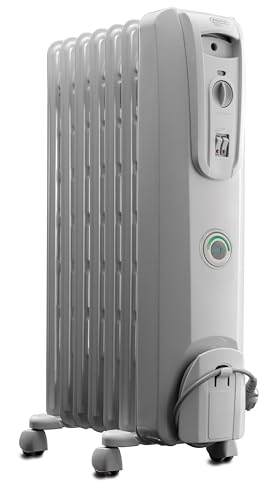
De’Longhi has been making oil-filled radiators longer than most of its competitors have existed. The EW7707CM is the model I’d point a first-time radiator buyer toward. It’s simple, it’s well-built, and the ComfortTemp feature is the closest thing to genuine energy savings in this category.
ComfortTemp automatically adjusts power and temperature to hold a steady room reading instead of cycling between too hot and too cold. De’Longhi claims up to 20% more efficiency versus running the same unit at max thermostat. That’s a real difference over a winter, not a marketing number. The thermal slot design pushes heat into the room while keeping the outer surface cooler than most oil-filled units, which matters if you have kids or pets.
Here’s the honest downside: the controls are basic. No remote, no display, no timer. You set it and forget it, which is either a feature or a frustration depending on your habits. It also doesn’t have the wide thermostat range of the Dumos. And the integrated handle is convenient but the unit is heavier than it looks when filled with oil.
- 1500W with ComfortTemp automatic temperature management
- Thermal slot design for cooler surface temps
- Gentle heat with no fan, less dry air
- Integrated handle and control panel for relocation
- Allergy-friendly design that doesn’t stir up dust
Best for: Buyers who want a proven brand, low-maintenance operation, and real energy savings without fiddling with settings.
DREO Oil Filled Radiator
De'Longhi
De'Longhi Oil filled Radiator Heater, 1500W Electric Space Heater for indoor use, portable room heater, Energy Saving, full room like office and bedroom with safety features, EW7707CM
- Simple Controls allow you to easily adjust power level and temperature.
- Up to 20% more efficient* deploy the ComfortTemp feature to automatically maintain the optimal temperature and power levels. *vers…
- Exclusive thermal slot design maximizes heat flow into the room while maintaining a low surface temperature
If the De’Longhi felt a little too basic, the DREO oil-filled radiator is the opposite end of the spectrum. This is the pick for someone who wants a small electric radiator heater with smart features usually reserved for larger units. Seven fins, a 24-hour timer, eco mode, remote control, and a large LED touchscreen.
The 92.3% heating boost claim comes from DREO’s own testing, and the 7-fin design does disperse heat faster than the 5-fin units common at this price. Eco mode is the real standout. It uses a temperature sensor and algorithm to hold steady warmth without the swings you get from a basic dial thermostat. The child lock and mute modes are thoughtful touches for a nursery or shared bedroom.
Nothing is free, though. The touchscreen and remote add complexity, and some buyers find the display bright at night (there’s a screen-off mode, so this is fixable). The larger fin count also means a slightly wider footprint than the Dumos or Sweetcrispy. And the smart features won’t help you if you never use them.
- 1500W with 600W and 900W lower settings
- 7 fins for faster heat dispersion
- 24-hour programmable timer
- Eco mode with precise temperature sensor
- LED touchscreen, remote, child lock, mute, screen-off
Best for: Tech-comfortable buyers who want timer scheduling, remote control, and eco mode in a small-to-medium room.
Sweetcrispy Oil Filled Radiator

DREO
DREO Oil Filled Radiator Heater, Electric Heaters for indoor use Large Room | Quiet, Digital Thermostat, ECO, Remote Control, 4 Modes, Child Lock, Overheat & Tip-Over Protection, 24h Timer, 1500W, Grey
- 360° Whole-Home Warmth: DREO radiator heater delivers swift and silent heating at 1500W, boosting efficiency by 92.3%. Its 7 advan…
- Peaceful Safety: DREO oil filled heater ensures peace of mind with triple overheat protection, fire-resistant material, and ETL li…
- Personalized Comfort: Set your ideal temperature with eco mode. DREO's precise sensor and smart algorithms maintain steady warmth,…
The Sweetcrispy is the budget pick, and it doesn’t pretend otherwise. It covers the same 10-15 square meter range as the Dumos, runs at the same 600W/900W/1500W settings, and includes the same safety basics: power indicator light, overheat protection, and tip-over shutoff. If you just need reliable warmth and don’t care about extras, this is the one to check.
Quiet operation is the headline here. No fan, no hum, no rattle. It’s the kind of heater you forget is running until you notice the room is warm. Four casters and a carry handle make it easy to roll from bedroom to home office. For the price, the build feels more solid than I expected.
What you give up: no timer, no remote, no digital display, no eco mode. The thermostat is a basic dial. Heat-up time is also slower than the DREO units because of the lower fin count. If you want fast heat in a cold room, this isn’t the one. If you want steady background warmth for hours, it works.
- 1500W with three power levels
- Fanless quiet operation, no humming or rattling
- Tip-over protection and overheat shutoff
- Four heavy-duty casters plus carry handle
- Simple dial thermostat, no digital features
Best for: Budget-conscious buyers who want quiet, reliable heat without paying for features they won’t use.
DREO Radiator Heater, Quiet

Sweetcrispy
Sweetcrispy Oil Filled Radiator Heater for Indoor Use 1500W Quiet Operation | Adjustable Thermostat, 22.8*11.8*4.9in, Fast Heating, Portable, Noiseless, White
- Quickly Warm: Sweetcrispy 1500W radiator heater provides fast and powerful heating, quickly warming up spaces of 10-15㎡ for instan…
- Energy Saving: With three energy-saving modes (600W/900W/1500W), this oil filled radiator heater from Sweetcrispy helps reduce win…
- Tip-over Protection: Equipped with a power indicator light, overheat protection, and a tip-over safety switch, this oil heater aut…
This is the second DREO on the list, and it’s a different animal from the oil-filled model above. The M-shaped 7-fin design gives it 39.5% more heating surface area than standard fins, which translates to more even warmth across a larger room. It’s the pick for a living room or open-plan space where a smaller unit would leave cold corners.
The dual-knob control is refreshingly simple after using touchscreen models. One knob sets wattage (600W/900W/1500W), the other sets temperature. The built-in auto thermostat cuts energy use by up to 60% by cycling power intelligently. Eight safety protections, including auto temp limiter, tip-over shutoff, and V-0 flame retardant housing, plus ETL listing, make this one of the safer options on the list.
The catch is size. This is a larger radiator than the Dumos or Sweetcrispy. It’s not the right fit for a 100-square-foot bedroom. It’s also fanless, so it won’t dry out the air, but it also won’t heat a room as fast as a fan-forced heater. Give it 20-30 minutes to reach full output.
- 1500W with 600W and 900W settings
- 7 M-shaped fins for 39.5% more heating area
- Auto thermostat cuts energy use up to 60%
- 8 safety protections, ETL listed
- Fanless design, no dryness, silent operation
Best for: Buyers heating a large bedroom or living room who want even warmth, strong safety features, and simple knob controls.
How We Chose These Products

DREO
DREO Radiator Heater, Quiet Electric Space Heater for Indoor Use Large Room | Dual Knobs, Energy Saving, 8 Safety Protection, 1500W Quiet Oil Filled Radiator for Bedroom, Adjustable Thermostat, Grey
- Heat the chill away: With 1500W and a 92.3% heating boost, this radiator heater for indoor large room fills every inch with warmth…
- All-around Heating: With 7 M-shaped fins and 39.5% more heating area, this radiator heater delivers even, wall-to-wall warmth in y…
- Dual knobs, big savings: Adjust heat (600W/900W/1500W) and temp with dual knobs on this oil filled radiator heater. Built-in auto…
I started with a shortlist of 14 oil-filled and dry element radiators under $200. The first cut removed anything without tip-over protection, overheat shutoff, or a recognizable safety certification. That eliminated about half the field. A heater without those basics isn’t worth the risk, no matter how cheap it is.
The second cut focused on real-world usability. I weighed fin count, thermostat range, control type, portability, and noise. I also read through owner complaints, not just the positive reviews, to find recurring problems. Units with consistent reports of rattling, thermostat drift, or weak heat output got dropped. The five picks here survived both rounds. If you want a broader look at the category, this tested radiator heater roundup covers more options.
Buying Guide: What Really Matters
Wattage is the first spec that matters, and it’s also the most misunderstood. A 1500W heater draws 1500 watts at full power. That’s the same as running 15 old-fashioned 100W light bulbs. If your circuit is already loaded with a space heater, a hair dryer, and a TV, you’ll trip the breaker. Small rooms rarely need 1500W continuous. The 600W or 900W settings are usually enough once the room is warm.
Thermostat type matters more than most buyers realize. A dial thermostat is fine, but it drifts. You’ll set it to 70°F and come back to find the room at 65°F or 75°F. Digital thermostats with sensors (like DREO’s eco mode or De’Longhi’s ComfortTemp) hold temperature within a degree or two. If you’re heating a bedroom overnight, that stability is worth paying for.
Fin count affects heat dispersion. More fins means more surface area, which means faster, more even warmth. Five fins is the minimum for a small room. Seven fins handles a medium or large room better. But more fins also means a wider, heavier unit, so measure your floor space before buying. For more small-room options, this small radiator heater guide covers the trade-offs in more detail.
What Small Actually Means: Dimensions, Weight, and Footprint
Small is a relative term in this category. A ‘small’ oil-filled radiator typically measures 13-17 inches wide, 24-27 inches tall, and 10-14 inches deep. That footprint is roughly the size of a nightstand. It fits beside a bed, under a desk, or in a corner, but it won’t disappear.
Weight is the bigger surprise. An empty oil-filled radiator weighs 15-20 pounds. Filled, it’s closer to 20-25 pounds. That’s why casters matter. You’re not lifting this thing up a flight of stairs regularly. You’re rolling it across a floor. If you need to move a heater between floors often, a lighter dry element or fan heater makes more sense.
Clearance is the other number nobody mentions. Most manufacturers recommend 12 inches of space on all sides, and 3 feet from anything flammable. In a tight bedroom, that limits where you can place it. Measure your intended spot before you buy. A unit that doesn’t fit the clearance won’t get used.
Sizing Chart: Watts and BTUs per Square Foot
Here’s the simple math most product pages skip. You need roughly 10 watts of heating power per square foot of floor space in a well-insulated room. In a poorly insulated room or one with lots of windows, bump that to 12-15 watts per square foot.
| Room Size | Watts Needed | BTUs Needed | Recommended Setting |
|---|---|---|---|
| 50 sq ft (small bath) | 500-600W | 1,700-2,000 | 600W low |
| 100 sq ft (small bedroom) | 1,000-1,200W | 3,400-4,100 | 900W medium |
| 150 sq ft (medium bedroom) | 1,500W | 5,100 | 1500W high |
| 200 sq ft (large bedroom) | 1,500W+ | 5,100+ | 1500W high, or two units |
A 1500W radiator is the practical ceiling for a standard 15-amp household circuit. Anything above that needs a dedicated circuit. If your room is over 200 square feet, one small radiator won’t cut it. You’ll need two units or a larger heater.
Oil-Filled vs Dry Element: Which Heats Small Rooms Better
Oil-filled radiators use thermal mass. The oil heats up, the metal fins radiate that heat into the room, and the warmth lingers after the power cuts off. That makes them ideal for small rooms where you want steady, background heat for hours. They’re heavier and slower to warm up, but they hold temperature better.
Dry element heaters use a metal or ceramic element inside the housing. They heat up in seconds, not minutes. But they also cool down just as fast. For a small room where you need quick warmth for 30 minutes, a dry element wins. For overnight or all-day heating, oil-filled is the better choice.
Convection heat is the third option. Convection heaters pull cool air in, heat it, and push it out. They warm a room faster than radiant heat but dry the air more. Oil-filled radiators blend radiant and convection heat, which is why they feel gentler on your skin and sinuses. If you’re comparing options for a bedroom, this small bedroom heater guide breaks down the differences further.
Real Running Costs: kWh Math by Wattage and Electricity Rate
Here’s the math nobody puts on the box. A 1500W heater running at full power uses 1.5 kWh per hour. At the U.S. average rate of about 16 cents per kWh, that’s roughly 24 cents per hour. Run it 8 hours a day and you’re looking at about $1.92 per day, or $58 per month.
Drop to 900W and the cost falls to about 14 cents per hour, or $1.15 for 8 hours. At 600W, you’re at roughly 10 cents per hour, or 77 cents for 8 hours. That’s $23 per month instead of $58. The lower settings aren’t just gentler on the room. They’re a lot gentler on your bill.
Two caveats. First, your local rate might be 10 cents or 30 cents, so adjust the math. Second, a radiator doesn’t run at full power constantly. Once the room reaches temperature, the thermostat cycles the element on and off, often cutting actual consumption by 30-50%. That’s why a good thermostat matters more than a low wattage rating.
Safety, Noise, and Overnight Use
Oil-filled radiators are among the safest space heaters you can buy. There’s no exposed heating element, no open flame, and no fan to clog with dust. The main risks are tip-over and overheating, both of which are handled by automatic shutoff switches on every unit in this roundup.
Noise is where oil-filled radiators shine. They run at essentially 0 decibels because there are no moving parts. You’ll hear a faint click when the thermostat cycles, and occasionally a soft tick as the metal expands. That’s it. No fan hum, no rattle, no whine. For a bedroom or nursery, that’s a huge advantage over fan-forced heaters, which typically run at 40-50 decibels.
Overnight use is fine as long as you follow two rules. Keep the unit at least 3 feet from bedding, curtains, and anything flammable. And plug it directly into a wall outlet, never an extension cord or power strip. Extension cords can overheat and start fires under sustained high-wattage load.
Setup, Placement, and Maintenance Tips
Setup is minimal. Attach the casters (usually four screws each), let the unit sit upright for an hour if it was shipped on its side, and plug it in. Oil-filled radiators don’t need assembly beyond the wheels. The first heat-up takes 15-20 minutes to reach full output.
Placement matters more than most buyers think. Put the heater under a window if possible. Cold air falls from the window, gets heated, and rises, creating a natural convection loop. Avoid corners, which trap heat and reduce airflow. Keep it away from furniture that blocks the fins.
Maintenance is almost nothing. Wipe the fins with a dry cloth every few weeks to remove dust. Don’t open the unit or try to drain the oil. Oil-filled radiators are sealed for life. If it stops working, it’s a replacement, not a repair. Expect 5-10 years of service from a well-made unit.
Who Should Skip a Radiator Heater
Oil-filled radiators aren’t right for everyone. If you need heat in under 5 minutes, skip them. A fan-forced or ceramic heater will warm a small room faster. Radiators are for steady, long-duration warmth.
If your room is over 200 square feet, one small radiator won’t do the job. You’ll need two units or a larger heater. And if your electricity rate is above 25 cents per kWh, the running cost adds up fast. A heat pump or gas option may be cheaper over a full winter.
Also skip radiators if you need a wall-mount unit. Most oil-filled models are floor-standing only. Wall-mount heaters exist, but they’re usually dry element or panel designs, not oil-filled. For those, look at a different category entirely. This small bathroom heater guide covers wall-mount and IP-rated options.
Frequently Asked Questions
Do oil-filled radiators actually save money over fan heaters?
Not on a per-hour basis. A 1500W radiator and a 1500W fan heater use the same electricity. The savings come from two things: lower wattage settings and better heat retention. A radiator keeps warming the room after the power cuts off, so the thermostat cycles less often. Over an 8-hour night, that can mean 20-40% less total consumption than a fan heater running continuously.
Can I leave a radiator heater on overnight?
Yes, if it has tip-over and overheat protection, which all five picks here do. Keep it 3 feet from bedding and curtains, plug it directly into a wall outlet, and set it to a moderate temperature. Most people find 65-68°F comfortable for sleeping. Running it at max all night wastes power and dries out the room.
How long does an oil-filled radiator take to heat a small room?
Expect 15-20 minutes to reach full output and 30-45 minutes to noticeably warm a 100-150 square foot room. The first heat-up is always the slowest. After that, the oil stays warm and the unit recovers temperature quickly. If you need heat in 5 minutes, this isn’t the right category.
Will a radiator heater trip my breaker?
A 1500W heater draws about 12.5 amps on a 120V circuit. Standard household circuits are 15 amps. If nothing else is running on that circuit, you’re fine. Add a hair dryer (12 amps) or a microwave (10 amps) and you’ll trip the breaker. Run the heater on a circuit with minimal other load, or use the 900W setting.
Final Verdict
The Dumos Oil Filled Radiator is the best small electric radiator heater for most people. It hits the sweet spot of price, quiet operation, wide thermostat range, and portability. No timer or digital display, but it does the core job well.
If you want smart features and scheduling, the DREO Oil Filled Radiator is the upgrade pick. For proven reliability and genuine energy savings, the De’Longhi EW7707CM is the safe bet. On a tight budget, the Sweetcrispy delivers the essentials without extras. And if you’re heating a larger room, the second DREO with M-shaped fins is the one to get.
Match the wattage to your room size, check the clearance, and do the kWh math before you buy. That’s the difference between a heater you love and one that sits in the closet.

