You type ‘best Sunbeam ceramic heater’ into Amazon and get back a wall of irons, coffee makers, and heaters from four other brands. That happened to me three times last winter. The Sunbeam name is on the box, but half the listings are marketplace sellers pushing generic PTC units with a Sunbeam sticker slapped on the photo.

So I stopped trusting the search bar and started reading spec sheets. A good ceramic heater needs three things: a real PTC element, a thermostat you can actually set, and safety switches that work without you thinking about them. Wattage matters too, but only if it matches the room you’re heating. A 1500W unit in a 60-square-foot bathroom is overkill. A 750W desk heater in an open living room is a paperweight.
This guide covers five ceramic heaters that fit real rooms and real budgets. The Lasko tower takes the top spot for medium spaces. The Amazon Basics compact wins for tight budgets. DREO’s Atom One is the quietest of the bunch. Two more picks round out the list for oscillating coverage and desk use. Every spec below comes from the manufacturer data, not from marketing copy.
Here’s a quick side-by-side of the specs that actually drive the buying decision.
| Features | Lasko 23 Tower | Amazon Basics Compact | DREO Atom One | Amazon Basics Oscillating | BLACK+DECKER Personal |
|---|---|---|---|---|---|
| Wattage Settings | 1500W ceramic | 1500W / 900W / Fan | 1500W with ECO mode | 1500W / 900W / Fan | 1500W / 750W / Fan |
| Oscillation | Wide oscillation | Non-oscillating | 70-degree wide angle | 45-degree oscillation | None |
| Noise Level | Quiet ceramic heat | 43 dB | 37.5 dB | 43 dB | Quiet operation |
| Safety Features | Overheat, cool-touch, ETL | Tip-over, overheat | Shield360, ETL, flame-retardant | Tip-over, overheat | Tip-over, overheat |
| Best Use Case | Medium bedrooms, offices | Small rooms, desks | Bedrooms, basements, garages | Wider small rooms | Desks, cubicles |
Lasko 23″ Ceramic Tower S…

Lasko
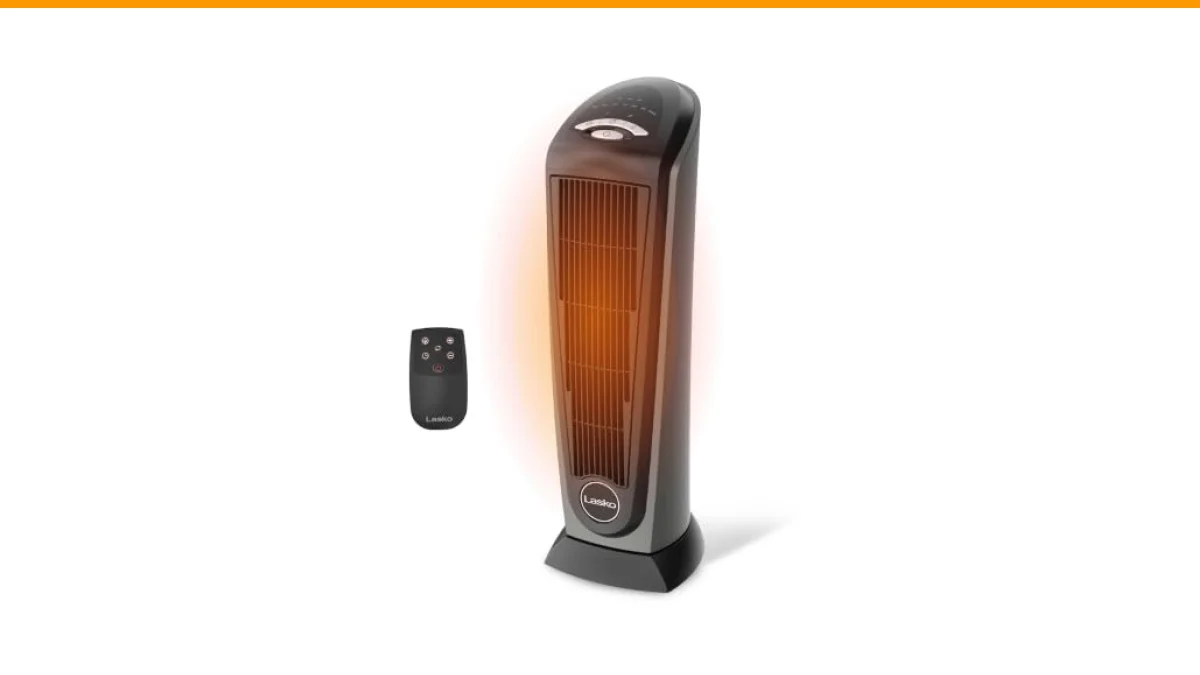
Lasko 23" Ceramic Tower Space Heater with Remote Control - Silver - 751320 | 1500W, Widespread Oscillation, 2 Heat Settings, Portable Tower Heater for Indoor Use and Office, Timer, Overheat Protection
- POWERFUL ELECTRIC SPACE HEATER: Trade the extra layers for real warmth. 1500W of quiet ceramic heat and wide oscillation cover med…
- ETL CERTIFIED: Relax while it runs. A self-regulating ceramic element, overheat protection, and cool-touch housing make this ETL-l…
- CUSTOMIZE YOUR COMFORT: The remote control handles heat settings, oscillation, and a timer—no need to leave the couch or bed. A 7-…
The Lasko 751320 is a 23-inch tower heater built for people who want warmth across a whole room, not just at their ankles. It suits a home office, a master bedroom, or a living room where the central heat never quite reaches. Remote workers chasing a warmer desk setup will get the most out of it.
What separates this tower from the pack is the combination of wide oscillation and a 7-hour timer. You set the heat level, aim the oscillation, and walk away. The remote handles all three functions, which sounds minor until you’re under a blanket and don’t want to get up. The ceramic element is self-regulating, so it won’t keep drawing full power once it hits temperature. ETL certification and cool-touch housing matter if you have kids or pets circling the unit.
The trade-off is footprint. A 23-inch tower takes up floor space that a compact cube doesn’t. It’s also not designed for a bathroom or any high-moisture area. And the timer maxes out at 7 hours, so overnight use means it shuts off before you wake. For some people that’s a feature, not a bug.
- 1500W ceramic heating with wide oscillation for medium rooms
- Remote control manages heat settings, oscillation, and timer
- 7-hour auto shut-off timer for set-and-forget use
- ETL certified with overheat protection and cool-touch exterior
- Built-in carry handle for moving between rooms
Best for: Anyone heating a medium bedroom or home office who wants remote control and doesn’t mind a tower footprint.
Amazon Basics Ceramic Spa…

Amazon Basics
Amazon Basics Ceramic Space Heater, Portable Indoor Heating Solution, With Overheat and Tip-Over Protection, Thermostat, Non-Oscillating, 1500W, 7.52"D x 6.34"W x 9.45"H, Black
- CUSTOMIZABLE HEATING OPTIONS: Choose from three settings to suit your needs - High (1500W), Low (900W), or Fan Only for air circul…
- COMPACT & PORTABLE: Weighing just 3 lbs and sized at 7.5“L x 6.3”W x 9.5“H, this space heater is easy to move and perfect for your…
- Built-in Tip-Over Protection, Overheat Protection, and a Power Indicator Light for safe operation.
The Amazon Basics non-oscillating ceramic heater is the budget pick that doesn’t feel like a compromise. It weighs 3 pounds and measures roughly 7.5 by 6.3 by 9.5 inches, so it fits on a desk, a nightstand, or a corner shelf. Renters in small apartments and students in dorms are the natural buyers here.
Three settings cover most needs: 1500W for fast heat, 900W for longer sessions, and fan-only for air circulation when the room isn’t cold but feels stuffy. Ceramic heating brings the element up to temperature in minutes rather than the slow ramp of an oil-filled radiator. At 43 dB, it’s roughly the noise level of a quiet conversation, so it won’t drown out a podcast or a phone call.
Two honest limitations. First, no oscillation means heat concentrates in one direction, so you’ll want to aim it at yourself rather than a whole room. Second, the manufacturer explicitly warns against bathrooms, laundry rooms, and other humid spaces. If you need a bathroom heater, this isn’t it.
- Three modes: High 1500W, Low 900W, and fan-only
- Compact 3-pound build with a 7.5 x 6.3 x 9.5 inch footprint
- Tip-over and overheat protection with a power indicator light
- 43 dB noise level for offices and bedrooms
- Not rated for humid environments like bathrooms
Best for: Budget-conscious buyers heating a small, dry room who want fast ceramic heat without extra features.
DREO Space Heater, Portab…

DREO
DREO Space Heater, Portable Electric Heaters for Indoor Use wite ECO Mode | Thermostat, 70°Oscillation, Remote, 12H Timer, 5 Modes, Safe Quiet Room Heater for Bedroom, PTC Ceramic Heater for Office
- Faster Heat Than Ever: Powered by DREO Hyperamics Technology, Atom One space heater heats up more efficiently with up to 1500W wor…
- Shield360° Protection: DREO Room Heater Heat up your day and night without worries. ETL-listed Shield360° system provides tip-over…
- Save More on Energy Bills: ECO Mode adjusts the heat level automatically to reach your desired temperature while saving more on en…
DREO’s Atom One is the quietest heater on this list at 37.5 dB, which puts it below the hum of a refrigerator. That matters if you sleep light or take calls from a home office. The 70-degree oscillation is wider than most competitors, so it covers more of a bedroom, basement, or garage from a single position.
The ECO mode is the standout feature. It adjusts the heat level automatically to hold your target temperature, and the digital thermostat lets you set anything from 41 to 95 degrees Fahrenheit in 1-degree increments. That precision is rare at this price point. Most heaters give you low, high, and a vague dial. The Shield360 safety system adds tip-over protection, overheat shutoff, an enhanced safety plug, and UL94 V-0 flame-retardant materials.
Nothing is perfect. The digital controls take a day or two to get used to if you’re coming from a manual dial. And like every ceramic heater on this list, it’s not built for bathrooms. The brushless DC motor and nine aerodynamic blades are the reason it runs so quiet, but that also means the airflow feels softer than a high-velocity fan heater.
- 1500W with DREO Hyperamics heating technology
- ECO mode auto-adjusts heat to save on energy bills
- Digital thermostat adjustable from 41 to 95 degrees F in 1-degree steps
- 70-degree oscillation for wide coverage
- 37.5 dB operation with Shield360 safety and ETL listing
Best for: Light sleepers and remote workers who want precise temperature control and the quietest possible operation.
Amazon Basics Oscillating…

Amazon Basics
Amazon Basics Oscillating Ceramic Space Heater, Portable Fast Heating Indoor Solution, With Overheat and Tip-Over Protection, Thermostat, 1500W, 7.52"D x 6.34"W x 9.45"H, Black
- EVEN HEAT DISTRIBUTION: The heater's 45-degree oscillation function ensures even heat distribution across the room, warming a wide…
- CUSTOMIZABLE HEATING OPTIONS: Choose from three settings to suit your needs - High (1500W), Low (900W), or Fan Only for air circul…
- COMPACT & PORTABLE: Weighing just 3 lbs and sized at 7.5“L x 6.3”W x 9.5“H, this space heater is easy to move and perfect for your…
This is the oscillating version of the Amazon Basics compact, and the 45-degree sweep changes how the heater performs in a room. Instead of blasting one spot, it spreads warmth across a wider area. Small bedrooms, studio apartments, and home gyms benefit most from this.
You still get the same three settings: 1500W high, 900W low, and fan-only. The 3-pound weight and compact dimensions make it easy to move from room to room. Ceramic heating brings it up to temperature fast, and 43 dB keeps it quiet enough for a bedroom. Tip-over protection, overheat protection, and a power indicator light round out the safety package.
The oscillation motor adds one more moving part, which is a long-term reliability consideration. It’s also still not rated for humid spaces. And the 45-degree sweep is narrower than DREO’s 70 degrees, so in a large room you’ll notice the difference. For a small room, though, 45 degrees is plenty.
- 45-degree oscillation for even heat distribution
- High 1500W, Low 900W, and fan-only settings
- 3-pound compact body at 7.5 x 6.3 x 9.5 inches
- Tip-over and overheat protection with power indicator
- 43 dB ceramic heating for fast warm-up
Best for: Buyers who want the compact Amazon Basics design but need heat spread across a small room instead of one spot.
BLACK+DECKER Personal Cer…
The BLACK+DECKER BHDC201 is a personal desk heater, not a room heater, and it’s honest about that. It’s designed for a cubicle, a home office desk, or a small den where you want warmth within arm’s reach. At 2.8 pounds with a carry handle, it moves easily between rooms.
Three settings give you flexibility: fan-only, low at 750W, and high at 1500W. The 750W low setting is the interesting one. It draws half the power of a standard high setting, which means lower operating cost if you only need to take the chill off. The adjustable thermostat uses manual controls, which some people prefer over digital panels for simplicity. Safety features include a power-on indicator light, automatic tip-over shutoff, and overheat shutoff.
Limitations are straightforward. No oscillation, so the heat stays pointed where you aim it. It’s a personal heater, so don’t expect it to warm a living room. And the manual thermostat is less precise than a digital one, so you’ll adjust it by feel rather than by exact degree.
- Three settings: fan-only, 750W low, and 1500W high
- Adjustable manual thermostat with power-on indicator light
- Automatic tip-over shutoff and overheat shutoff protection
- Lightweight 2.8-pound build with carry handle
- Designed for desks, cubicles, and small personal spaces
Best for: Office workers and desk users who want a lightweight personal heater with a low-wattage option for longer sessions.
What Is a Sunbeam Ceramic Heater (and How Ceramic Heating Works)
Sunbeam has been making heating products for over a century, and ceramic heaters are one of their core categories. A ceramic heater uses a PTC (positive temperature coefficient) ceramic element. The element’s resistance rises as it heats up, which means it naturally draws less power once it reaches temperature. That self-regulating behavior is why ceramic heaters are considered safer and more energy-efficient than older coil-based designs.
The ceramic element heats up fast, usually within a minute or two. A fan pushes air across the hot element and out into the room. The result is quick, directional warmth rather than the slow radiant heat you get from an oil-filled radiator. For a small room or a personal space, that speed is the main advantage.
Ceramic vs. Quartz vs. Infrared
Ceramic heaters use a PTC element and a fan. They heat air, which then circulates through the room. Quartz heaters use a glowing tube that radiates heat directly to objects and people. Infrared heaters work similarly to quartz but often use a different element and reflect heat toward a target. The practical difference: ceramic warms a space, quartz and infrared warm a person. If you want a whole room warmer, ceramic is the better fit. If you want to feel warm the second you sit down, infrared wins.
Sunbeam’s ceramic lineup focuses on the room-warming approach. That’s why their heaters include thermostats, oscillation, and timers. Those features make more sense when you’re heating air, not just radiating at a chair.
Top Sunbeam Ceramic Heaters Compared
Sunbeam’s current ceramic lineup includes tower models, compact personal heaters, and oscillating units. Some older models have been discontinued, including several early ceramic tower designs. If you’re shopping secondhand, check the model number against Sunbeam’s current product page before buying. Discontinued models may lack modern safety features like tip-over switches or cool-touch housings.
The five heaters reviewed above represent the current best options in the ceramic space. If you want a broader look at ceramic space heaters across brands, the best electric ceramic space heater guide covers more ground. For portable options specifically, the best portable ceramic heater roundup is worth a read.
Specs, price, and room-size table
Room size is the single most important spec to match. A 1500W heater can comfortably warm a room up to about 150 square feet under normal insulation. A 750W setting handles roughly 75 square feet. If your room is larger, you’ll need a second heater or a higher-output unit. Sunbeam’s ceramic heaters typically fall in the 750W to 1500W range.
Price varies by model and retailer. Check the current price on Amazon for each unit before buying, since ceramic heater prices swing with the season. The compact models tend to sit at the lower end, while tower models with remotes and timers cost more.
Key Features That Matter
Not every feature on a spec sheet is worth paying for. Here’s what actually changes your experience day to day.
Thermostat, wattage settings, oscillation, safety shut-off
A thermostat lets you set a target temperature instead of guessing. Digital thermostats are more precise; manual ones are simpler. Wattage settings matter because they let you choose between fast heat and lower operating cost. Oscillation spreads heat across a wider area, which helps in rooms where you’re not sitting directly in front of the heater. Safety shut-off is non-negotiable. Tip-over switches cut power if the unit falls. Overheat protection cuts power if the element gets too hot. Auto shut-off timers prevent the heater from running indefinitely.
Cool-touch housing is another feature worth having. It keeps the exterior safe to touch even when the heater is running. If you have kids or pets, this matters more than any smart feature.
How to Choose the Right Sunbeam Heater for Your Room
Start with square footage. Measure the room, then match it to wattage. A 1500W heater suits most bedrooms and home offices. A 750W heater works for a desk or a small bathroom-sized space, though you should avoid humid rooms entirely. If the room is over 150 square feet, consider two heaters or a higher-output model.
Next, think about how you’ll use it. A bedroom heater benefits from quiet operation and a timer. An office heater benefits from a compact footprint and a low-wattage setting. A living room heater benefits from oscillation and a remote. Match the feature set to the use case, not to the spec sheet.
Finally, check the safety certifications. ETL listing and UL94 V-0 flame-retardant materials are good signs. Tip-over and overheat protection should be standard on any heater you buy.
Energy Use and Real Operating Costs
Ceramic heaters are energy-efficient compared to older resistance heaters, but they still draw real power. A 1500W heater running on high for one hour uses 1.5 kilowatt-hours. At an average U.S. electricity rate of about 16 cents per kWh, that’s roughly 24 cents per hour. Run it 8 hours a night and you’re looking at about $1.92 per night, or roughly $58 per month.
Drop to the 750W setting and the math halves. That’s about 12 cents per hour, or $0.96 for 8 hours. The ECO mode on the DREO Atom One can reduce consumption further by cycling the element on and off to hold temperature rather than running continuously.
Here’s the practical takeaway: use the lowest wattage that keeps you comfortable, and use a timer or thermostat to avoid running the heater when you don’t need it. A ceramic heater used strategically costs far less than heating an entire house with central heat.
Safety and Maintenance Tips
Keep the heater on a flat, stable surface. Never place it on carpet pile so deep that it blocks the air intake. Keep it at least three feet from curtains, bedding, and anything else flammable. Plug it directly into a wall outlet, not an extension cord or power strip.
Clean the intake and exhaust vents every few weeks during heavy use. Dust buildup restricts airflow and makes the heater work harder. Unplug the unit before cleaning. If the heater has a removable filter, rinse it and let it dry completely before putting it back.
Store the heater in a dry place during the off-season. Moisture can damage the ceramic element and the electrical components. If you notice any burning smell or unusual noise, stop using the heater and check the vents for debris.
Frequently Asked Questions
Do ceramic heaters actually save money compared to central heating?
Yes, if you’re only heating one room. Running a 1500W ceramic heater for one room costs roughly 24 cents per hour. Heating an entire house with central heat costs far more per hour. The savings come from heating less space, not from the ceramic element itself.
Can I leave a ceramic heater running overnight?
Only if the heater has an auto shut-off timer or a thermostat that cycles the unit. Models with tip-over and overheat protection are safer for overnight use. Never leave a heater running unattended in a room with pets or small children.
Why do some Sunbeam ceramic heaters cost more than others?
Features drive the price. Tower models with remotes, timers, and wide oscillation cost more than compact personal heaters. Digital thermostats and ECO modes add cost too. The heating element itself is similar across models.
Are discontinued Sunbeam ceramic heaters worth buying?
Only if you can verify the safety features. Older models may lack tip-over switches or cool-touch housings. Check the model number against Sunbeam’s current lineup. If the model isn’t listed, look for a UL or ETL certification mark on the unit itself.
How We Chose These Products
We started with a simple filter: only genuine ceramic heaters with verifiable specs. That eliminated the brand-confusion problem that plagues most search results. Every product on this list has a PTC ceramic element, a thermostat, and at least one safety shut-off feature.
From there, we compared wattage settings, oscillation range, noise levels, and safety certifications. We prioritized models with ETL listing, tip-over protection, and overheat protection. We also looked at real-world use cases: desk heaters for offices, tower heaters for bedrooms, and compact units for small apartments. The final five cover the full range of budgets and room sizes.
Buying Guide: What Really Matters
Wattage and room size are the two specs that matter most. Match a 1500W heater to a room up to 150 square feet. Use a 750W setting for smaller spaces or longer sessions. Ignore marketing claims about ‘whole house’ heating from a single portable unit.
Safety features are the next priority. Tip-over protection, overheat protection, and a cool-touch housing should be on every heater you consider. ETL or UL certification is a good sign that the unit has been independently tested.
Finally, think about noise. If you’ll use the heater in a bedroom or office, look for a model rated under 45 dB. The DREO Atom One at 37.5 dB is the quietest on this list. The Amazon Basics models at 43 dB are still quiet enough for most people.
Our Top Recommendation
The Lasko 751320 takes the top spot for most buyers. It combines 1500W ceramic heating with wide oscillation, a remote control, and a 7-hour timer. That feature set covers medium bedrooms, home offices, and living rooms without overcomplicating things. ETL certification and cool-touch housing add peace of mind.
If budget is the priority, the Amazon Basics compact is the runner-up. It’s simple, light, and effective in small rooms. For quiet operation, the DREO Atom One wins with its 37.5 dB rating and precise digital thermostat. The oscillating Amazon Basics model is the pick for wider small rooms. And the BLACK+DECKER BHDC201 is the best desk heater of the group.
For a deeper look at how these heaters compare across brands, the best portable ceramic space heater guide is a useful companion. You can also check current availability and pricing on Amazon for any of the models above.
Verdict
Sunbeam ceramic heaters are a solid choice for room-specific warmth, but the brand confusion online makes shopping harder than it should be. Stick to verified specs: wattage, thermostat type, oscillation, and safety features. Match the heater to your room size, and don’t pay for features you won’t use.
The Lasko tower is the best all-around pick. The Amazon Basics compact is the best budget pick. The DREO Atom One is the best for quiet operation. Whichever you choose, check the current price on Amazon and verify the safety certifications before you buy.