You know the drill. You’re mid-shampoo and the water turns icy. Or you’re rinsing a cast-iron skillet and the tap gives you a lukewarm trickle. A tankless water heater fixes that by heating water only when you need it. No 40-gallon tank sitting there, burning energy all day to keep water hot that you might not use.
But here’s the catch: not every tankless unit works for every home. The best type of tankless water heater depends on your climate, your electrical panel, your gas line, and how many fixtures you need to serve at once. This article walks through the real trade-offs so you can pick the right one without overpaying or under-sizing.

xwdzswgs
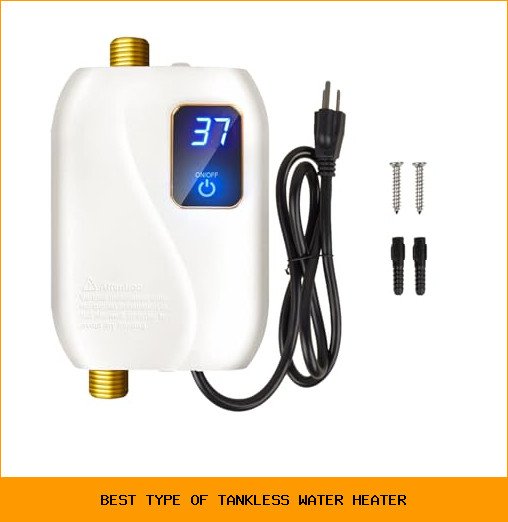
Tankless Water Heater Electric 110V, 3000W Instant Water Heater Under Sink, On Demand Hot Water Heater Electric with Digital Display, Electric Mini Water Heater for Kitchen Bathroom Washin
- ✔ MINI INSTANT HOT WATER HEATER - This 110 volt water heater is equipped with state-of-the-art technology, with 3000W power, LED d…
- ✔ SAFETY INTELLIGENCE RELIABLE - This under sink water heater has multiple protection functions. IPX4 waterproof, leakage protecti…
- ✔ LIGHTWEIGHT PORTABLE DESIGN - This small water heater compact design, is suitable for installation in the bathroom, kitchen unde…
You’ll leave knowing the difference between whole-home and point-of-use units, why gas versus electric matters more than you think, and exactly what to measure before you buy.
For small spaces like a single sink or a bathroom vanity, a compact electric unit gets the job done without major rework. The xwdzswgs Tankless Water Heater Electric 110V is a good example of this category. It mounts under the sink, pulls 3000W from a standard 110V outlet, and raises water temperature by about 82°F at low flow rates. It won’t run a whole house, but it’s perfect for a kitchen sink or a half bath where you just need warm water for washing hands or dishes.
First, Decide: Whole-Home or Point-of-Use?
This is the biggest fork in the road. A whole-home tankless unit sits in one central location, usually where your old tank was, and feeds every faucet and shower in the house. A point-of-use (POU) unit sits right at the sink or under the vanity and only serves that one spot.
Whole-home units are powerful. They need to be. A typical shower uses about 2.5 gallons per minute (GPM) at 105°F. If you run the shower and the kitchen tap at the same time, you’re asking for 4 to 5 GPM of hot water. A gas unit in the 150,000 to 200,000 BTU range can usually handle that. An electric whole-home unit needs 27 to 36 kW of power to match it, which is a massive electrical load.
Point-of-use units are the opposite. They’re small, cheap, and easy to install. The trade-off is flow rate. The 3000W unit mentioned above delivers hot water at roughly 0.3 to 0.5 GPM. That’s fine for a bathroom faucet or a kitchen sink where you’re not filling a tub. It’s not enough for a shower or a washing machine.
My honest take: if you have a typical 2- or 3-bedroom home with a family, you want a whole-home unit. POU units are for apartments, RVs, cabins, or adding hot water to a specific sink that’s far from the main heater.
But here’s where people get tripped up. They buy a POU unit thinking it’ll replace their tank. It won’t. Read the flow rate spec before you buy, not after.
Gas vs. Electric: The Real Trade-Offs
Gas tankless heaters use a burner to heat a copper heat exchanger. Electric units use heating elements, like a giant immersion rod. Both work. They’re just very different in what they demand from your home.
Gas pros:
- Higher flow rates. A good gas unit can do 8 to 10 GPM, enough for two showers plus a dishwasher.
- Works in cold climates. Groundwater in Minnesota can be 40°F. Gas units can still lift that to 110°F at a usable flow.
- Lower operating cost in most places, since natural gas is cheaper than electricity per unit of heat.
Gas cons:
- Venting. You need a dedicated vent pipe to the outside. If your home wasn’t built for it, that’s extra cost.
- Gas line size. Many homes only have a 1/2-inch line. A big tankless unit needs 3/4-inch or larger. You might pay a plumber to run a new line.
- Maintenance. Hard water builds up scale inside the heat exchanger. You’ll need to descale it every year or two.
Electric pros:
- No venting. Just plug it in or wire it to a breaker.
- Small footprint. Some are small enough to fit under a sink.
- No combustion. No risk of carbon monoxide inside the house.
Electric cons:
- Big electrical draw. A whole-home electric unit needs 60 to 120 amps. Most older homes have a 100-amp panel total. You’d need a service upgrade, which costs thousands.
- Lower flow rates in cold weather. If your incoming water is below 50°F, an electric unit will struggle to keep up with a shower.
So which is the best type of tankless water heater? For most existing homes, gas wins if you have a gas line nearby. For a small apartment or a single sink, electric is simpler and cheaper. For a new build with a big electrical panel, electric can work fine.
Venting and Installation: What Nobody Tells You
Let’s talk about venting, because this is where installation costs explode. A gas tankless unit produces exhaust. That exhaust is hot, acidic, and needs to go outside. You have two options: a powered vent that blows it out through a side wall, or a direct vent that pulls air in and pushes exhaust out through a concentric pipe.
Powered venting is easier to retrofit. It uses a fan to push the exhaust through a shorter, smaller pipe. Direct venting is more efficient but requires the unit to be near an exterior wall. Either way, you’re looking at a few hundred dollars in pipe and fittings, plus labor.
Electric units skip all that. You just need a dedicated circuit. For the 3000W under-sink unit, that’s a standard 15-amp or 20-amp outlet. For a whole-home electric unit, you need a 60-amp double-pole breaker and 6-gauge wire. That’s not a DIY job unless you really know what you’re doing.
One thing I learned the hard way: check your incoming water temperature first. The spec sheet for any tankless heater lists a maximum temperature rise at a certain flow rate. If your groundwater is 45°F and you want 110°F water, that’s a 65°F rise. A unit rated for a 65°F rise at 3 GPM will only give you lukewarm water at 4 GPM. Size for your actual conditions, not the marketing numbers.
Comparing the Main Types Side by Side
Here’s a quick reference table to help you sort through the options. Use it as a starting point, then check the specs for your specific model.
| Type | Best For | Flow Rate | Power Source | Installation Cost | Operating Cost |
|---|---|---|---|---|---|
| Whole-Home Gas | Families, cold climates | 6-10 GPM | Natural gas or propane | High (venting + gas line) | Low |
| Whole-Home Electric | Mild climates, new builds | 3-6 GPM | 240V, 60-120 amps | Medium (panel upgrade often needed) | Medium to high |
| Point-of-Use Electric | Single sink, RV, cabin | 0.3-1.5 GPM | 110V or 240V | Low (plug-in or small circuit) | High per gallon, but low total usage |
| Condensing Gas | Large homes, high hot water demand | 8-11 GPM | Natural gas | Very high | Lowest |
That condensing option is worth a mention. It captures heat from the exhaust that standard units waste. It’s more efficient, but it’s also more expensive and heavier. Only consider it if you have a big house and high demand.
What About Flow Rate and Temperature Rise?
These two numbers matter more than any other spec. Flow rate is how many gallons per minute the unit can heat. Temperature rise is how many degrees it can add to the incoming water.
Here’s the math. In the winter, your incoming water might be 50°F. You want a shower at 105°F. That’s a 55°F rise. A unit rated for 5 GPM at a 55°F rise will handle a shower and a sink. A unit rated for 5 GPM at a 35°F rise will give you a lukewarm shower in January.
For the point-of-use unit mentioned earlier, the spec says it can raise water by 82°F at 0.3 GPM, or 131°F at 0.5 GPM. That means if your tap water is 60°F, you can get 142°F water at a very slow trickle, or about 110°F water at a slightly faster trickle. That’s fine for washing hands or rinsing a mug. It’s not going to fill a pot for pasta.
So before you buy anything, grab a thermometer and check your cold water temperature in the winter. Then work backward from your desired shower temperature. If the numbers don’t line up, you need a bigger unit.
Five Questions People Actually Ask
How long does a tankless water heater last?
Most units are rated for 20 years, compared to 10 to 12 years for a tank heater. But that assumes you maintain them. If you have hard water and never descale, expect scaling to shorten the lifespan significantly. Plan to flush the unit with vinegar or a descaling solution once a year.
Can I install a tankless water heater myself?
An electric point-of-use unit is a reasonable DIY project if you’re comfortable with basic plumbing and wiring. A whole-home gas unit is not. Venting, gas connections, and potential carbon monoxide issues are too risky. Hire a licensed plumber or HVAC tech for anything gas-powered.
Will a tankless water heater save me money?
Probably, but the payback period varies. You save the standby losses from a tank (about 10-15% of your water heating bill). But the unit itself costs more upfront. If your current tank is working fine, it might not be worth replacing it early. If the tank is nearing the end of its life, tankless makes sense.
What size tankless water heater do I need for a family of four?
You need roughly 7 to 8 GPM if you might run two showers at once. That means a gas unit around 180,000 BTU or an electric unit rated for at least 27 kW. Check the temperature rise spec for your region. A family of four in Florida needs less than a family of four in Montana.
Do tankless water heaters work with well water?
Yes, but you need to be careful. Well water often has higher mineral content, which accelerates scaling. Install a whole-house sediment filter before the unit. Also, check the flow rate of your well pump. If it can’t keep up with the heater’s demand, you’ll get cold water even if the unit is working fine.
What to Actually Do Next
You don’t need to become a plumbing expert. You just need to make a smart decision with a few key facts in hand.
- Measure your incoming water temperature in the winter. This is non-negotiable.
- Count your fixtures and estimate your peak simultaneous demand. Two showers plus a dishwasher means you need at least 6 GPM.
- Check your electrical panel. If you don’t have spare amps, an electric whole-home unit will cost you thousands in panel upgrades.
- Check your gas line size. If it’s 1/2-inch, plan for a plumber to run a larger line.
- For a single sink or small space, a 110V point-of-use unit like the xwdzswgs under-sink heater is a simple, affordable fix that installs in under an hour.
- Budget for maintenance. Set a yearly reminder to descale the unit, especially if you have hard water.
- Get two quotes from local installers if you’re going with gas. Prices vary wildly, and venting runs can add significant cost.
The best type of tankless water heater is the one that matches your actual water demand, your home’s infrastructure, and your climate. Skip the marketing hype, do the math on temperature rise, and you’ll get years of endless hot water without a single cold shower.


