You know the feeling. You step into the shower, soap up, and then — ice. The hot water ran out halfway through. Or you wait a full minute at the kitchen sink, hand under the tap, waiting for something warm to appear. Water heaters are one of those appliances nobody thinks about until they fail. And when they fail, it’s usually at the worst possible moment.
This article covers the real water heater cons — not the marketing hype, not the generic top-ten lists. I’ve installed, repaired, and tested both tank and tankless systems for years. There are trade-offs you almost never hear about on packaging. Things like electrical demand, flow rate limits, and maintenance schedules nobody tells you about until you’re stuck with a cold house.

xwdzswgs
Tankless Water Heater Electric 110V, 3000W Instant Water Heater Under Sink, On Demand Hot Water Heater Electric with Digital Display, Electric Mini Water Heater for Kitchen Bathroom Washin
- ✔ MINI INSTANT HOT WATER HEATER - This 110 volt water heater is equipped with state-of-the-art technology, with 3000W power, LED d…
- ✔ SAFETY INTELLIGENCE RELIABLE - This under sink water heater has multiple protection functions. IPX4 waterproof, leakage protecti…
- ✔ LIGHTWEIGHT PORTABLE DESIGN - This small water heater compact design, is suitable for installation in the bathroom, kitchen unde…
By the time you finish reading, you’ll know exactly which downsides matter for your setup. You’ll also learn a few surprising upsides of smaller point-of-use heaters that most people overlook.
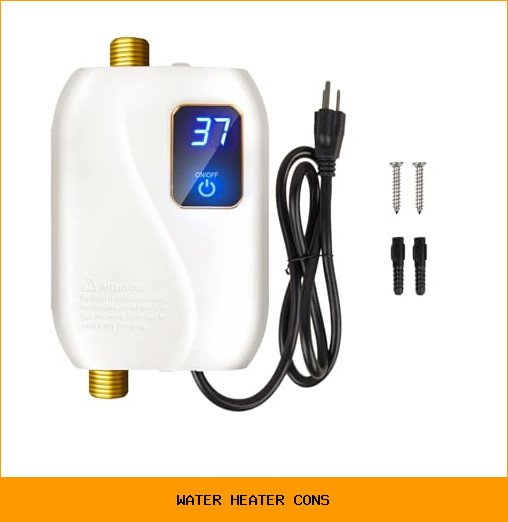
One Small Heater That Sidesteps Bigger Headaches
Before we dig into the big-picture cons of whole-house systems, it’s worth looking at a smaller option that handles specific weak spots. The xwdzswgs Tankless Water Heater Electric 110V, 3000W fits under a sink and delivers hot water in 3–5 seconds. It’s not meant to replace your main water heater — it handles a single sink in a kitchen or bathroom. That alone kills the waiting-time problem and saves you from running a long pipe run from a distant tank.
Does it have its own cons? Absolutely. It’s limited to about 0.5 gallons per minute at 131°F. You won’t fill a bathtub with it. But for washing dishes or your face, it’s a practical fix that sidesteps many of the issues covered below.
Misconception #1: Tankless Heaters Never Run Out of Hot Water
This one gets repeated everywhere. The reality is more complicated. A tankless heater is limited by its flow rate. The unit can heat a certain number of gallons per minute at a given temperature rise. If you turn on two showers at once, you can easily exceed that limit. The water temperature drops, or the flow slows down.
There’s another annoyance: the cold water sandwich. When you turn off a hot water tap and then turn it back on within a few minutes, you get a burst of cold water sitting in the pipes between the heater and the fixture. The heater fires up fast, but that cold slug has to pass through first. It’s a quick jolt, but enough to make you jump.
With a big tank system, you get steady temperature until the stored hot water runs out. With tankless, you get a continuous hot supply — if you stay within the flow limit. Exceed it, and you’ll feel the difference instantly. That’s a real water heater con that manufacturers rarely mention in the fine print.
Misconception #2: Higher Wattage Always Means Better Performance
More watts sounds better. But wattage interacts with voltage and amperage in ways that can wreck your plan. A 3000W unit running on 110V pulls about 27 amps. That’s a lot for a standard 15-amp or 20-amp circuit. You’ll need a dedicated 30-amp breaker and 10-gauge wire for many point-of-use models.
Now look at whole-house tankless units. A typical 240V 27 kW heater pulls over 112 amps. Your home might not have that kind of spare capacity. Upgrading the electrical panel often costs $1,000–$3,000. That’s a hidden con that turns a simple swap into a major project.
Smaller heaters like the xwdzswgs unit have their own limits. At 3000W and 110V, the maximum temperature rise is about 82°F at 0.3 GPM. That’s plenty for handwashing but won’t supply a shower. The lesson: look at the flow rate and temperature rise together, not just watts. A 3000W heater is great for one sink. A 27 kW heater can run a whole house — if your breaker box can handle it.
The Hidden Costs Most Homeowners Miss
A new water heater is not a set-it-and-forget-it purchase. Here are four costs that regularly catch people off guard.
Installation complexity
Swapping a tank for a tankless often requires new gas lines (larger diameter), new venting (stainless steel, sometimes through the roof), and sometimes a new electrical subpanel. A simple tank-to-tank swap might cost $500. Going tankless can run $1,500–$3,000 for the install alone.
Water quality maintenance
Hard water kills tankless heaters faster than tanks. Scale buildup narrows the heat exchanger passages, reducing flow and efficiency. You’ll need to descale the unit annually with vinegar or a specialized cleaner. Tanks also suffer from sediment, but they’re easier to flush — and cheaper to replace when they fail.
Standby heat loss vs. startup waste
Tank heaters lose 10–15% of their energy keeping 50 gallons hot all day. Tankless heaters eliminate standby loss but waste water while you wait for hot to arrive at the tap. If the heater is far from the fixture, you dump a gallon or more down the drain before the hot water shows up. That’s wasted water and energy. Point-of-use heaters like the xwdzswgs unit reduce that wait to seconds because they’re right under the sink.
When a Tank Water Heater Still Makes Sense
Not every con applies equally. If you live in a cold climate with well water that’s 40°F incoming, a tankless heater has to work hard. The temperature rise needed is huge, which limits flow even further. A tank system stores hot water at 120°F, so cold incoming water doesn’t matter much until the tank empties.
If your household uses hot water in short, frequent bursts — wash hands, rinse a dish, shave — the waiting time for a distant tankless heater becomes a real pain. That’s where a point-of-use heater under the sink solves the problem without converting the whole house.
But if you have a family of four that takes consecutive long showers, a well-sized tank heater (50–80 gallons) is simpler and cheaper than a whole-house tankless with adequate flow rate. The tank’s con is eventual exhaustion. The tankless con is simultaneous-use limits.
| Feature | Tank Water Heater | Whole-House Tankless | Point-of-Use (e.g., xwdzswgs) |
|---|---|---|---|
| Flow rate at 100°F rise | Unlimited until tank empties (~0.7 GPM recovery typical) | ~3-5 GPM (depends on unit) | ~0.3-0.5 GPM |
| Electrical demand | Low (120V, <15A for gas) | Very high (240V, >100A) | Moderate (110V, 27A) |
| Install complexity | Low (replace in place) | High (new gas/vent/panel) | Low (plug or hardwire) |
| Maintenance | Sediment flush yearly | Descaling yearly | Descaling yearly |
| Cold water sandwich | No | Yes | Minimal (short pipe run) |
| Best use case | Whole-house, simultaneous use | Single large draw, high efficiency | Single sink, fast hot water |
Five Real Questions People Ask About Water Heater Cons
Do tankless water heaters waste more water than tanks?
It depends on the layout. A tankless heater far from the tap forces you to run cold water out of the pipe before hot arrives — that cold water goes down the drain. With a tank, the pipe stays warm if you use hot water frequently. Point-of-use electric heaters, installed right at the sink, eliminate that waste entirely because the distance is inches instead of feet.
Can I install a point-of-use tankless heater myself?
If you’re comfortable with basic electrical work, yes. The xwdzswgs unit needs a dedicated 30-amp breaker and wire sized at least 2.5 mm² (roughly 14 AWG, but check local code). It connects to standard 1/2-inch NPT plumbing fittings. The manual says to mount it vertically to avoid error code E2. If wiring a breaker sounds intimidating, hire a licensed electrician. Expect an hour of labor.
What size point-of-use heater do I need for my kitchen?
For washing dishes, you want a unit that can deliver at least 0.5 GPM at 110°F. The 3000W xwdzswgs model raises water by 82°F at 0.3 GPM. If your incoming water is 70°F, that’s output of 152°F — too hot for bare hands, but fine for dishes. For handwashing, you’d mix with cold. If your incoming water is 50°F (winter), the output is 132°F at 0.3 GPM. Plenty for a sink. Just don’t expect to fill a sink basin in ten seconds; flow is modest.
Do tankless heaters work in cold climates?
Yes, but you’ll get lower flow rates. A whole-house gas tankless might drop from 6 GPM to 3 GPM when incoming water is 40°F. That’s still enough for one shower but not two. Electric tankless units struggle more because they have lower power density. A point-of-use heater under the sink works fine if you only draw from one fixture at a time. Just don’t run the dishwasher and the hand sink simultaneously.
Are tankless water heaters worth the extra cost?
For energy savings, a tankless unit pays back slowly — maybe $100–$200 per year depending on usage. That’s a 10–20 year payback. The real value is in convenience: never running out of hot water during a long shower. But if you have a family that showers at the same time, a tankless may not keep up. The point-of-use approach avoids both the big upfront cost and the simultaneous-use problem. It’s not an either/or; many homes use a main tank plus a small electric unit under the far sink.
What to Do With This Information
- Match the flow rate to your usage, not the wattage. A 3000W heater works for one sink. A 27 kW heater works for a whole house — if you have the electrical capacity.
- Install a point-of-use unit at the sink you use most. It saves waiting time and water waste. The xwdzswgs model fits under a kitchen or bathroom cabinet.
- Don’t believe the never-runs-out promise. Tankless heaters have a flow rate ceiling. Exceed it and you’ll feel a temperature drop.
- Factor in installation costs. A whole-house tankless often needs panel upgrades, new venting, or gas line changes. Get three quotes before you buy.
- Descale any tankless heater annually. Hard water buildup is the #1 cause of premature failure. Use vinegar or a descaling kit.
- Consider a hybrid: a central tank for big draws (showers, laundry) plus a small electric point-of-use for a distant kitchen or bathroom. That’s the most reliable setup I’ve seen.
- Check the warranty before you buy. The xwdzswgs comes with a 24-month warranty. Keep the receipt and register the product — that’s your safety net if something goes wrong.


