You look at your utility bill every month and wince. Water heating sucks up around 18% of your home’s energy — second only to heating and cooling. Solar water heaters promise to cut that by half or more. But the question everyone asks: what’s the efficiency of solar water heaters? Not the marketing brochure numbers. Real-world numbers.
This article gives you those numbers. You’ll learn how efficiency is actually measured (it’s not what most people think), what system types perform best in your climate, and why a 60% efficient system can still be a better investment than an 80% efficient one. I’ve installed and tested these systems for years, and I’ll tell you what the manufacturers won’t.

New Society Publishers
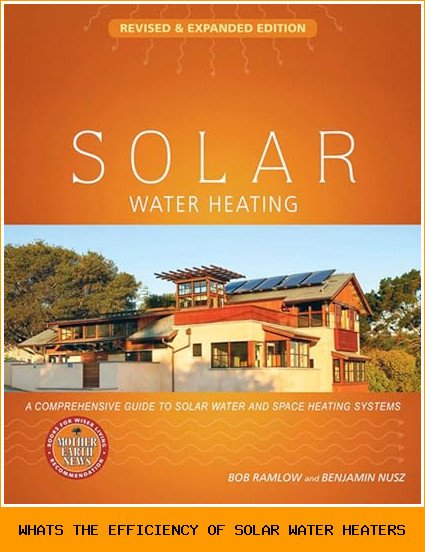
Solar Water Heating--Revised & Expanded Edition: A Comprehensive Guide to Solar Water and Space Heating Systems (Mother Earth News Wiser Living Series)
- New
- Mint Condition
- Dispatch same day for order received before 12 noon
If you want a deep technical reference, grab the book Solar Water Heating–Revised & Expanded Edition: A Comprehensive Guide to Solar Water and Space Heating Systems (Mother Earth News Wiser Living Series) by Bob Ramlow. It’s the best single resource I know — covers every component, sizing method, and troubleshooting step. Mint condition, ships same day if ordered before noon, no-quibble returns. Worth owning if you’re serious about building or retrofitting a system.
How Solar Water Heater Efficiency Is Really Measured
Most people assume efficiency means the percentage of sunlight that ends up as hot water. That’s close but misleading. Solar thermal collectors convert sunlight to heat — that part is high. A typical flat-plate collector has an optical efficiency of 70–80%. Evacuated tube collectors hit 75–90%. Those are lab numbers.
Real-world system efficiency factors in heat loss from pipes, storage tanks, and the collector itself when the sun isn’t shining. A system sitting idle overnight loses 5–15% of its stored heat, depending on tank insulation and ambient temperature. So a collector that’s 80% efficient might deliver only 55–65% of the sun’s energy into actual usable hot water over a day.
The standard industry metric is Solar Energy Factor (SEF) — the ratio of total water heating energy delivered to the total energy consumed by the system (pumps, controllers, backup heating). Higher SEF means better efficiency. A typical solar water heater scores an SEF of 1.5 to 3.5. Compare that to an electric resistance water heater with an SEF around 0.9. A heat pump water heater hits 2.0–3.0. Solar beats them both when the sun is out.
Flat-Plate vs. Evacuated Tube: Which Is More Efficient?
Two main collector types dominate the market. Here’s how they compare on efficiency, with real numbers you can use.
| Factor | Flat-Plate Collector | Evacuated Tube Collector |
|---|---|---|
| Optical efficiency | 70–80% | 75–90% |
| Heat loss coefficient (W/m²K) | 4–6 | 1.5–3 |
| Best annual efficiency (temperate climate) | 45–55% | 55–70% |
| Best annual efficiency (cold climate) | 30–40% | 50–65% |
| Cost per sq. ft. | $15–$25 | $30–$50 |
| Durability / maintenance | Simple, good for 20+ years | Glass can break; tubes are replaceable individually |
| Best use case | Mild to warm climates, large roof area | Cold climates, limited roof space, cloudy regions |
Evacuated tubes win on efficiency in cold weather because the vacuum eliminates convective heat loss. But they cost almost double per square foot. In Miami, a flat-plate system at 50% efficiency will out-earn a tube system at 60% efficiency simply because the upfront cost difference takes 10+ years to recover.
For a 4-person household in a moderate U.S. climate, a flat-plate system covers 50–70% of your annual water heating. Tubes push that to 60–80%. Neither hits 100% — you always need a backup heater for cloudy stretches and winter.
Here’s my honest take: if you live where it freezes, go with evacuated tubes. If you’re in the Sun Belt, flat-plate is smarter. I’ve seen too many people overpay for tubes in Phoenix and never see a payback before the tank rusts.
What Affects Real-World Efficiency the Most
Four variables dominate how well your system actually performs, far more than the collector brand or model.
- Solar insolation at your location. Phoenix gets 6.5 kWh/m²/day average. Seattle gets 3.5. That’s a 46% difference in potential output no matter what collector you pick. Check NREL’s PVWatts calculator — it works for solar thermal too.
- System sizing. An undersized system runs the backup heater constantly, killing efficiency. An oversized system stagnates in summer, overheating the fluid and degrading glycol. Right sizing means matching collector area to household hot water demand (typically 1.5–2 sq. ft. per gallon of daily use).
- Heat loss from storage. A 80-gallon tank with R-12 insulation loses about 2°F per hour in a 65°F basement. That doubles to 4°F per hour in an unheated garage at 40°F. Tank location matters. Wrap old tanks with an extra blanket if you can.
- Pump controller settings. Differential controllers that turn the pump on when collector temp is 10°F above tank temp waste energy. Set the differential to 15–20°F for better stratification in the tank. Your controller likely defaults to 10°F — change it.
I’ve seen the same $8,000 system deliver 62% annual efficiency in Denver and 48% in Portland. The difference was cloud cover and tank location, not the equipment.
Why Efficiency Numbers Alone Don’t Tell You the Cost Story
This is where people get tripped up. A high-efficiency evacuated tube system might save you $200 more per year than a flat-plate system. But it costs $4,000 more upfront. That’s a 20-year payback on the premium. Meanwhile, the cheaper flat-plate system pays for itself in 10–12 years.
Simple payback is the real metric most homeowners should care about. For a typical U.S. home replacing electric water heating, a solar thermal system saves $300–$700 per year. Total installed cost ranges from $5,000 to $10,000 after federal tax credits (30% of cost through 2032). So payback is 7–15 years, depending on your local sun, utility rates, and system cost.
If you have natural gas water heating at $0.80/therm, your annual savings drops to $150–$350. That pushes payback past 15 years. Solar thermal still makes sense if you’re building new and can integrate it into the roof design for lower cost. Retrofits are harder to justify with cheap gas.
One more thing: efficiency drops with age. Collector glazing gets hazy after 15 years, reducing transmissivity by 5–10%. Glycol degrades and becomes less effective at transferring heat. Change your glycol every 5–7 years, and wash the collector glass annually. That keeps efficiency within 5% of the original spec.
Frequently Asked Questions About Solar Water Heater Efficiency
Does a solar water heater work on cloudy days?
Yes, but at reduced output. A well-designed system still produces 10–30% of its rated capacity under heavy overcast skies. Diffuse radiation penetrates clouds. Evacuated tubes perform better than flat-plate in diffuse light because the vacuum reduces heat loss, so the collector stays warmer and can still generate useful heat. On a completely overcast winter day, your backup heater will cover the rest. That’s normal. Most systems are sized to provide 60–80% of annual load, not 100% every day.
What is the lifespan of a solar water heater, and does efficiency degrade?
Flat-plate collectors last 20–30 years. Evacuated tubes last 15–25 years — individual tubes can be replaced. Storage tanks last 10–15 years. Efficiency does drop. Expect a 10–15% decrease in system output after 15 years due to glazing degradation, seal leaks in tubes, and heat exchanger fouling. Replace the tank and glycol at the 10-year mark to keep efficiency high. I’ve seen 30-year-old flat-plate systems still working at 60% of original output.
Can a solar water heater replace my existing water heater entirely?
In most climates, no. You need a backup heat source — electric element, gas burner, or heat pump. Even in Hawaii, a 10-day stretch of rain will leave you cold. Most installations integrate the solar preheat tank with an existing water heater or use a tank with an electric backup element. Code in many areas requires a backup for safety. A 100% solar system would need massive storage (two to three days’ worth) and that’s bulky and expensive.
How does the efficiency of solar thermal compare to solar photovoltaic (PV) for water heating?
Solar thermal is about 3–4 times more efficient at converting sunlight to heat than PV + heat pump water heater combination. A solar thermal collector converts 50–70% of sunlight into heat. A PV panel converts 18–22% of sunlight into electricity, then a heat pump with a COP of 3.0 converts that electricity into 3x the heat, giving an overall efficiency of 54–66%. So they’re roughly equal in total system efficiency today. However, PV systems have no moving parts and last 25+ years with minimal maintenance. Solar thermal requires pump service and glycol changes. The gap is closing. I’d consider PV + heat pump for new construction unless you have high hot water demand.
Is a solar water heater worth it if I have a heat pump water heater?
Usually not. A modern heat pump water heater (HPWH) has an SEF of 2.5–3.5 and costs $1,200–$2,000 installed. A solar thermal system costs $5,000–$10,000 and saves maybe $200 more per year. The HPWH pays for itself in 3–5 years. Solar thermal takes twice as long. The exception is if you have large hot water usage (more than 6 people, a hot tub, radiant floor heating) — then solar thermal’s higher capacity and lower operating cost per Btu beat the HPWH’s limits. But for a typical family, put your money into a HPWH and invest the difference in your attic insulation.
What You Should Actually Do Next
- Check your local solar insolation at NREL’s website. If you average below 4.5 kWh/m²/day, solar thermal payback will be slow. Consider PV + heat pump instead.
- Get at least three quotes from licensed solar thermal installers. Ask for their own system’s SEF or annual performance data — not manufacturer brochures.
- Size the system for 60–70% of your annual load, not 100%. Oversizing wastes money and causes stagnation damage.
- If you live in a freeze zone, choose evacuated tubes or a flat-plate system with a freeze-tolerant drainback design. Glycol systems need annual maintenance.
- Factor in the 30% federal tax credit. No other home energy improvement gives that level of subsidy right now (2026 onward may change — check IRS updates).
- Wash the collector glass every spring and fall. A layer of pollen can drop output by 10%. I use a garden hose and a soft brush — takes ten minutes.
- Never trust efficiency numbers from a single sunny day test. Real annual efficiency is always lower. A system that hits 80% in July will average 55–65% over the year.


