It’s 6:30 AM, and the floor is cold. You know the feeling—that moment when you have to talk yourself into leaving the bed because the air in the room is biting. You shuffle to the thermostat, crank it up, and then wait twenty minutes for the central system to push warm air through the ducts. Meanwhile, your coffee goes cold and your feet stay numb.
Most people solve this with a space heater, but not all space heaters are created equal. Some blow hot air for ten seconds and shut off. Others are so loud you can’t hear the TV. A few are outright dangerous. That’s why the Gaiatop 1500W space heater has been getting a lot of attention—not because it’s flashy, but because it fixes the specific annoyances that make space heaters frustrating.
This article breaks down the real-world performance of this unit: how fast it heats, what the noise is actually like, whether the safety features hold up, and if it’s worth swapping out your old heater. You’ll leave with a clear answer on whether this is the right tool for your bedroom, office, or drafty living room.
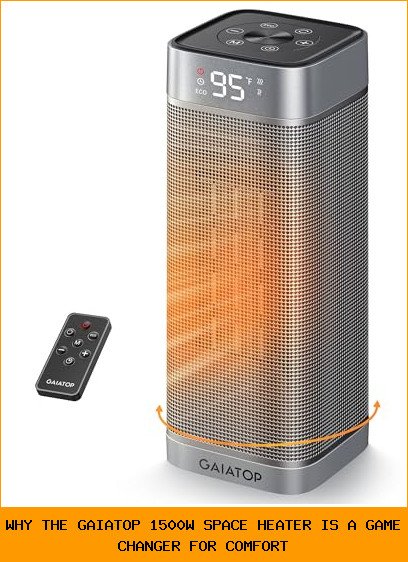
One option that checks nearly every box is the Gaiatop 1500W PTC Ceramic Space Heater. It combines a brushless DC motor with a 60-degree oscillation range and a remote control, which addresses the three biggest complaints about typical heaters: slow warm-up, uneven heat, and having to get up to adjust the temperature.
Why 1500W Is the Right Amount of Power
Let’s talk about the number that matters most: wattage. A 1500W heater is the maximum you can plug into a standard 15-amp household circuit in the US. That’s not a coincidence—it’s the legal and practical limit for a portable electric heater.
So why is this the sweet spot? Because it draws about 12.5 amps, which gives you serious heat output without tripping your breaker every time you run it alongside a lamp and a TV. Smaller heaters (750W) are safer for circuits but take twice as long to warm a room. Bigger ones don’t exist for home use—they’d require a dedicated 20-amp outlet that most bedrooms don’t have.
The Gaiatop uses that full 1500W with a PTC ceramic element. PTC stands for Positive Temperature Coefficient, which means the ceramic element self-regulates its temperature. As it gets hotter, its resistance increases, which naturally limits the heat output. That’s a safety feature baked into the physics of the material itself—not a circuit board that can fail.
In practical terms, you’ll feel the heat within about two seconds. The unit uses a 3,000 RPM brushless DC motor to push air through the ceramic core. That sounds like a spec sheet, but here’s what it means in real life: you point it at your desk, turn it on, and your hands stop being cold before you finish replying to an email.
Oscillation and Airflow: The Difference Between Warm and Comfortable
Here’s a question you should ask about any space heater: does it heat the room, or just the spot directly in front of it? A stationary heater creates a hot column of air and leaves the corners freezing. That’s why oscillation matters.
The Gaiatop sweeps 60 degrees. That’s not the full 90 degrees you see on some tower fans, but it’s enough to cover a typical desk setup or a queen-sized bed. The motor also runs at a higher RPM than most competitors, which means the air moves faster and reaches farther across the room.
There’s a subtle engineering detail here worth noting: the unit has about 50% more hot air vents than a standard heater. More vents mean lower airspeed per vent but higher total volume. The result is that the warm air doesn’t feel like a harsh jet blast—it feels like a gentle wave that spreads out. If you’ve ever used a cheap heater that scorches your shins while your back stays cold, you understand why this matters.
One honest caveat: the oscillation motor makes a slight clicking sound when it changes direction. It’s not loud—about the same volume as a mechanical keyboard—but if you’re hypersensitive to repetitive sounds, you’ll notice it for the first day or two. Most people stop hearing it after that.
Noise Levels: What ‘Quiet’ Actually Means
Manufacturers love to slap the word “silent” on products that are anything but. So let’s be specific about what the Gaiatop does and doesn’t do.
The brushless DC motor is genuinely quieter than the AC motors used in budget heaters. AC motors hum at 60 Hz, which sits right in the range of human speech and cuts through background noise. DC motors run smoother and produce a lower-frequency hum that your brain filters out more easily.
In a quiet bedroom, you’ll hear a soft white noise—like a very gentle fan on low. It’s around 40 decibels at the lowest setting, which is quieter than a library. On the highest heat setting, it creeps up to maybe 50 decibels, which is about the level of light rainfall. You can watch TV, take a phone call, or fall asleep without issue.
That said, it’s not completely inaudible. If you’re the kind of person who needs absolute silence to sleep, you’ll want to run it in ECO mode or set a timer so it shuts off after you doze off. The 12-hour timer helps here, and so does the memory function that remembers your last settings when you power it back on.
Safety Features That Actually Matter
Space heaters cause about 25,000 house fires a year in the US, according to the National Fire Protection Association. So safety isn’t a checkbox—it’s the whole point. Here’s what the Gaiatop does differently.
First, the housing is made from V0-grade flame retardant plastic. That’s the highest rating for flammability resistance; it won’t catch fire easily, and if it does, it self-extinguishes. Second, the unit has a tilt-detection sensor. If it tips over, it shuts off within a second. That’s not a mercury switch like older heaters—it’s a solid-state sensor that’s harder to fool with a slight incline.
Third, there’s an NTC overheat protection system. NTC stands for Negative Temperature Coefficient, and it’s a thermistor that monitors the internal temperature continuously. If the airflow gets blocked (like if you push the heater against a couch), it cuts power before things get dangerous.
Fourth, the plug has built-in fuses. Most heaters rely on your home’s breaker, but this one has a second line of defense right at the outlet. If the heater ever draws too much current, the fuse blows instead of the wiring overheating.
There’s also an automatic shutdown after 24 hours of continuous operation. That’s not a typo—it’s a long safety timer. It’s designed for people who forget to turn the heater off when they leave for work. The unit won’t run indefinitely, which is a thoughtful touch.
One thing to note: the heater is rated for indoor use only, and while it’s marketed for bathrooms, you should keep it away from direct water contact. It’s not IP-rated for wet locations, so use common sense.
Temperature Control and Modes: More Than Just On and Off
Cheap heaters have one knob: high, low, off. The Gaiatop gives you five modes and a thermostat range from 41°F to 95°F. That might seem like overkill, but it solves a real problem.
If you run a heater at full blast without a thermostat, it overheats the room, then you turn it off, then it gets cold, then you turn it on again. That cycle wastes electricity and makes you uncomfortable. The Gaiatop’s digital thermostat reads the ambient temperature and cycles the heating element on and off to hold a steady temperature.
Here’s the breakdown of the modes:
- Fan mode: No heat, just air circulation. Useful in summer or to dry a damp floor.
- Low heat (750W): Gentle warmth for a small desk area or a single person.
- Medium heat (1000W): Good for a standard bedroom.
- High heat (1500W): Maximum output for a drafty room or quick warm-up.
- ECO mode: This is the smart one. It sets a target temperature and uses the minimum power needed to maintain it, rather than cycling between full blast and off.
ECO mode is where the energy savings come from. Instead of running at 1500W for 15 minutes and then off for 10, it might run at 800W continuously. That uses less total power and keeps the temperature steadier. The remote control works up to 33 feet away, so you can adjust the temperature from your bed without getting up.
Comparing Heating Approaches: Which One Fits Your Room?
Not every room needs the same heating strategy. Here’s a practical comparison of the common options.
| Heating Method | Best For | Heat-Up Speed | Energy Efficiency | Noise Level | Safety Risk |
|---|---|---|---|---|---|
| Gaiatop 1500W PTC (this unit) | Bedrooms, offices, medium rooms up to 200 sq ft | Seconds | High with ECO mode | Low (40-50 dB) | Very low (multiple sensors) |
| Oil-filled radiator | Large rooms, overnight use | Slow (15-20 min) | Medium (heats slowly, holds heat) | Silent | Low (hot surface) |
| Infrared panel | Heating people, not air | Instant (directional) | High (no air loss) | Silent | Low |
| Baseboard heater (fixed) | Whole-room, permanent install | Slow | Low (convection losses) | Low | Medium (wiring) |
| Cheap fan-forced heater | Small spots, quick blast | Fast | Low (no thermostat) | High (60+ dB) | Medium (tip-over risk) |
The main trade-off with the Gaiatop is that it’s not silent like an oil-filled radiator. But it heats up in seconds, which the radiator can’t do. And it’s much safer than a cheap fan-forced unit because of the V0 housing and tilt sensors. For most people, that’s the right balance.
Real Questions People Ask About This Heater
Can I leave the Gaiatop heater on overnight?
Yes, with caveats. The unit has an automatic shutdown after 24 hours, plus overheat and tip-over protection. It’s safe to run while you sleep. That said, you should keep it at least three feet away from bedding, curtains, and furniture. Use the ECO mode and set a timer (like 4-6 hours) so it’s not running at full blast all night. Also, plug it directly into a wall outlet—never into a power strip or extension cord, because those can overheat.
How much does it cost to run per month?
It depends on your local electricity rate and how long you run it. A 1500W heater uses 1.5 kWh per hour at full blast. At the US average of about $0.17 per kWh, that’s roughly $0.26 per hour. If you run it 8 hours a day at full power, that’s about $62 a month. But here’s the thing: you won’t run it at full power all the time. In ECO mode, it cycles down to about 800W, which drops the cost to roughly $0.14 per hour. The thermostat does the work of saving you money—let it.
Is it safe to use in a bathroom?
The marketing says it’s for bathrooms, but you need to be careful. This unit is not IP-rated for wet locations, meaning it’s not designed to get splashed. You can use it in a bathroom if you place it away from the shower or tub, on a dry surface, and never touch it with wet hands. For a truly wet environment, you’d want a unit specifically rated for bathroom use. Use this one to pre-warm the room before you shower, then move it out of the way.
How is this different from a cheap $25 heater?
The biggest differences are the motor, the thermostat, and the safety sensors. A cheap heater uses an AC motor that hums loudly and a bi-metallic strip thermostat that swings wildly between too hot and too cold. The Gaiatop uses a brushless DC motor that’s quieter and more efficient, plus a digital sensor that holds the temperature within a degree or two. The V0 flame-retardant housing and dual fuses are also a step up—cheap units often use standard plastic that burns more readily. You’re paying for reliability and peace of mind, not just heat.
Does the remote control actually work well?
Yes, and it’s one of the most underrated features. The remote works up to 33 feet away, which is more than enough for a bedroom. You can turn the unit on/off, adjust the temperature, set the 12-hour timer, and toggle oscillation. The only minor gripe is that the remote is small and easy to lose in a couch cushion. The unit also has touch controls on the body, so you’re not stuck if you misplace the remote.
What You Should Do Before You Buy
You’ve got the full picture now. Here’s the short version of what to remember:
- Check your room size. This heater covers up to about 200 square feet. Bigger rooms need a second unit or a different approach.
- Plug it directly into the wall. No power strips, no extension cords. That’s non-negotiable for any 1500W heater.
- Use ECO mode for daily comfort. It saves power and keeps the temperature steadier than blasting high heat.
- Set the timer before bed. A 4-6 hour timer is plenty to get you through the coldest part of the night.
- Keep a 3-foot clearance around the unit. The V0 plastic is flame-retardant, but that’s not a license to bury it under a pile of laundry.
- Use the oscillation for even heat. It’s not just a gimmick—it prevents hot spots and cold corners.
- Check the current price on Amazon before you commit. Prices fluctuate, and you might catch a deal that makes this an easy decision.
The Gaiatop 1500W isn’t a miracle machine, but it’s a well-engineered tool that solves the three biggest annoyances of portable heating: slow warm-up, uneven airflow, and excessive noise. If you’re tired of shivering at your desk or waking up to a freezing bedroom, this is a solid investment that pays for itself in comfort within the first week.



