Your bathroom is the coldest room in the house. Tile floors, bare walls, and a fan pulling air outside all work against you. Stepping out of a hot shower into 62-degree air is miserable, and a regular space heater usually makes it worse with noise and dry heat.
An oil-filled radiator fixes most of that. It heats quietly, holds warmth after you switch it off, and doesn’t blow dust around. But bathrooms have rules other rooms don’t. Moisture, splash risk, and tight placement near a tub or shower change what’s actually safe to plug in.
Below are four oil heaters worth considering for a 150 sq ft bathroom, matched to different buyer types. You’ll also find the IP rating and zone rules most guides skip, real decibel expectations, and honest running-cost math so you know what you’re paying per month.
Here’s a quick spec comparison to help you match a heater to your bathroom before reading the full reviews.
| Features | De’Longhi EW7707CM | Amazon Basics 7-Fin | Dumos 1500W Radiator | DREO Radiator Heater |
|---|---|---|---|---|
| Wattage Options | 1500W with ComfortTemp | 600W / 900W / 1500W | 600W / 900W / 1500W | 600W / 900W / 1500W |
| Fin Count | Thermal slot design | 7 wavy fins | Standard oil fins | 7 advanced fins |
| Noise Level | Fanless, silent | Whisper quiet, fanless | Ultra-quiet, fanless | Silent, fanless |
| Safety Features | Thermal cut-off, tip-over | Tip-over, overheat, ETL | Tip-over, overheat switch | Triple overheat, tilt, ETL |
| Best Use Case | Allergy-friendly rooms | Budget bedrooms | Small to medium rooms | Large rooms, smart control |
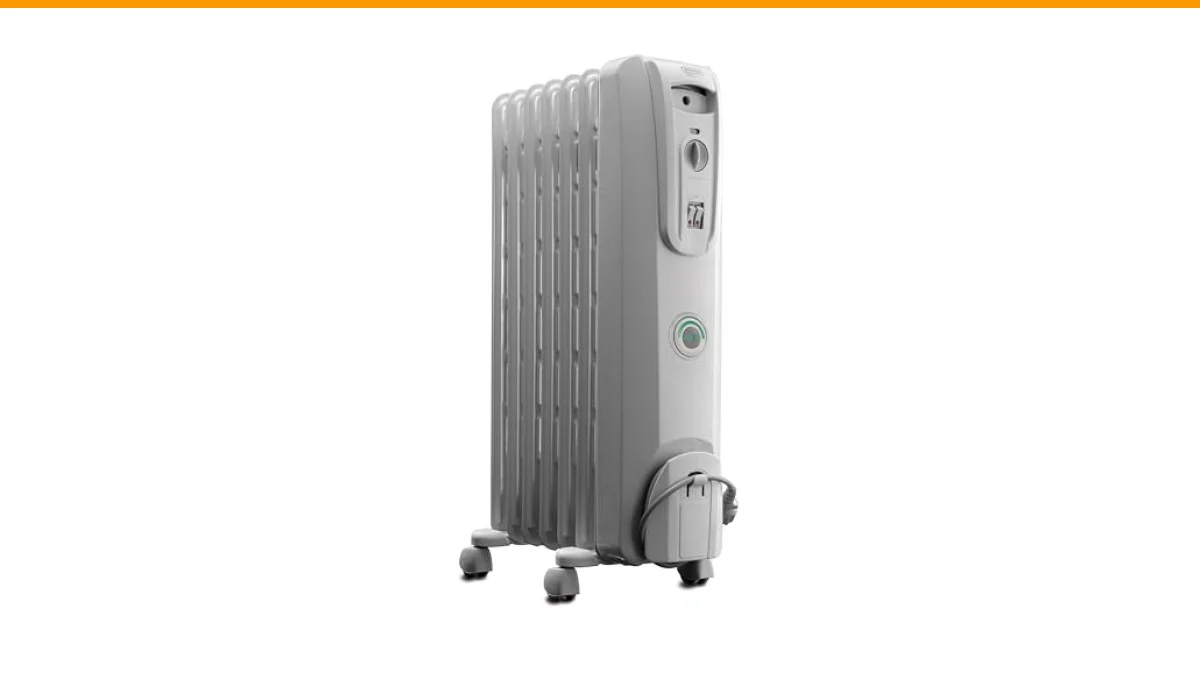
De’Longhi Oil filled Radiator Heater
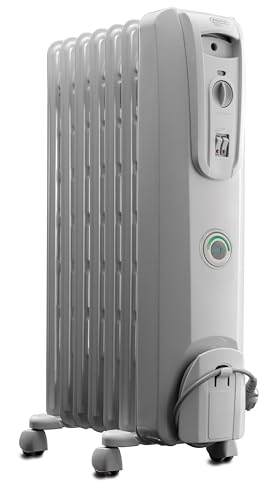
De'Longhi
De'Longhi Oil filled Radiator Heater, 1500W Electric Space Heater for indoor use, portable room heater, Energy Saving, full room like office and bedroom with safety features, EW7707CM
- Simple Controls allow you to easily adjust power level and temperature.
- Up to 20% more efficient* deploy the ComfortTemp feature to automatically maintain the optimal temperature and power levels. *vers…
- Exclusive thermal slot design maximizes heat flow into the room while maintaining a low surface temperature
This is the pick for someone who wants a bathroom heater they don’t have to think about. De’Longhi has been making oil radiators for decades, and the EW7707CM is their mainstream model. It suits a primary bathroom in a 150 sq ft range where you want steady background heat without fiddling with dials every morning.
The ComfortTemp feature is the standout. It adjusts power and temperature on its own instead of running at full blast until you manually turn it down. De’Longhi claims up to 20% better efficiency versus leaving the same unit at max thermostat. In practice, that means less cycling on and off, which keeps the room temperature more even. The thermal slot design also pushes heat into the room while keeping the outer surface cooler than older radiator styles.
For allergy sufferers, the fanless design matters. No fan means no dust, pollen, or dander getting blown into the air. If your bathroom doubles as a getting-ready space and someone in the house has asthma, this is a real advantage. The trade-off? No digital display, no remote, and no timer. You set it and forget it, which is fine for some people and annoying for others. It’s also one of the heavier units here, so moving it between rooms isn’t effortless.
- ComfortTemp auto-regulates power and temperature
- Thermal slots push heat out while keeping surface temps lower
- Fanless operation won’t stir up dust or allergens
- Integrated handle and control panel for relocation
- No timer or remote control
Best for: Buyers who want a set-and-forget oil heater for an allergy-friendly bathroom and don’t need smart features.
Amazon Basics Portable Oil Space Heater

Amazon Basics
Amazon Basics Portable Oil Space Heater with 7 Oil-Filled Fins, 3 Heat Settings, Adjustable Thermostat, Tip-Over and Overheat Protection, ETL Safety Certificate, 1500W, Black
- POWERFUL & ADJUSTABLE HEATING: Offers an adjustable thermostat and three heat settings - High (1500W), Medium (900W), and Low (600…
- LONG-LASTING HEATING: The radiator heating technology retains heat longer, providing consistent warmth even after the unit is turn…
- ENHANCED HEAT DISPERSION: The seven oil-filled wavy fins ensure faster and more even heat dispersion for optimal comfort.
Budget shoppers, this is your pick. The Amazon Basics 7-fin model does the core job of an oil radiator without charging for extras. It fits a guest bathroom, a rental, or a second bathroom where you only need heat a few months a year. Three heat settings (600W, 900W, 1500W) let you match output to how cold it actually gets.
The seven wavy fins are the practical story here. More fin surface means faster, more even heat dispersion across the room. Amazon Basics seals the diathermic oil permanently inside each fin, so there’s nothing to refill ever. The unit also retains heat after you switch it off, which is a small energy win if you’re the type who turns the heater off before leaving the bathroom.
Where it falls short: no timer, no remote, no digital thermostat readout. The adjustable thermostat is analog, so you’re guessing at exact temperatures. It’s also the plainest-looking unit in this group, which matters if your bathroom has a specific aesthetic. And while it’s ETL certified with tip-over and overheat protection, it carries no IP rating, so it needs to stay well away from the splash zone.
- Three heat settings from 600W to 1500W
- Seven wavy fins for faster heat dispersion
- Sealed oil, no maintenance or refills
- ETL safety certificate, tip-over and overheat protection
- Analog thermostat with no digital readout
Best for: Renters and budget buyers who want reliable oil heat in a guest or secondary bathroom without paying for smart features.
Dumos Oil Filled Radiator Heater

DUMOS
Dumos Oil Filled Radiator Heater with Adjustable Thermostat, Noiseless | 1500W Oil Space Heater for Indoor Use, Portable, Bedroom, Living Room, 22inch Black
- 1500W Oil Filled Radiator Heater: Dumos 1500W Oil Filled Radiator Heater provides fast and efficient heating, quickly warming up s…
- Energy Efficient with 3 Heat Settings: This Dumos oil heater offers 600W, 900W, and 1500W modes with a adjustable thermostat (from…
- Safe & Reliable Operation: Equipped with a power indicator light, overheat protection, and a tip-over safety switch, this radiator…
Dumos targets the middle of the market with a radiator that’s easy to wheel around. The 1500W output is rated for 10-15 square meters, which covers most standard bathrooms. Four heavy-duty casters and a carry handle make it simple to roll from the bathroom to a bedroom or hallway when you’re done.
The adjustable thermostat range is unusually wide, from -5°C to 60°C. Most people will never use the extremes, but the range gives you fine control in a small space. The three heat settings (600W, 900W, 1500W) let you run it low overnight and crank it up for morning showers. A power indicator light, overheat protection, and a tip-over switch that cuts power when the unit gets knocked over round out the safety package.
The honest downside is build feel. Dumos isn’t a premium brand, and the plastic housing and control dial reflect that. It’s also fanless and silent, which is great, but the trade-off is slower warm-up compared to a fan heater. You’ll want to switch it on 15-20 minutes before your shower, not two minutes before.
- 1500W output rated for 10-15 square meters
- Wide thermostat range from -5°C to 60°C
- Four universal casters plus carry handle
- Tip-over switch and overheat protection
- Fanless, silent operation
Best for: Anyone who wants one oil heater to roll between the bathroom and other rooms, with a wide thermostat range for fine control.
DREO Oil Filled Radiator Heater

DREO
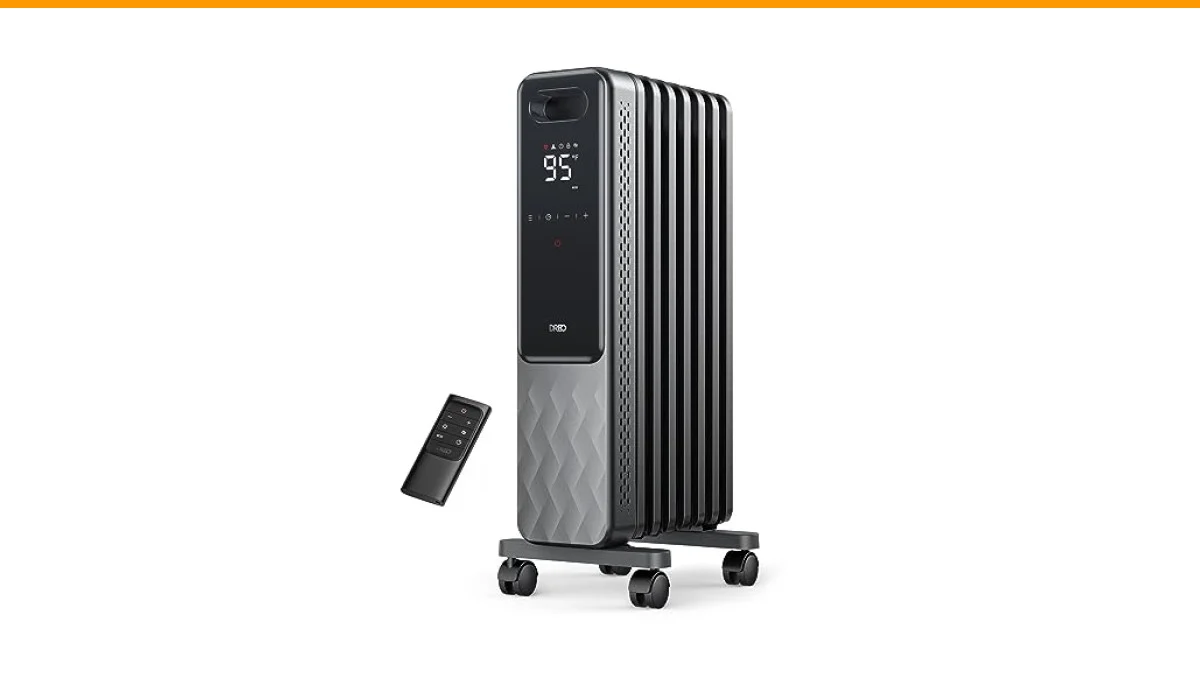
DREO Oil Filled Radiator Heater, Electric Heaters for indoor use Large Room | Quiet, Digital Thermostat, ECO, Remote Control, 4 Modes, Child Lock, Overheat & Tip-Over Protection, 24h Timer, 1500W, Grey
- 360° Whole-Home Warmth: DREO radiator heater delivers swift and silent heating at 1500W, boosting efficiency by 92.3%. Its 7 advan…
- Peaceful Safety: DREO oil filled heater ensures peace of mind with triple overheat protection, fire-resistant material, and ETL li…
- Personalized Comfort: Set your ideal temperature with eco mode. DREO's precise sensor and smart algorithms maintain steady warmth,…
DREO built this for people who want options. The 7-fin radiator delivers 1500W with what DREO claims is 92.3% efficiency and 39.49% better heat dispersion than competitors. Those are manufacturer figures, so take them with a grain of salt, but the fin design is genuinely effective in a large bathroom or a bathroom connected to a bigger suite.
The control set is where DREO separates from the pack. A large LED display, touchscreen, and remote control let you adjust temperature without bending down. Eco mode uses a sensor and algorithms to hold steady warmth instead of cycling between hot and cold. There’s also a 24-hour timer, child lock, mute mode, and screen-off mode. If your bathroom is next to a nursery or you want the heater to pre-warm before your alarm goes off, the timer alone is worth the upgrade.
Safety is thorough: triple overheat protection, fire-resistant material, ETL listing, tilt protection, and a burn-proof plug. The catch is availability. This model often shows lead times, so check stock before you commit. It’s also the priciest of the four, and the smart features add complexity some users won’t want. If you just want heat, the extra buttons are noise.
- 1500W with eco mode and precise temperature sensor
- LED display, touchscreen, and remote control
- 24-hour timer with child lock and mute modes
- Triple overheat protection and tilt protection
- ETL listed with fire-resistant materials
Best for: Tech-friendly buyers with a large bathroom who want a timer, remote, and eco mode to manage heat and energy use precisely.
How We Chose These Products
We started with the bathroom use case, not general space heating. That means every pick had to run fanless, since fans pull moisture and dust into places you don’t want them. We also filtered for tip-over protection and overheat shutoff, because bathrooms have wet floors and accidental knocks are common.
From there, we weighed fin count, wattage options, and control type against realistic buyer profiles. A budget renter doesn’t need a remote. A tech-forward homeowner with a big master bath probably does. We also looked at what each unit does after you switch it off, since oil radiators keep giving heat for a while, and that affects running cost.
Buying Guide: What Really Matters
Wattage is the first number to check. A 1500W setting is standard for oil radiators, and it’s what you want for a 150 sq ft bathroom in cold weather. Lower settings (600W, 900W) are for mild days or smaller rooms. If your bathroom is under 50 sq ft, a 700-1000W heater may be plenty, and you can read more in this oil heater small room guide.
Fin count affects how fast and evenly heat spreads. Seven fins is the common standard for 1500W units. More fins mean more surface area, which means better convection heating and less waiting. Fewer fins on a 1500W unit often means hotter surface temps and slower room warm-up.
Controls matter more than people expect. An analog dial is fine if you set it once. A digital thermostat with a timer is better if you want the bathroom warm before you wake up. And if you plan to move the heater between rooms, casters and a carry handle aren’t optional.
Finally, check the safety certification. ETL or equivalent listing, tip-over switch, and overheat protection are baseline. For bathroom use specifically, you also need to think about IP rating and placement, which we cover below.
Are Oil Heaters Safe in Bathrooms? IP Ratings and Zone Rules
This is the section most guides skip, and it’s the one that actually matters. Bathrooms are divided into zones based on how close you are to water. The rules come from wiring regulations, and they dictate what kind of electrical equipment is allowed where.
Zone 1, 2, and 3 Explained
Zone 1 is the area directly above a bathtub or inside a shower enclosure. Only fixed, permanently wired, splash-proof fixtures belong here. No portable oil heater should ever go in Zone 1.
Zone 2 extends 60cm beyond the tub or shower. Portable appliances are allowed here only if they carry a suitable IP rating, typically IPX4 or higher. None of the four heaters in this guide are rated for Zone 2, so keep them out.
Zone 3 is anywhere beyond 60cm from the water source. This is where portable oil heaters belong. If your bathroom is small, that can be tricky, but a 150 sq ft bathroom usually gives you a safe corner or wall space outside the splash zone.
Splash-Proof vs Bathroom-Safe
Splash-proof means the housing can handle water spray without shorting. Bathroom-safe is a broader term that includes splash protection plus correct placement. An oil heater with no IP rating isn’t splash-proof, but it can still be bathroom-safe if you keep it in Zone 3 and away from direct water contact.
Moisture is the other concern. Metal fins can rust over time in a humid bathroom. Wipe the unit down monthly and avoid leaving it in the bathroom year-round. Store it dry during warmer months. For a deeper look at bathroom heater options beyond oil, see this electric heater for bathroom roundup.
How Quiet Are Oil Heaters? Real dB Levels
Oil radiators are the quietest space heaters you can buy. There’s no fan, no compressor, and no moving air. The only sound is the faint tick of expanding metal as the oil heats up, which is usually under 30 dB, quieter than a whisper.
For comparison, a typical fan heater runs 45-55 dB, and a panel heater with a fan can hit 50 dB. In a bathroom, that difference matters. A fan heater can wake a sleeping partner or drown out a podcast. An oil radiator won’t.
The trade-off is warm-up time. Silent heat is slow heat. Expect 15-25 minutes to feel a real difference in a 150 sq ft bathroom. If you want instant warmth, a fan or ceramic heater is faster, but you’ll pay for it in noise. You can compare options in this ceramic heater for bathroom guide.
Sizing and Running Costs for a 150 Sq Ft Bathroom
Running cost is where oil heaters earn their reputation for being energy-efficient. They’re not magic, but they hold heat longer than fan heaters, so they cycle less.
Wattage and Fin Count
For 150 sq ft, 1500W is the right target in cold climates. A 7-fin unit disperses that heat faster than a 5-fin unit, so the room reaches temperature sooner and the thermostat cuts power earlier. If your bathroom is well-insulated, 900W may be enough on mild days.
Cost Per Hour and Per Month
At a US average of about 16 cents per kilowatt-hour, running a 1500W oil heater at full power costs roughly 24 cents per hour. But oil heaters don’t run at full power the whole time. Once the room hits temperature, they cycle on and off, often averaging 40-60% duty cycle.
Realistic math: 3 hours of use per day at an average 800W draw equals 2.4 kWh, or about 38 cents per day. Over a 30-day month, that’s roughly $11.50. Use it 5 hours a day and you’re closer to $19. Compare that to a 1500W fan heater running continuously at 100% duty cycle, which can cost $18-25 per month for the same usage. The oil heater wins on cost because it doesn’t run flat out the whole time.
Oil Heater vs Fan and Panel Heaters for Bathrooms
Fan heaters are fast and cheap upfront. They push hot air within seconds, which is great if you only need heat for 10 minutes. But they’re loud, they stir up dust, and they dry out the air. In a bathroom, that dry heat can make the room feel stuffy.
Panel heaters are slim and wall-mountable, which saves floor space in tight bathrooms. They heat by convection and radiation, similar to oil radiators, but they don’t retain heat as long after shutoff. They’re also usually lower wattage, so they struggle in a cold 150 sq ft bathroom.
Oil radiators sit in the middle. Slower to warm up, silent, gentle on air quality, and cheaper to run over long sessions. For a bathroom you use every morning for 30-60 minutes, the slow warm-up is a minor annoyance. For a bathroom you use for quick trips, a fan heater may be more practical. If you have a larger space, this oil filled radiator for large room guide covers higher-output options.
Placement, Humidity, and Maintenance Tips
Place the heater in Zone 3, at least 60cm from the tub or shower, on a dry, level surface. Keep it away from towels, bath mats, and anything that can drape over the fins. Never block the top or sides, since oil radiators rely on airflow across the fins to work.
Humidity is the long-term enemy. Wipe the fins and housing with a dry cloth once a month. Check for rust spots, especially on cheaper units with painted metal fins. If you see rust, stop using the heater in the bathroom and move it to a dry room.
Don’t leave an oil heater running unattended for long periods in a bathroom. The moisture and the risk of accidental water contact make it a bad idea. Run it while you’re using the room, then switch it off. If you want overnight heat, move it to a bedroom. For bathroom wall-mounted alternatives, see this electric wall heater for bathroom guide.
Our Top Recommendation
The De’Longhi EW7707CM is our top pick for most bathrooms. ComfortTemp takes the guesswork out of temperature control, the thermal slot design keeps surface temps lower, and the fanless build is ideal for allergy sufferers. It’s not the cheapest or the smartest, but it’s the most reliable set-and-forget option for a 150 sq ft bathroom.
If you want smart features and a timer, the DREO is the better fit. It costs more and stock can be spotty, but the remote, eco mode, and 24-hour timer are genuinely useful for pre-warming a bathroom before your alarm goes off.
On a tight budget, the Amazon Basics 7-fin model does the core job for less. And if you need to move one heater between rooms, the Dumos with its casters and wide thermostat range is the most flexible of the four.
Frequently Asked Questions
Can I leave an oil heater on overnight?
Oil heaters are generally safe to leave on overnight in a dry room with tip-over and overheat protection. In a bathroom, no. Moisture, splash risk, and the chance of someone stumbling in the dark make it a bad idea. Use it while you’re awake and in the room, then switch it off.
Do oil heaters need refilling?
No. The diathermic oil inside a sealed oil radiator is permanent. It doesn’t burn off, evaporate, or need topping up. If a unit ever leaks oil, that’s a manufacturing fault, not a maintenance issue, and you should stop using it.
Will an oil heater rust in a humid bathroom?
It can over time, especially on budget models with painted metal fins. Wipe the unit dry monthly, avoid leaving it in the bathroom during humid months, and store it in a dry room when not in use. Surface rust is a sign to relocate the heater.
How long does an oil heater take to warm a 150 sq ft bathroom?
Expect 15-25 minutes for a noticeable temperature rise. Oil heaters warm gradually because there’s no fan pushing air. Switch it on before you shower, not after. Once warm, the room stays comfortable for 20-30 minutes after you switch it off.
Final Verdict
For most bathrooms around 150 sq ft, the De’Longhi EW7707CM is the safest bet. It balances efficiency, quiet operation, and allergy-friendly heating without overcomplicating things. The DREO is the upgrade pick for tech-minded buyers, the Amazon Basics is the budget workhorse, and the Dumos is the most portable of the group.</n
Whichever you choose, keep it in Zone 3, wipe it down monthly, and don’t run it unattended in a wet room. A good oil heater will quietly turn your coldest room into the most comfortable one in the house.