Your old tank heater just died, or maybe you’re tired of lukewarm showers when the dishwasher runs. Either way, you’ve landed on Rheem’s 240V tankless lineup and you’re staring at model numbers like RTEX-08, RTEX-11, and RTEX-24 without a clue which one your house can actually run.
Here’s the thing nobody tells you upfront: the right Rheem 240V tankless water heater isn’t the biggest one or the cheapest one. It’s the one your electrical panel can feed, your climate can support, and your household demand can justify. Get those three things wrong and you’ll either freeze in January or spend $2,000 on an electrician for nothing.
This guide walks through five Rheem 240V models worth your time, from a 6.5kW point-of-use unit up to a 24kW whole-house workhorse. You’ll get real breaker and wire specs, honest trade-offs, and a clear recommendation at the end.
Compare the key specs side by side before you read the full reviews.
| Features | Rheem 18kW 240V | Rheem RTEX-24 | Rheem 11kW | Rheem 8kW | Rheem RTEX-06T |
|---|---|---|---|---|---|
| Power Output | 18kW | 24kW | 11kW | 8kW | 6.5kW |
| Flow Rate | Up to 4.4 GPM | Up to 5.9 GPM | Up to 2.68 GPM | Up to 1.95 GPM | Point-of-use only |
| Breaker Requirement | Not listed | Three 40-amp double-pole | One 50-amp double-pole | One 40-amp double-pole | Not listed |
| Wire Gauge | Not listed | Three sets #8 AWG | One set #8 AWG | One set #8 AWG | Not listed |
| Best Use Case | 2-bath homes | Whole-house, multiple fixtures | Light whole-house | Single bathroom or cabin | Single sink or shower |

Rheem 18kW 240V Tankless
Rheem
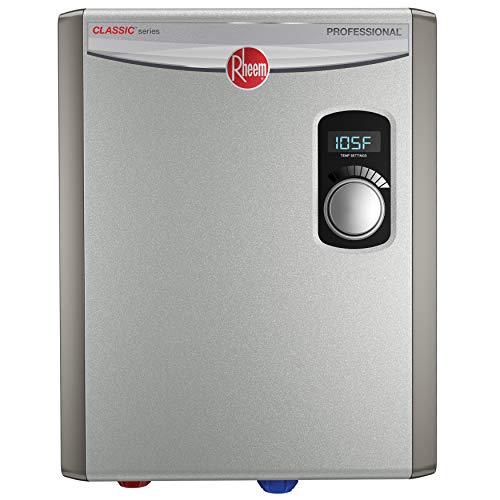
Rheem 18kW 240V Tankless Electric Water Heater, Gray
- External digital thermostatic control with LED display (+/1 degree accuracy)
- Most advanced self-modulation, adjust power to meet hot water demand
- Durable Copper immersion two heating elements, field Serviceable. Flow Rate- up to 4.4 GPM
The middleweight that punches above its class
Rheem’s 18kW unit sits in a sweet spot most homeowners overlook. It’s the Goldilocks pick for a two-bathroom house where you don’t need to run the shower, dishwasher, and laundry sink at the same time. Think of it as the practical choice for a family of three or four in a moderate climate.
What separates this model from the smaller 11kW and 8kW units is the self-modulation. The heater reads incoming water temperature and adjusts power draw to match demand. On a mild day when the incoming water is 65°F, it doesn’t blast all 18kW. That translates to lower operating cost over a year, and it explains why the temperature stays steady within one degree of what you set.
The two copper immersion heating elements are field-serviceable, which matters more than most buyers realize. If one element fails after five years, a technician can swap it without pulling the whole unit off the wall. The trade-off? You’ll need a household electrical service panel rated for the load, and this model doesn’t publish its exact breaker spec in the product data. Confirm with an electrician before ordering.
- External digital thermostat with LED display and 1-degree accuracy
- Self-modulating power draw adjusts to actual hot water demand
- Dual copper immersion elements are field-serviceable
- Up to 4.4 GPM flow rate at optimal temperature rise
- Bottom 3/4-inch NPT water connections simplify replacement
Best for: Two-bath households in moderate climates that want steady temperature without jumping to a 24kW panel upgrade.
Rheem RTEX-24 24kW 240V E…
Rheem
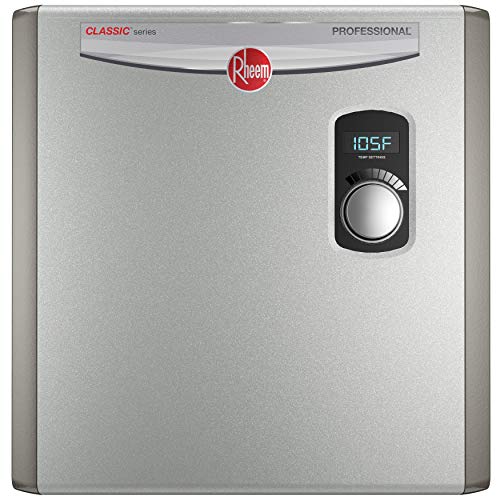
Rheem RTEX-24 24kW 240V Electric Tankless Water Heater, Gray
- Get the performance you expect. Choose the right size water heater for your home and verify electrical requirements before install…
- 24kW model provides up to 5.9 GPM
- Multiple fixture applicatons
The one you buy when you’re done compromising
The RTEX-24 is Rheem’s answer for whole-house performance in a 240V package. Up to 5.9 GPM means you can run two showers and a kitchen sink without anyone noticing a temperature drop. That’s the kind of capacity that makes a tankless upgrade feel worth the money.
Digital thermostatic controls let you dial in any temperature from 80°F to 140°F in one-degree increments. No guessing, no mixing valves, no arguing with your partner about whether 118°F or 120°F is the right setting. The unit holds that number.
Here’s the catch, and it’s a big one. The RTEX-24 needs three 40-amp double-pole breakers, three separate runs of #8 AWG copper wire with ground, and a household panel rated for at least 200 amps. If your home has a 100-amp service, you’re looking at a panel upgrade before this unit even comes out of the box. That’s a real cost, often $1,500 to $3,000 depending on your area and local code. Budget for it.
- 24kW output with up to 5.9 GPM flow
- Three 40-amp double-pole breakers required
- Three sets of #8 AWG copper conductors with ground
- Minimum 200-amp household service panel recommended
- Temperature range 80°F to 140°F in 1-degree steps
Best for: Larger homes with 200-amp service that need true whole-house hot water without a tank.
Rheem 11kW Multi Fixture T…
Rheem
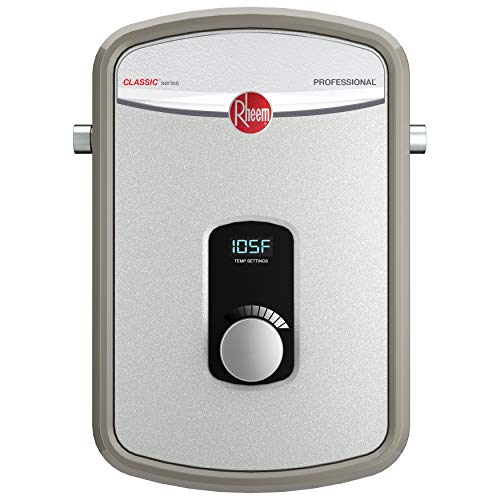
Rheem 11kW Multi Fixture Tankless Electric Water Heater - 240V
- Get the performance you expect. Choose the right size water heater for your home and verify electrical requirements before install…
- 11kW model provides up to 2.68 GPM
- Multiple fixture applicatons
The light whole-house option that won’t break your panel
An 11kW Rheem works well for a small home, a guest house, or a renovation where you want tankless but the electrical service is limited. Up to 2.68 GPM covers one shower comfortably, and a second fixture if you’re not running both at full blast.
The wiring story is refreshingly simple compared to the bigger models. One 50-amp double-pole breaker, one run of #8 AWG copper with ground, and a 100-amp household panel. That’s it. Most homes built after 1980 already have the capacity, which means installation stays in the hundreds of dollars rather than thousands.
Temperature control matches the rest of the RTEX line, holding within one degree from 80°F to 140°F. The honest limitation is flow rate. In a cold climate where incoming groundwater drops to 45°F, this unit struggles to deliver hot water to two fixtures simultaneously. It’s a one-shower-at-a-time heater in winter, and that’s fine if you know it going in.
- 11kW output with up to 2.68 GPM
- Single 50-amp double-pole breaker required
- One set of #8 AWG copper conductors with ground
- Works with 100-amp household service panel
- Digital thermostatic control in 1-degree increments
Best for: Small homes, cabins, or additions where 100-amp service is the ceiling and one hot shower at a time is acceptable.
Rheem 8kW Multi Fixture Ta…
Rheem
Rheem 8kW Multi Fixture Tankless Electric Water Heater - 240V
- Get the performance you expect. Choose the right size water heater for your home and verify electrical requirements before install…
- 8kW model provides up to 1.95 GPM
- Multiple fixture applicatons
The budget-friendly entry point that still delivers
At 8kW, this Rheem handles a single bathroom without drama. Up to 1.95 GPM is enough for a shower or a sink, but don’t expect to run the washing machine at the same time. It’s a focused heater for a focused job.
The installation requirements are the friendliest in the lineup. One 40-amp double-pole breaker, one #8 AWG copper run, and a 100-amp panel. If you’re replacing an old point-of-use tank heater under a sink or in a utility closet, this often drops right in with minimal rewiring.
Where this model shines is in warm climates. In Florida or Southern California, where incoming water sits around 70°F, an 8kW unit can comfortably serve a shower with room to spare. In Minnesota in February, it’s a different story. Groundwater at 40°F means the temperature rise needed is huge, and flow rate drops accordingly. Know your climate before you commit.
- 8kW output with up to 1.95 GPM
- Single 40-amp double-pole breaker required
- One set of #8 AWG copper conductors with ground
- Compatible with 100-amp household panels
- Temperature range 80°F to 140°F in 1-degree increments
Best for: Single-bathroom homes, cabins, or warm-climate installations where one hot water point is all you need.
Rheem RTEX-06T, 6.5kw Pro…

Rheem
Rheem RTEX-06T, 6.5kw Professional Classic 240V Point of Use Thermostatic Tankless Electric Water Heater
- Endless On-Demand Hot Water - Consistent hot water when you need it that never runs out
- Continuously monitored water temperature and controlled flow rates ensure efficiency and consistent performance within 1 degree of…
- Save Space - Rheem Professional POU T tankless electric water heaters are 90% smaller than traditional tank heaters, great for poi…
The point-of-use specialist for tight spaces
The RTEX-06T isn’t trying to heat your whole house. It’s a point-of-use heater designed to sit close to the fixture it serves, whether that’s a bathroom sink, a kitchen, or a workshop sink far from the main water heater. At 6.5kW, it’s the smallest unit in this roundup, and that’s the point.
Rheem builds this model about 90% smaller than a traditional tank heater. In a cramped cabinet or a utility closet, that footprint difference is the whole reason to buy it. You get endless hot water at that one fixture without waiting for a distant tank to send hot water down the pipe.
Temperature stays within one degree of your setting, monitored continuously. Flow rate is modest, so this works for handwashing, a small sink, or a single low-flow shower. It won’t run a full bathroom with a tub filler. And like the 18kW, the product data doesn’t spell out the exact breaker size, so check with an electrician or Rheem’s spec sheet before you buy.
- 6.5kW point-of-use output
- About 90% smaller than a traditional tank heater
- Continuous temperature monitoring within 1 degree
- Heats water only when the fixture is in use
- Ideal for remote sinks, workshops, or additions
Best for: A single remote fixture where running a long hot water line from the main heater doesn’t make sense.
How We Chose These Products
We started by filtering Rheem’s 240V tankless lineup down to models with published, verifiable electrical specs. Anything with vague amperage or wire gauge claims got cut, because those are the details that determine whether a unit actually works in your home.
From there we weighed four factors: real-world flow rate at typical incoming water temperatures, installation complexity based on breaker and panel requirements, temperature control accuracy, and whether the unit solves a specific household problem better than its siblings. Models that duplicated another pick’s role without adding value didn’t make the list.
Buying Guide: What Really Matters
Start with your electrical panel. A 100-amp service caps you around 11kW. A 200-amp service opens the door to 24kW or higher. This single fact eliminates half the lineup before you even think about GPM.
Next, figure out your required temperature rise. Subtract your incoming groundwater temperature from your target output temperature. In Miami, that might be 75°F incoming and 120°F target, a 45-degree rise. In Minneapolis, incoming water can be 40°F, making the rise 80 degrees. Higher rise means lower flow rate from the same kW unit. That’s the math most buyers skip, and it’s why a heater that works great in Texas disappoints in Michigan.
Finally, count your simultaneous fixtures. One shower at a time needs roughly 1.5 to 2 GPM. Two showers plus a sink pushes you toward 4 to 5 GPM. Match the unit’s published GPM at your climate’s temperature rise, not the marketing number at ideal conditions. If you’re on well water or dealing with hard water, read our guide to the best tankless for well water before you commit to any model.
Frequently Asked Questions
Can I install a Rheem 240V tankless heater myself?
Mechanically, yes. Legally, it depends on your local code. Most jurisdictions require a licensed electrician to pull a permit and make the final connections, especially for units drawing 40 amps or more. DIY electrical work on a 50-amp circuit is where homeowners get into trouble with inspectors and insurance companies.
Why does 240V matter compared to 120V?
A 120V circuit maxes out around 1.5kW to 1.8kW, which isn’t enough to heat water at any useful flow rate. Doubling the voltage to 240V lets the same wire carry roughly four times the power. That’s why every serious tankless electric heater runs on 240V.
How much does it cost to run a Rheem tankless heater monthly?
Multiply the unit’s kW by your hours of active use, then by your electricity rate. An 18kW unit running two hours a day at $0.14 per kWh costs about $1.51 daily, or roughly $45 monthly. A 24kW unit at the same usage runs closer to $60. Your actual number depends on how often the heater fires and your local rate.
Do I need to descale a Rheem tankless water heater?
Yes, especially in hard water areas. Mineral buildup inside the heat exchanger reduces flow and efficiency over time. Annual descaling with a pump kit takes about an hour and can add years to the unit’s life. Our tankless descaling guide walks through the process step by step.
Our Top Recommendation
The Rheem RTEX-24 wins for most households with 200-amp service. It delivers up to 5.9 GPM, handles multiple fixtures at once, and gives you precise digital temperature control. Yes, it needs three 40-amp breakers and three wire runs, and yes, that installation bill stings. But it’s the only unit here that genuinely replaces a tank heater for a family of four.
If your panel is 100 amps, drop to the Rheem 11kW. It won’t run two showers at once in cold weather, but it handles a small home or cabin without a panel upgrade. For a single-bathroom setup or a tight budget, the Rheem 8kW gets the job done in warm climates. And for one remote fixture, the RTEX-06T solves a problem no whole-house unit can.
Before you buy, compare Rheem against other brands in our A.O. Smith vs Rheem comparison if you’re still deciding on the brand itself. Either way, confirm your panel capacity first. That one step saves more headaches than any spec sheet.
Pros and Cons: Detailed Breakdown
Rheem 18kW 240V Tankless
Pros: Self-modulating power saves energy on mild days. Field-serviceable copper elements extend lifespan. External digital thermostat is easy to adjust. 4.4 GPM covers two fixtures in moderate climates. Bottom NPT connections simplify replacement of an existing unit.
Cons: Breaker specification isn’t published in product data, so you must verify with Rheem or an electrician. Not enough output for cold-climate whole-house use. Two simultaneous high-flow fixtures will push it to its limit.
Rheem RTEX-24 24kW 240V
Pros: 5.9 GPM handles multiple fixtures at once. Precise 1-degree temperature control from 80°F to 140°F. True whole-house replacement for a tank heater. Well-documented electrical requirements make planning straightforward.
Cons: Requires 200-amp service panel and three separate 40-amp breakers. Installation cost can exceed the heater price if a panel upgrade is needed. Higher kW draw means higher monthly operating cost than smaller units.
Rheem 11kW Multi Fixture
Pros: Works with a 100-amp panel, no upgrade required in most homes. Single 50-amp breaker keeps installation simple and affordable. 2.68 GPM covers one shower comfortably. Digital thermostat holds temperature within one degree.
Cons: Struggles with two simultaneous fixtures in cold climates. Not a true whole-house solution for larger families. Limited output in northern states during winter months.
Rheem 8kW Multi Fixture
Pros: Lowest electrical demand in the lineup with a single 40-amp breaker. Fits 100-amp panels without modification. Affordable entry point into tankless. Reliable for single-bathroom use in warm climates.
Cons: 1.95 GPM is tight even for one shower in cold weather. Not suitable for simultaneous fixture use. Performance drops sharply as incoming water temperature falls.
Rheem RTEX-06T 6.5kW Point-of-Use
Pros: Tiny footprint fits under sinks and in tight cabinets. Eliminates waiting for hot water at remote fixtures. Only heats water when the tap is open. Temperature stays within one degree of setting.
Cons: Serves only one fixture. Not designed for whole-house or multi-fixture use. Breaker spec not published, requiring verification before purchase.


