You finish a hard workout. Your legs ache, your mind races, and the shower doesn’t cut it anymore. That’s the moment most people start searching for a cold plunge tub or a home sauna. Then they see the price tags, the wiring requirements, and the maintenance schedules, and the whole idea stalls.
A great contrast therapy setup solves one problem well: it makes recovery convenient enough to actually do. The right pick depends on your space, your budget, and whether you want hot, cold, or both from one system. Chiller power, temperature range, insulation, and water care matter more than brand names.
Below are five picks that cover the main buyer types, from a complete sauna-and-plunge bundle to a bare-bones inflatable. We also break down what these things really cost over three years, how to sequence a contrast therapy session, and when you should walk away entirely.
Here is a quick look at how the five picks compare on the specs that actually change your daily experience.
| Features | Burneek Bundle | Finnish Barrel Cedar | Canadian Cedar Plunge | 400L Molded PE | Bubplay Ice Bath |
|---|---|---|---|---|---|
| Material and Build | Insulated tent plus inflatable tub | Canadian cedar with stainless steel | Canadian cedar with stainless steel | One-piece molded PE shell | 210D fabric with steel rods |
| Heating and Cooling | 1600W steam sauna, chiller included | 3600W heat, 2400W cool | 3700W heat, 2800W cool | 1HP chiller, 2100W cooling | No chiller, ice only |
| Temperature Range | Adjustable sauna heat, chilled plunge | About 37°F to 107°F | About 37°F to 107°F | About 37.4°F to 104°F | Depends on ice added |
| Water Care | Insulated cover and drain system | Circulation and water-care functions | Self-cleaning and circulation | Filtration, circulation, fitted lid | Drain valve and hose |
| Best Use Case | Full home recovery bundle | Patio centerpiece and sauna pairing | Indoor sauna room pairing | Home gym or garage setup | Renters and tight budgets |
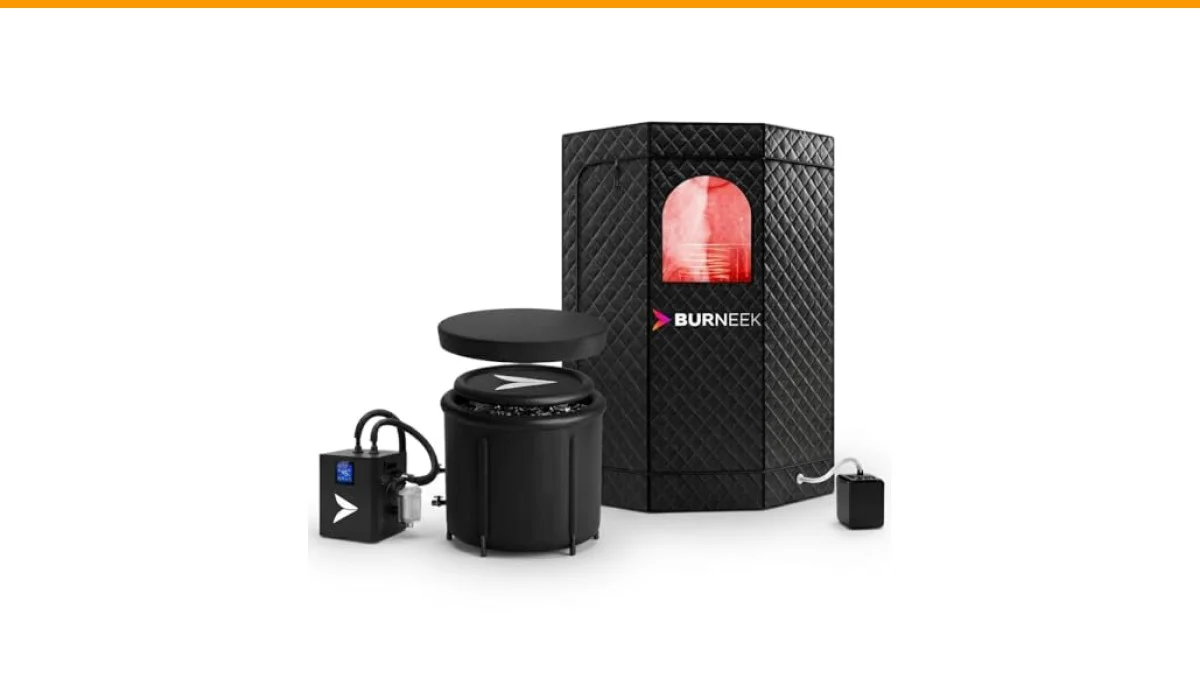
Burneek Home Sauna & Cold…

Burneek
Burneek Home Sauna & Cold Plunge Tub Recovery Bundle, Infrared Sauna & Cold Plunge, Sauna Box for At Home Sauna Sessions, Ice Bath for Post Workout Recovery & Wellness (Chiller Included)
- 🏠 COMPLETE HOME RECOVERY BUNDLE: Enjoy the perfect recovery routine with the Burneek Halo Sauna and ice bath tub. Relax in a sooth…
- ⚡ QUICK SETUP & FAST HEATING: The Burneek Halo Sauna works as a portable infrared sauna with a powerful 1600W steam unit, adjustab…
- 💆 DAILY WELLNESS & RECOVERY: Alternate between the warmth of an infrared sauna with red light therapy and the refreshing feel of a…
The one you buy when you want the whole hot-and-cold routine in a single order.
Burneek sells this as a recovery bundle, and that’s exactly what it is. You get a portable infrared sauna box with red light therapy plus an inflatable cold plunge tub, and the chiller comes in the box. That last part matters. Most budget plunge tubs ship without cooling, which means you’re hauling ice bags every few days. This pick is aimed at the person who wants a complete contrast therapy setup without shopping for five separate items.
The sauna side runs on a 1600W steam unit with adjustable heat and timer controls. Quad Hyper-Insulated Technology helps the tent hold heat between sessions, which is the difference between a sauna you use daily and one you abandon after a month. Setup is genuinely simple: the tub inflates in minutes with the included air pump, and the sauna folds into a carry bag. If you rent an apartment or move often, that portability is a real advantage over a permanent cedar build.
Here’s the honest trade-off. An infrared sauna tent is not a traditional Finnish sauna. The heat feels different, the ceiling is lower, and the experience is more functional than luxurious. The inflatable plunge also won’t match a molded tub for durability over five or more years. And you still need to manage water chemistry yourself. This bundle solves convenience, not permanence.
- Includes both sauna and cold plunge with chiller, so nothing extra to buy
- 1600W steam unit with adjustable heat levels and timer
- Quad Hyper-Insulated Technology retains heat between sessions
- Frozeneek plunge uses insulated materials to hold water temperature
- Full package: chair, floor mat, remote, carry bag, cover, and drain
Best for: Anyone who wants a complete at-home sauna and cold plunge routine without installing permanent equipment.
1-Person Finnish Barrel C…

Duthss
1-Person Finnish Barrel Cedar Hot & Cold Plunge Tub with WiFi, 120V | Classic cedar barrel design with stainless steel interior, 37–107°F range and flexible sauna-side placement.
- 【CLASSIC FINNISH BARREL DESIGN】 The rounded barrel-style profile draws inspiration from traditional Finnish bathing tubs, while Ca…
- 【HOT & COLD TEMPERATURE CONTROL】 The system delivers 2400W cooling output and 3600W heating output, with an adjustable temperature…
- 【MOVABLE CHILLER FOR FLEXIBLE PLACEMENT】 The tub and temperature-control unit use a separate configuration, allowing the wheeled c…
The one that turns a patio into a proper Nordic bathing corner.
Duthss built this around the classic Finnish barrel profile, and the Canadian cedar exterior gives it a furniture-grade look. This is a hot and cold plunge in one unit, which separates it from most tubs on this list. The system pushes 3600W of heating and 2400W of cooling, with a range from roughly 37°F to 107°F. You can soak warm in winter and plunge cold in summer from the same tub.
The movable chiller is the smartest design choice here. The wheeled unit sits away from the tub, connected by quick-connect hoses, so you can tuck it behind a fence or against a wall. Maintenance access is easier too. WiFi control lets you drop the temperature before you get home, which sounds like a gimmick until you use it. The stainless steel interior wipes down clean and won’t stain like bare wood.
Two things to know before ordering. This is a lead-time product, so you won’t have it next week. And the open barrel design means more heat loss than an insulated cabinet tub, so the chiller works harder to hold cold temperatures in summer. That shows up on your electric bill.
- 3600W heating and 2400W cooling in one system
- Adjustable range of roughly 37°F to 107°F
- Wheeled chiller with quick-connect hoses for flexible placement
- Hand-finished Canadian cedar with stainless steel interior
- WiFi control plus built-in circulation and water care
Best for: Buyers who want one tub that does hot and cold, and have outdoor space for a barrel-style centerpiece.
1-Person Canadian Cedar C…

Duthss
1-Person Canadian Cedar Cold Plunge Tub with Integrated Cooling & Heating | WiFi control, stainless steel interior and 37–107°F range for sauna areas, home gyms, patios and dedicated wellness spaces.
- 【CANADIAN CEDAR & STAINLESS STEEL】 Natural Canadian cedar surrounds the dark cabinet with a warm, furniture-style appearance suite…
- 【INTEGRATED COOLING & HEATING】 The all-in-one system combines 2800W cooling and 3700W heating in one integrated unit, with an adju…
- 【1-PERSON FULL-BODY IMMERSION】 Designed as a dedicated single-user plunge for regular home use. The spacious interior supports com…
The one that looks like furniture and hides all the machinery.
This Duthss model takes the same cedar-and-stainless formula and wraps it in a dark cabinet. The integrated cooling and heating live inside the unit, so there are no exposed hoses or a separate chiller box cluttering your space. That matters if the tub sits indoors next to a home sauna or in a finished basement. It reads as a piece of furniture, not gym equipment.
Performance is the strongest on this list for a single-person plunge. The integrated system delivers 2800W of cooling and 3700W of heating, with the same 37°F to 107°F range. Built-in circulation and self-cleaning water-care functions cut down on how often you’re scrubbing the interior. WiFi control and a panel on the tub give you two ways to run it. It’s designed for standard 120V household power, which removes the electrician visit most people dread.
The catch is the footprint. An integrated cabinet tub is heavier and harder to move than an inflatable, and it needs a level surface that can handle the loaded weight. This is also a lead-time item. Plan for a few weeks, not a few days.
- Integrated 2800W cooling and 3700W heating, no external chiller
- Temperature range of approximately 37°F to 107°F
- Canadian cedar cabinet with stainless steel interior
- Self-cleaning and circulation functions reduce manual upkeep
- Runs on 120V / 60Hz standard U.S. power
Best for: Homeowners with a dedicated wellness room who want a permanent, clean-looking plunge next to their sauna.
400L Molded PE Cold Plung…

Duthss
400L Molded PE Cold Plunge Tub with Integrated Cooling System, 110V | cooling, filtration and water care with insulated construction for home gyms, sauna areas and dedicated wellness spaces.
- 【DURABLE MOLDED PE CONSTRUCTION】 The one-piece molded PE shell provides a strong, low-maintenance structure designed for frequent…
- 【INTEGRATED COOLING SYSTEM】 The built-in 1HP chiller delivers up to 2100W cooling output, with adjustable water temperature from a…
- 【400L FULL-BODY IMMERSION】 Measuring approximately 60 L × 30.5 W × 26 H in, the spacious 400L tub provides a comfortable single-us…
The one built for garages, gyms, and people who hate cleaning.
Molded polyethylene is the material you see in commercial plunge setups, and Duthss uses it here in a 400L single-user tub. The one-piece shell has no seams to leak or harbor mold, which is the failure point on cheaper inflatables. Insulated construction helps hold temperature between cooling cycles, so the 1HP chiller isn’t running constantly. This is the pick for a home gym, garage, or covered patio where function beats aesthetics.
Everything is integrated: cooling, circulation, filtration, temperature control, and water care. No exposed hoses, no separate equipment to trip over. The 2100W chiller holds water from about 37.4°F to 104°F, and the wide, low-profile design makes entry and exit easier than climbing into a deep barrel. A fitted lid and valve-equipped drainage simplify the weekly routine. At roughly 60 by 30.5 by 26 inches, it fits where a barrel tub won’t.
It’s not pretty. The molded shell looks industrial, and the 110V chiller won’t drop a full tub to near-freezing as fast as a higher-output unit. In a hot garage, expect the chiller to run longer to hold temperature. That’s a fair trade for the durability and low maintenance.
- One-piece molded PE shell with insulated construction
- 1HP integrated chiller with 2100W cooling output
- Adjustable range of roughly 37.4°F to 104°F on 110V power
- 400L capacity at about 60 L x 30.5 W x 26 H inches
- Built-in filtration, circulation, lid, and drain valve
Best for: Athletes and home gym owners who want a durable, low-maintenance plunge and don’t care about cedar looks.
Bubplay Ice Bath Cold Plu…

Bubplay
Bubplay Ice Bath Cold Plunge Tub with Cover for Indoor Outdoor for Recovery, Cold Water Therapy, Athletes & Adults -105 Gallons, Black, XL
- 【XL 105-Gallon Cold Plunge for Full-Body Recovery】 Designed for adults who want a more immersive cold plunge experience at home. T…
- 【Includes Cover with 6-Layer Insulated Construction】 Comes with a fitted cover to help keep the water cleaner between uses and slo…
- 【Tool-Free Setup with 8 Stainless Steel Support Rods】 No tools required. Simply inflate the top ring with the included pump, inser…
The one that costs the least and asks the most of you.
Bubplay makes the budget entry point here, and it’s honest about what it is: an inflatable tub with no chiller. You add ice, or you don’t. The 105-gallon XL size fits users up to about 6 feet 7 inches, which is more generous than most inflatables at this level. Eight stainless steel rods keep the walls upright during entry and exit, and the 210D outer fabric with six-layer insulation slows temperature change once you’ve added ice.
Setup needs no tools. Inflate with the included pump, insert the rods, fill with water, and you’re done. The bottom drain valve and included hose let you empty it without tipping the tub over, which is a small thing until you’ve wrestled a full inflatable by yourself. When you’re finished, it deflates and folds flat for storage. That makes it the only pick here that works for renters, small apartments, or anyone who can’t commit permanent floor space.
The trade-offs are real. Without a chiller, you’re buying ice constantly, and the water warms up fast in summer. The insulation slows that, it doesn’t stop it. The manufacturer also recommends indoor use if temperatures drop below freezing, so it isn’t a year-round outdoor solution. And an inflatable won’t last as long as a molded or cedar tub.
- 105-gallon XL capacity fits users up to about 6 feet 7 inches
- Six-layer insulation with tough 210D outer fabric
- Eight stainless steel support rods for stability
- Bottom drain valve plus hose for no-tip emptying
- Tool-free inflatable setup, folds flat for storage
Best for: Renters, apartment dwellers, and first-timers testing whether cold water therapy sticks before spending on a chiller.
How We Chose These Products
We started with the specs that change daily use: chiller output, temperature range, insulation quality, and water care. A tub that can’t hold temperature forces you to babysit it, and a sauna that leaks heat gets abandoned. We weighted build materials heavily because they determine how long the product lasts and how much maintenance it demands.
We also looked at setup reality. Wiring requirements, footprint, and whether a chiller is included all affect the true cost. A cheap tub with no chiller isn’t cheap once you add ice, filters, and electricity. We factored that into every pick. Finally, we favored products that solve a specific problem well over ones that try to do everything adequately.
Buying Guide: What Really Matters
Chiller power is the first thing to check. Cooling output in watts tells you how fast the tub recovers temperature after you get in. A 1HP chiller handles a single-user tub fine. A larger tub or a hot climate needs more. Don’t compare tubs on price alone without comparing chiller specs.
Temperature range matters more if you want a hot and cold plunge combo. A tub that only cools is a one-trick product. A tub that spans roughly 37°F to 107°F gives you contrast therapy from one system, which saves space and money. If you already own a sauna, a cold-only tub is fine. If you don’t, a combo unit may be the smarter buy.
Water care deserves more attention than it gets. Filtration, circulation, and self-cleaning functions determine how often you change water and scrub surfaces. Tubs without them turn green faster and cost more in sanitizer. For a deeper look at pairing options, this sauna and cold plunge combo guide covers how the two systems work together. And if you’re weighing a permanent cedar build, see this breakdown of cedar hot tubs and saunas.
Best Saunas to Pair With a Cold Plunge
The sauna you choose changes how you use your plunge. Traditional Finnish saunas run hot and dry, often 170°F to 190°F, and pair with a short, intense cold plunge. Infrared saunas run cooler, around 120°F to 140°F, and suit longer sessions and people who find dry heat uncomfortable. Barrel saunas sit between the two and look great outdoors but lose more heat than a cabin.
For most home setups, an infrared cabin or tent is the practical choice. It heats faster, needs less power, and fits smaller rooms. A traditional sauna needs more ventilation and a dedicated circuit. If you’re building outdoors in a cold climate, read this guide to an outdoor sauna for cold climate before you commit.
Traditional vs Infrared vs Barrel Sauna
Traditional saunas deliver the deepest sweat and the most authentic experience. They also cost the most to install and run. Infrared saunas heat your body directly with radiant panels, so the air stays cooler and the session feels gentler. Barrel saunas are traditional heaters in a round cedar shell, and they’re the best-looking option for a backyard.
Contrast Therapy Protocol: Order, Timing, Temperature
Heat first, cold second. A typical session is 10 to 15 minutes in the sauna, then 1 to 3 minutes in the plunge. The cold water constricts blood vessels, then rewarming dilates them, which is the effect most people chase. Water between 45°F and 55°F works for beginners. Below 40°F is advanced territory.
Two to three rounds is plenty. More isn’t better. Finish on cold if you want the alert, energized feeling. Finish on hot if you want to relax before bed. If you’re new to this, start with one round and build up. Our sauna cold plunge protocol walks through the timing in more detail.
The Real Cost of Ownership Over 3 Years
The purchase price is only part of the math. A chiller running daily draws meaningful power. A 1HP unit pulls roughly 700 to 900 watts while cooling, and in a hot climate it may run several hours a day. Over three years, that’s a few hundred dollars in electricity for most households. A tub without a chiller costs less to run but more in ice, often $5 to $15 per session.
Filters and sanitizer add up too. Plan on replacing filters every few months, plus chlorine or bromine, test strips, and the occasional water change. Budget $150 to $400 per year for a chiller-equipped tub. Inflatables cost less to maintain but need replacing sooner, so the three-year total can end up close.
Then there’s water. A 100-gallon tub changed every two to four weeks uses a few thousand gallons a year. That’s minor on most bills but worth knowing. Add it all up, and a $2,000 tub might cost $2,800 to $3,200 over three years. A cedar combo unit costs more upfront but holds value and lasts longer.
Maintenance, Filtration, and Winterizing
Water care is the part nobody warns you about. Even with filtration, you need to check pH and sanitizer levels weekly. Skip it and the water clouds, then turns. A fitted lid slows evaporation and keeps debris out, which cuts how often you clean. Tubs with self-cleaning cycles save real time here.
Filter replacement is the other recurring task. Most integrated tubs use a cartridge you rinse monthly and replace every three to six months. Mold risk climbs if you leave water sitting without circulation, so run the system even on days you don’t plunge.
Winterizing depends on your setup. A chiller-equipped tub can run year-round outdoors if it’s insulated, though it works harder in freezing temps. Inflatables should come indoors below freezing to avoid cracking. If you drain a tub for winter, dry it fully before storage. Residual water is what causes mold and cracking.
Chiller vs Ice: Which Makes Sense for You
Ice is cheaper upfront and simpler. You fill the tub, dump in ice, and plunge. The problem is consistency. You need ice on hand every time, and the water warms within 20 to 30 minutes. That friction is why most ice-only tubs end up unused after a few months.
A chiller costs more but removes the friction. Set the temperature, and it holds. You plunge whenever you want, for as long as you want. If you’re serious about a daily cold water routine, a chiller pays for itself in convenience. If you’re testing whether you even like cold plunging, start with ice.
The middle path is a chiller-ready tub. Buy an inflatable now, add a chiller later if the habit sticks. That keeps your initial spend low without locking you out of an upgrade.
Who Should Skip a Cold Plunge or Sauna
Cold plunging isn’t for everyone. If you have a heart condition, high blood pressure, or circulation problems, talk to a doctor first. The cold shock response spikes heart rate and blood pressure fast. Pregnant women should skip it. So should anyone with Raynaud’s or a history of cold injuries.
Skip the sauna if you’re pregnant, have unstable angina, or take medications that affect sweating. Alcohol and saunas don’t mix. Neither do saunas and certain blood pressure drugs.
There’s also a practical case for skipping both. If you live in a small apartment with no outdoor space, no drain access, and no room for a chiller, a permanent setup will frustrate you. Stick with a foldable inflatable or use a gym. And if you won’t commit to weekly water care, don’t buy a chiller tub. Neglected water is a health hazard, not a recovery tool.
Safety and What the Research Shows
Cold water immersion has decent evidence for reducing perceived soreness and improving mood. The research on muscle recovery is mixed. Some studies show benefit, others show cold water may blunt strength gains if used right after resistance training. Use it on rest days or hours after lifting if muscle growth is your goal.
Sauna use has stronger long-term evidence, particularly for cardiovascular health. Regular sessions are linked to better heart outcomes in large population studies. The key word is regular. Occasional use won’t move the needle.
Contrast therapy, the back-and-forth between hot and cold, is popular but less studied. The anecdotal reports are strong. Treat it as a recovery and mood tool rather than a medical treatment. Start conservative, keep sessions short, and stop if you feel dizzy or lightheaded.
For a broader look at how these systems compare across brands, this comparison of cold plunge brands is worth a read. And if budget is your main constraint, this roundup of cold plunge tubs for every budget covers more options.
Frequently Asked Questions
Can I use a cold plunge tub indoors?
Yes, but you need to manage humidity and floor load. A full tub weighs several hundred pounds. Put it on a reinforced floor or a garage slab. Ventilation matters too, since splash and evaporation raise indoor moisture.
How cold should the water be for a cold plunge?
Beginners do well at 50°F to 55°F. Intermediate users often target 45°F to 50°F. Below 40°F is advanced and should be brief. Colder isn’t automatically better. Consistency matters more than extremity.
Do cold plunge tubs qualify for HSA or FSA reimbursement?
Sometimes. Some plans reimburse cold plunge tubs and saunas with a letter of medical necessity. Rules vary by plan and provider. Check with your administrator before buying, and keep your receipt.
How often do I need to change the water?
With good filtration and sanitizer, every two to four weeks is typical. Without filtration, weekly. If the water looks cloudy or smells off, change it sooner. Never plunge in water you wouldn’t swim in.
Our Top Recommendation
The Burneek bundle wins for most people. It’s the only pick here that hands you a complete contrast therapy setup in one box, chiller included, with no wiring or installation. The sauna and the plunge work together the way they’re supposed to. For anyone starting from zero, it removes the guesswork.
If you want a permanent, good-looking setup and have the space, the Duthss Canadian cedar plunge is the runner-up. It’s the strongest single tub here, and it pairs cleanly with a home sauna. For a home gym or garage where durability beats looks, the 400L molded PE tub is the practical choice. And if you’re not ready to spend on a chiller, the Bubplay inflatable lets you test the habit for the least money.
Sources
- Sun Home Saunas, Best Cold Plunge Tubs of 2026
- Ice Cold Tubs, Best Cold Plunge Tubs 2026
- Manufacturer specifications for Burneek, Duthss, and Bubplay products