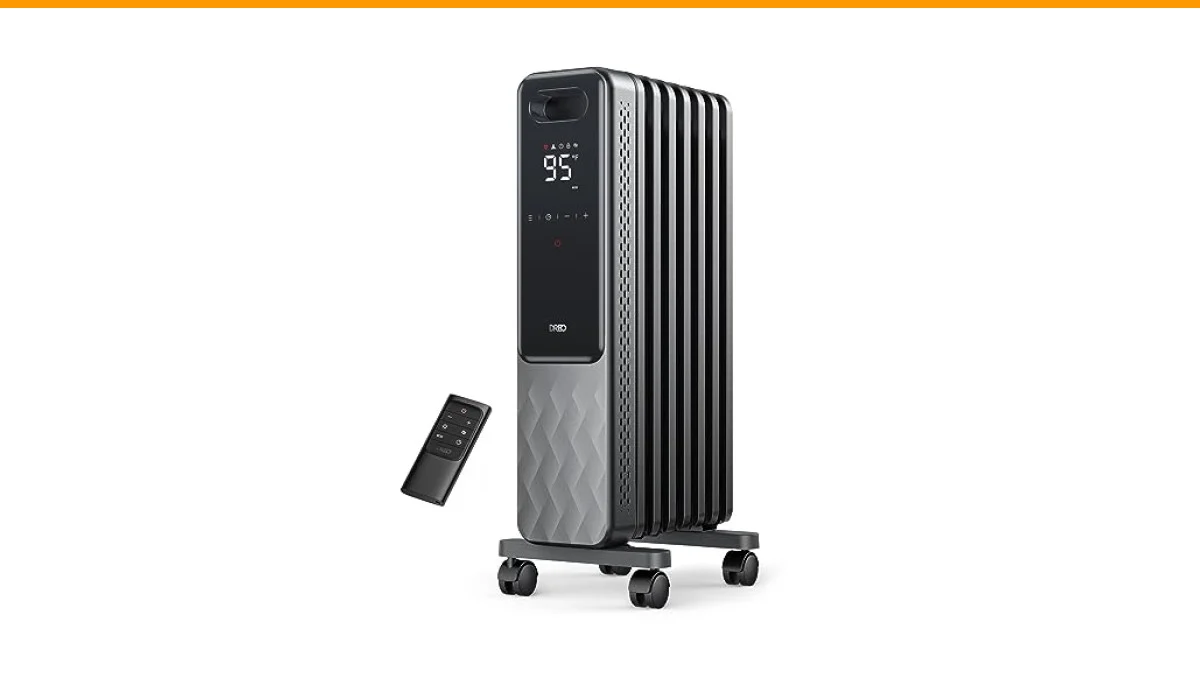
A 1500W plug-in heater pulls 12.5 amps. That single number explains why your last space heater tripped the breaker, why it never warmed the far corner of your living room, and why the ‘large room’ claim on the box deserves a closer look.

Most plug-in heaters max out at 1500 watts because a standard 15-amp household circuit can’t safely handle more. That ceiling shapes everything: how much square footage one unit can realistically warm, how many you can run at once, and when you should stop shopping for plug-ins and call an electrician about a 240V circuit instead.
We picked four heaters that make the most of that 1500W limit. Two are DREO ceramic units, one is a dual-heating infrared machine, and one is a low-wattage wall panel for zone heating. Each fits a different room and a different buyer. Below you’ll find the specs, the real math, and an honest answer to whether one plug-in heater can handle your space.
Here’s a quick side-by-side of the four picks before we dig into each one.
| Features | DREO 1500W Ceramic | Dr Infrared DR-968 | DREO 25 Inch Tower | Envi Wall Panel |
|---|---|---|---|---|
| Heating Type | PTC ceramic | Infrared quartz + PTC | Ceramic tower | Fan-less convection |
| Wattage Draw | 1000W / 1500W | 1500W, 12.5 amps | 1500W max | 500W, 4.2 amps |
| Noise Level | 34 dB | 39 dB | 25 dB | Silent (no fan) |
| Coverage Claim | 270 sq ft | Large room | 100-270 sq ft | Zone / spot heat |
| Best Use Case | Bedroom or office | Garage or basement | Open-plan living room | Wall-mount 24/7 heat |
Can One Plug-In Heater Really Heat a Large Room?
Short answer: it depends on what you mean by ‘large’ and what you mean by ‘heat.’ A single 1500W plug-in heater produces about 5,100 BTU per hour. That’s enough to take the chill off a 300-400 sq ft room, but it won’t bring a 600 sq ft open-plan space up to 72°F when it’s 20°F outside.
Most manufacturers rate coverage generously. A ‘270 sq ft’ claim usually assumes a well-insulated room with 8-foot ceilings and an outdoor temp around 40°F. Drop the outdoor temp to 15°F and that same heater might only keep a 150 sq ft bedroom comfortable.
Wattage, BTU, and Square-Foot Math

DR. INFRARED HEATER
Dr Infrared Heater DR-968 Portable Space Heater, 1500-Watt, Cherry
- Can heat up a large room with Auto Energy Saving Model With High and Low Feature. Tip-over protection and Overheat protection.Heat…
- Dual Heating Systems featuring infrared quartz tube + PTC with 12-Hour automatic shut-off timer. Amperage: 12.5 Amps
- IR Remote Control, High Pressure Low Noise Blower with Noise level 39 dB super quiet. Heating can cover for a large room.
The conversion is simple. Multiply watts by 3.41 to get BTU per hour. A 1500W heater delivers roughly 5,115 BTU. A 1000W setting gives you about 3,410 BTU, and a 750W low setting gives 2,558 BTU.
For rough sizing, you need about 10 watts per square foot in a well-insulated room. That means 1500W covers roughly 150 sq ft in cold climates. In mild weather with decent insulation, the same heater can handle 250-300 sq ft. The gap between those two numbers is why coverage claims vary so wildly.
A 400 sq ft room at 10W per sq ft needs 4,000W. No single plug-in can deliver that. A 600 sq ft space needs 6,000W. You’d need two 1500W heaters running on separate circuits, or a 240V unit, to get close.
When You Need Two Heaters or 240V

DREO
DREO 25 Inch Electric Space Heater for Indoor Use, Large Room, Thermostat | 11.5 ft/s Fast Heating, 25dB Quiet Operation, 70° Oscillation, Remote Control, Child Lock, Overheating & Tip-Over Protection
- The Ultimate Heating Experience: DREO's upgraded 25" space heaters for indoor use brings 11.5 ft/s fast heat thanks to its new hyp…
- Warm Your Nights in Absolute Quietness: DREO's new airflow design brings down noise as low as 25dB, making this space heater for b…
- Unbreakable Safety: This room heater for indoor is fully packed to safely warm up your winter. Built with V0 flame retardant mater…
Two 1500W plug-in heaters on separate 15-amp circuits will give you roughly 10,200 BTU. That’s enough for a 500-600 sq ft room in most climates. The catch: they must be on different breakers. Plug both into the same circuit and you’ll trip it every time.
A 240V garage heater or a hardwired wall unit delivers 4,000-5,000W from a single outlet. That’s 13,600-17,000 BTU, which handles a 400-500 sq ft garage easily. The trade-off is installation cost and a dedicated circuit.
If your room is over 500 sq ft with high ceilings or poor insulation, a plug-in heater is a supplement, not a solution. Use one to warm the area you’re sitting in, not the whole space. For a deeper look at which heater types handle big rooms best, see this space heater type guide.
Top Plug-In Heaters for Large Rooms

ENVI
Envi Plug-in Electric Panel Wall Heaters for Indoor Use, Energy Efficient 24/7 Heating w/Safety Sensor Protection, Patented Quiet Fan-less Design, Easy 2-Min Install, Space Heater, Made in USA
- EFFICIENT LOW-WATTAGE WALL HEATER: This wall-mounted heater is designed to provide targeted comfort in specific areas of your home…
- SAFE AND USER-FRIENDLY DESIGN: This heater operates at a cool 90°F and includes a wall-sense safety sensor that cuts power if it’s…
- QUIET AND COMFORTABLE HEATING: Experience completely silent, gentle warmth with our patented fan-less design featuring “Stack Conv…
DREO Space Heaters for Indoor Use
This is DREO’s compact 1500W ceramic heater, and it’s the one most people should start with. It’s small enough to sit on a nightstand, quiet enough to sleep next to, and smart enough to hold a temperature without you babysitting the dial. The 270 sq ft coverage claim is realistic for a bedroom or home office in mild-to-moderate cold.
The standout feature is the ECO mode. A built-in temperature sensor switches between 1000W and 1500W automatically to maintain your set temp. That’s not just a marketing line; it genuinely cuts power draw once the room reaches target. The 70° oscillation uses a trackball system rated for 750,000 cycles, which spreads heat into corners better than a fixed-direction heater. At 34 dB, it’s about as loud as a quiet library.
Here’s the honest limitation: 270 sq ft is the ceiling, not the floor. In a 400 sq ft living room during a cold snap, you’ll feel the warmth only within 8-10 feet of the unit. And DREO specifically warns against extension cords. Plug it directly into a wall outlet or you risk overheating the cord.
- 1500W PTC ceramic with 1000W ECO mode
- 34 dB noise level, 70° oscillation
- 12-hour timer and 24-hour auto power-off
- Tip-over and overheat protection, ETL certified
- 6 ft flat cord, 2-prong plug
Best for: Anyone heating a bedroom, office, or small living room who wants quiet operation and automatic temperature control.
Dr Infrared Heater DR-968
The DR-968 is the odd one out here, and that’s why it earns a spot. It uses a dual heating system: an infrared quartz tube plus a PTC element. The combination produces about 60% more felt heat than a ceramic-only unit at the same wattage, according to the manufacturer. Rated around 5,200 BTU, it’s the warmest-feeling heater in this group.
Infrared heat works differently. It warms objects and people directly rather than heating the air first. That makes it effective in drafty spaces like garages and basements where air-based heaters struggle. The unit weighs 19 lbs and rolls on caster wheels, so moving it between rooms is easy. A remote control handles power, temp, and the 12-hour timer from across the room.
Two things to know before buying. First, it draws 12.5 amps, which is close to the 15-amp circuit limit. Don’t run anything else on that circuit while it’s on. Second, at 39 dB it’s louder than the DREO units. The blower is noticeable in a quiet bedroom. This heater belongs in a workshop or living room, not next to your pillow.
- Dual infrared quartz + PTC heating, ~5,200 BTU
- Electronic thermostat adjustable from 50-85°F
- 12-hour auto shut-off, tip-over and overheat protection
- Remote control, caster wheels, lifetime filter
- 39 dB noise level, 12.5 amp draw
Best for: Garage, basement, or drafty workshop owners who need penetrating heat and don’t mind a bit of fan noise.
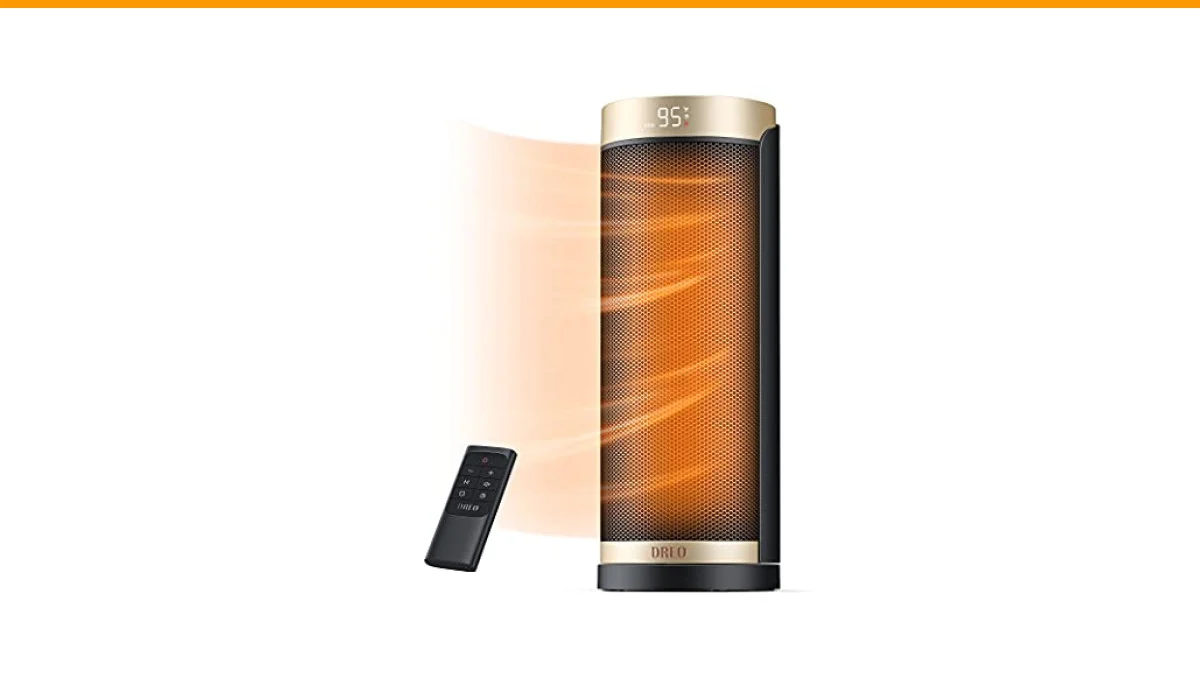
DREO 25 Inch Electric Space Heater
This is DREO’s upgraded tower model, and it’s the quietest heater in this roundup at 25 dB. That’s quieter than a whisper. If noise is your main complaint with space heaters, this one solves it. The 25-inch height and extended impeller push air at 11.5 ft/s, which is faster than the compact DREO and spreads warmth across a wider area.
Temperature control is the other selling point. You can set the thermostat between 41°F and 95°F with 1°F precision. Most heaters only let you pick low, medium, or high. This one lets you dial in exactly 68°F and holds it. Four modes (H1, H2, H3, ECO) give you flexibility, and a fan-only setting circulates air in summer.
The trade-off is size and price. It’s a tower, so it takes up more floor space than the compact DREO. It also costs more. And while the 270 sq ft coverage matches the smaller model, the wider oscillation makes it feel more effective in open rooms. A child lock adds safety if you have toddlers.
- 25 dB operation, 11.5 ft/s airflow
- 1°F precision thermostat, 41-95°F range
- 70° oscillation, four heating modes plus fan
- Child lock, 45° tip-over protection, ETL certified
- 100-270 sq ft coverage
Best for: Light sleepers and open-plan living rooms where quiet operation and precise temperature control matter most.
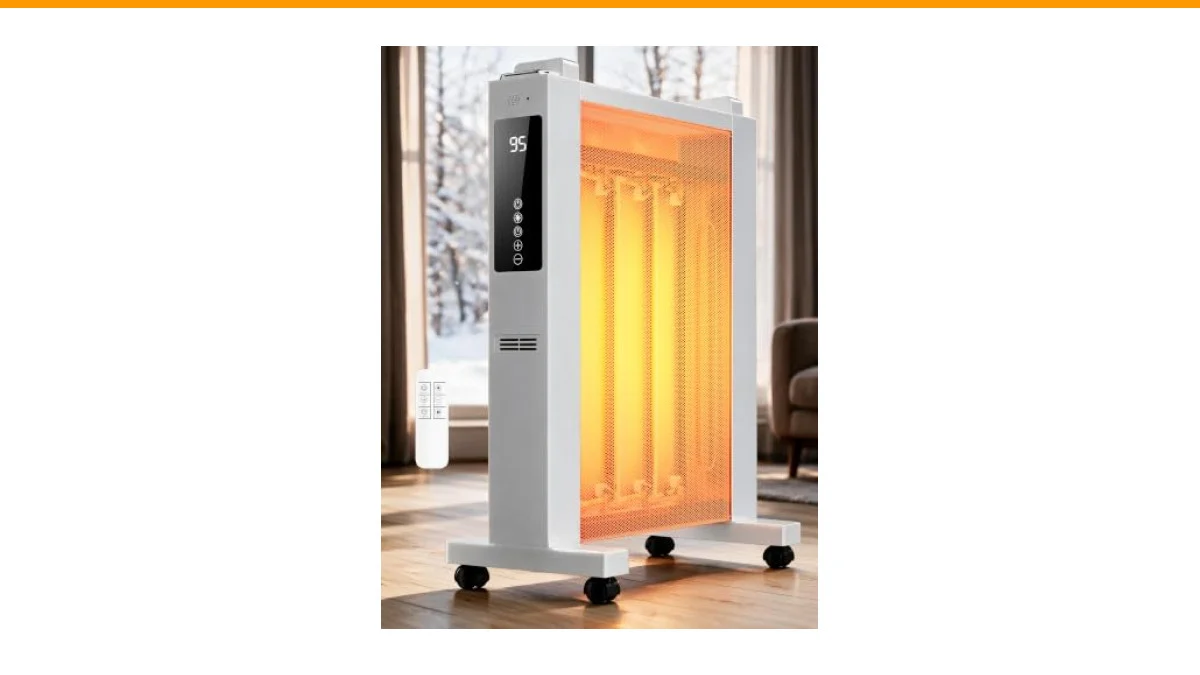
Envi Plug-in Electric Panel Wall Heater
The Envi is a different animal. It’s a 500W wall-mounted panel that runs on just 4.2 amps. That low draw means you can install several on the same circuit without tripping a breaker. It’s designed for 24/7 background heat, not rapid warm-up. Think of it as a replacement for baseboard heat in a specific zone, not a space heater you wheel out when you’re cold.
The fan-less design is completely silent. No moving parts, no dust blowing, no dry air. It maintains humidity better than forced-air heaters, which helps if you get nosebleeds or dry eyes in winter. The wall-sense safety sensor cuts power if the unit is removed from its mount. Installation takes about two minutes with no drilling or contractor needed.
Here’s the catch: 500W produces only about 1,700 BTU. That’s not enough to heat a large room on its own. It’s a zone heater. You’d install one in a bathroom, one in a bedroom, and one in a home office, each running continuously to take the edge off. For whole-room heating in cold weather, it won’t keep up. But for maintaining a comfortable temperature in a well-insulated space, it’s efficient and dead quiet.
- 500W, 4.2 amp draw, 1,700 BTU
- Fan-less convection, completely silent
- Wall-sense safety sensor, 90°F surface temp
- 2-inch slim profile, 2-minute install
- Made in USA, 3-year warranty
Best for: Homeowners who want permanent, silent, low-wattage zone heating in a bathroom, bedroom, or office without rewiring.
Heater Type Showdown: Ceramic vs Infrared vs Oil-Filled
Ceramic heaters use a PTC element and a fan to push warm air. They heat up fast, cool down fast, and work well in rooms you occupy intermittently. The DREO models here are ceramic. They’re compact, quiet, and responsive.
Infrared heaters emit radiant heat that warms objects directly. They feel warmer faster in drafty spaces because they don’t rely on heating the air. The Dr Infrared DR-968 uses this principle. The downside: once you step out of the line of sight, you lose the warmth.
Oil-filled radiators heat up slowly and stay warm after you turn them off. They’re silent and great for bedrooms, but they’re heavy and take 20-30 minutes to reach full output. If you want that slow, steady heat, a radiator heater comparison is worth reading before you buy.
For large rooms, ceramic and infrared are the practical choices. Ceramic circulates air; infrared targets people. Neither will heat 600 sq ft alone.
Electrical Reality Check: Outlets, Amps, and Power Strips
A 1500W heater draws 12.5 amps at 120V. A standard US wall outlet is on a 15-amp circuit. That leaves only 2.5 amps of headroom for everything else on that circuit: lights, TV, phone charger, laptop. Add a second high-draw device and the breaker trips.
Never plug a space heater into a power strip. Power strips are typically rated for 15 amps total, but the wiring inside is thin. A sustained 12.5-amp load can melt the strip or start a fire. The same goes for extension cords. DREO explicitly warns against them. Plug directly into a wall outlet.
If you have a 20-amp circuit (common in kitchens and garages), you have more headroom. But you still shouldn’t run two 1500W heaters on the same circuit. That’s 25 amps, which exceeds even a 20-amp breaker. For two heaters, use two separate circuits.
Check your breaker panel before buying. If the room you’re heating shares a circuit with a kitchen or bathroom, you’ll trip it constantly. A dedicated circuit for a heater is ideal but costs money to install.
Running Costs: What You’ll Actually Pay Per Hour
At the US average of $0.15 per kWh, here’s what each wattage setting costs per hour:
- 500W (Envi panel): $0.075 per hour, about $1.80 per day if run 24/7
- 750W (low setting): $0.11 per hour
- 1000W (ECO mode): $0.15 per hour
- 1500W (full power): $0.225 per hour
Run a 1500W heater eight hours a night and you’re looking at $1.80 per day, or about $54 per month. That’s real money. ECO mode cuts that significantly because the heater cycles on and off instead of running full blast. The DREO’s 1000W ECO setting drops the cost to roughly $36 per month for the same eight hours.
The Envi panel at 500W costs about $0.60 per day if run continuously. Over a month, that’s $18. It’s the cheapest to run, but it also produces the least heat. You’re trading output for efficiency.
For a more detailed breakdown of energy-efficient options, this energy-efficient heater guide covers the math in more depth.
Safety and Noise: What Matters in Big Rooms
Every heater here has tip-over and overheat protection. That’s table stakes. The differences are in the details. The DREO 25-inch model adds a child lock. The Envi has a wall-sense sensor that cuts power if it’s removed from its mount. The Dr Infrared has a lifetime filter that needs occasional cleaning.
Noise levels range from 25 dB (DREO tower) to 39 dB (Dr Infrared). For reference, 25 dB is a whisper, 34 dB is a quiet library, and 39 dB is a quiet conversation. If you’re sleeping or working in the same room, stick with the DREO units. The Dr Infrared is better for garages and workshops where noise doesn’t matter.
One safety note: never leave a space heater unattended for long periods unless it’s designed for 24/7 use. The Envi panel is rated for continuous operation. The others are not. If you want a heater that runs while you’re at work, the Envi is the safer choice.
Placement Tips for Open-Plan and High-Ceiling Spaces
Heat rises. In a room with 12-foot ceilings, a floor-level heater wastes most of its output warming the air above your head. Place heaters on the floor near where you sit, not in the center of the room. Oscillation helps, but it can’t defeat physics.
For open-plan spaces, use two heaters on opposite sides of the room on separate circuits. Aim them toward the seating area, not the walls. Ceiling fans on low speed push warm air back down, which can raise the felt temperature by 2-3°F without using more power.
Keep heaters at least three feet from furniture, curtains, and bedding. Don’t put them behind a couch or under a desk. Airflow matters. A blocked intake overheats the unit and shortens its life.
If your room has large windows or poor insulation, a plug-in heater will struggle. Consider a wall heater for large rooms instead. It mounts higher and can handle bigger spaces with less floor clutter.
How We Chose These Products
We started with the physics. A plug-in heater can’t exceed 1500W on a standard circuit, so we only considered units that make the most of that limit. We looked at heating type, noise level, thermostat precision, safety features, and real-world coverage claims. We cross-referenced manufacturer specs with the amp draw and BTU math to see which coverage claims hold up.
We also factored in who each heater serves. A garage owner has different needs than a light sleeper. A renter can’t install a 240V circuit. A homeowner with a cold bathroom wants silent, continuous heat. The four picks here cover those scenarios without overlap. We avoided heaters with vague specs or missing safety certifications.
Buying Guide: What Really Matters
Ignore the square footage claim on the box. It’s based on ideal conditions. Instead, calculate your room’s actual heating load. Multiply square footage by 10 watts for a cold climate, or 7 watts for a mild one. If the result is over 1500W, one plug-in heater won’t cut it.
Check your circuit. Find the breaker that controls the outlet you plan to use. If it’s 15 amps, you have room for one 1500W heater and nothing else. If it’s 20 amps, you have a bit more flexibility. Never use a power strip or extension cord.
Decide between spot heat and whole-room heat. Infrared and low-wattage panels warm people and objects. Ceramic heaters warm air. For a large room you occupy intermittently, spot heat is more efficient. For a room you want at a consistent temperature, ceramic with a thermostat works better.
Noise matters more than you think. A 39 dB heater in a bedroom is annoying. A 25 dB heater is unnoticeable. If you’re sensitive to sound, pay attention to the decibel rating, not just the word ‘quiet.’
Our Top Recommendation
The DREO 25 Inch Electric Space Heater is the best overall pick for most large rooms. It’s the quietest at 25 dB, has the most precise thermostat at 1°F increments, and its 70° oscillation spreads heat wider than the compact models. The child lock and 45° tip-over protection add peace of mind. It costs more than the compact DREO, but the quieter operation and better temperature control justify the difference for a bedroom or living room.
If budget is tight, the compact DREO Space Heater is the runner-up. It’s cheaper, still quiet at 34 dB, and has the same ECO mode. You give up some airflow speed and the child lock, but for a bedroom or office, it’s hard to beat.
For garages and basements, the Dr Infrared DR-968 is the better choice. Its dual heating system produces more felt heat in drafty spaces, and the caster wheels make it easy to move. Just accept the 39 dB noise and 12.5-amp draw.
If you want silent, continuous, low-wattage heat for a specific zone, the Envi panel is the only pick here designed for 24/7 operation. It won’t heat a large room alone, but it’s perfect for a bathroom or home office where you want background warmth without noise or high bills.
Frequently Asked Questions
Can I run two 1500W heaters on the same circuit?
No. Two 1500W heaters draw 25 amps combined, which exceeds a 15-amp or even 20-amp breaker. You’ll trip the breaker every time. Use two separate circuits, or step up to a 240V heater if you need more output.
Will a plug-in heater heat a 500 sq ft room?
One 1500W heater will take the chill off a 500 sq ft room but won’t bring it to a comfortable temperature in cold weather. You’d need two heaters on separate circuits, or a 240V unit, to properly heat that much space. A single plug-in works best as a supplement.
Why does my heater trip the breaker when I plug in anything else?
A 1500W heater uses 12.5 of the 15 amps available on a standard circuit. That leaves only 2.5 amps for everything else. A TV, laptop, or even a bright lamp can push it over. Plug the heater into an outlet with nothing else running on that circuit.
Is infrared better than ceramic for a large room?
It depends on the room. Infrared warms people and objects directly, so it feels warmer faster in drafty spaces like garages. Ceramic heats the air, which works better in sealed, well-insulated rooms. For a large room you occupy intermittently, infrared is often more efficient. For a room you want at a steady temperature, ceramic with a thermostat is the better fit.