You step into the shower, turn the handle, and wait. The water goes cold for three seconds, then scalding hot, then lukewarm. You adjust the knob again. It never settles. If you have ever dealt with a tankless water heater that can’t hold a steady temperature, you know how frustrating that dance is.
This article walks through what actually controls temperature stability in a propane tankless unit. You will learn the specific specs that matter, how installation choices affect performance, and the common mistakes that turn a good heater into a frustrating one. By the end, you will know exactly what to look for and what to avoid.

VELPAX
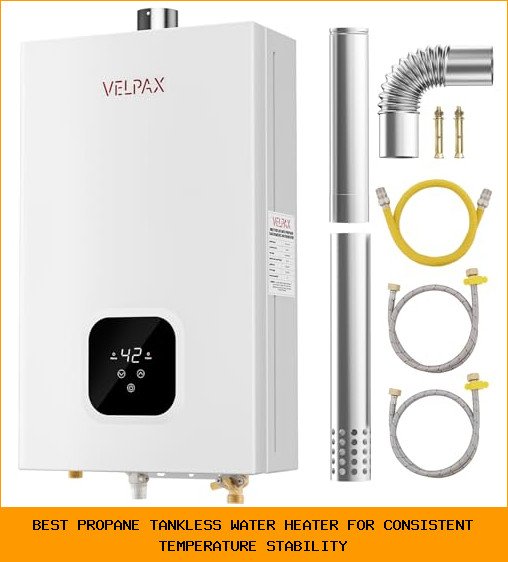
Propane Tankless Water Heater, 4.21GPM 16L Indoor, Constant propane water heater,Instant Hot Propane Gas Water Heater with Multi-Protection
- 【Tankless Water Heater】– This propane tankless water heater features steady temperature control and multiple safety protections, i…
- 【Efficient & Energy-Saving】– With a high-performance output of 68,000 BTU per hour, this 4.21 GPM instant propane water heater pro…
- 【Premium Quality & Durability】– Crafted with a stainless steel body for superior temperature and corrosion resistance, this propan…
One unit that handles this well is the VELPAX Propane Tankless Water Heater. It uses a gas modulation system and a digital temperature control board to keep output within a narrow range, which is the core of the problem we are talking about. We will reference it as a practical example throughout.
What Actually Causes Temperature Fluctuation in Tankless Heaters
Temperature instability does not happen randomly. It comes from three specific sources: gas valve response time, water flow changes, and undersized burners.
The gas valve is the heart of the problem. When you open a hot water tap, the heater needs to ignite the burner and ramp up to full fire within seconds. Cheap units use a simple on/off gas valve. That means the burner goes from zero to full output instantly, which overshoots the target temperature. Then it shuts off, the water cools, and the cycle repeats. You feel this as hot-cold-hot-cold waves.
Better units use a modulating gas valve. This adjusts the flame height continuously based on the difference between the incoming water temperature and your set point. The VELPAX model mentioned above does this with its constant temperature control system. It reads the water temperature dozens of times per second and adjusts the gas flow accordingly.
Water flow is the second culprit. In a tankless unit, the heater adds a fixed amount of heat to whatever water passes through. If someone flushes a toilet or opens a second tap, the flow rate changes. The burner has to adjust instantly. A unit with a narrow modulation range cannot keep up, so you get a cold blast until the system catches up.
Burner size matters too. A 68,000 BTU burner is the sweet spot for a single bathroom or a small home. It is large enough to handle a 65°C temperature rise at low flow, but small enough that it can modulate down without constantly cycling on and off. Huge 200,000 BTU units are overkill for most homes and actually cause more temperature swings because they cannot throttle down low enough.
How to Match the Heater to Your Home’s Real Flow Rate
Most people buy based on the maximum GPM rating, which is a mistake. The number that matters is the temperature rise you need, not the raw flow rate.
Temperature rise is the difference between your incoming ground water temperature and your desired hot water temperature. In the northern US, ground water sits around 50°F in winter. If you want 120°F water, you need a 70°F rise. In the south, ground water is closer to 70°F, so you only need a 50°F rise.
A unit rated at 4.21 GPM only achieves that at a low temperature rise. Check the spec sheet: the VELPAX unit delivers 4.21 GPM at a 65°C (149°F) maximum rise. That means at a 70°F rise in winter, you will get roughly 3.5 GPM. That is enough for one shower (about 2.5 GPM) plus a sink running at the same time.
Here is a simple way to calculate your needs:
- Measure the flow rate of your showerhead with a bucket and a stopwatch. Most are 2.0–2.5 GPM.
- Add the flow of the second fixture you will run simultaneously. A bathroom sink is about 1.0 GPM.
- Total your simultaneous flow. For a typical bathroom, this is 3.0–3.5 GPM.
- Check the heater’s GPM rating at your specific temperature rise, not at the maximum rise.
If your simultaneous flow exceeds what the heater can deliver at your temperature rise, the unit will struggle. The water temperature will drop steadily, not fluctuate. That is a capacity problem, not a stability problem. Do not confuse the two.
Installation Choices That Make or Break Temperature Stability
You can buy the best heater on the market and still get wild temperature swings if the installation is wrong. Three things matter more than anything else.
First, the gas line size. Tankless heaters need a lot of gas quickly. A 68,000 BTU unit requires a 1/2-inch or 3/4-inch gas line depending on the run length. If the line is too small, the pressure drops when the burner fires. The flame shrinks, the water cools, and then the pressure recovers and the flame grows again. That produces a slow, rhythmic temperature oscillation that drives people crazy.
Second, the water inlet filter. Most units, including the VELPAX, come with an inlet water screen. If that screen clogs with sediment, the flow rate drops. The heater sees less flow and reduces the flame. Then the screen partially clears, flow increases, and the flame jumps up. You get random temperature spikes. Clean the filter monthly if you have hard water.
Third, the venting setup. This unit uses a 2.5-inch horizontal vent pipe. If the vent is too long or has too many elbows, the exhaust backs up slightly. This causes the flame to burn inefficiently and can trigger the overheating protection, which shuts the burner off entirely. That is not a temperature fluctuation; that is a complete cold water event. Keep the vent run as short and straight as possible.
Comparing Temperature Stability Across Different Propane Tankless Types
Not all propane tankless heaters are built the same. The table below breaks down the three main types you will find on the market and how each handles temperature stability.
| Heater Type | Typical BTU Range | Temperature Stability | Best Use Case | Trade-offs |
|---|---|---|---|---|
| Basic On/Off Burner | 40,000–60,000 | Poor – cycles hot and cold in waves | Single sink or outdoor shower | Cheapest option, but you will feel every wave |
| Modulating Gas Valve (like VELPAX) | 60,000–80,000 | Good – holds within a few degrees | Single bathroom or small home | Requires proper gas line sizing to work well |
| Condensing High-Efficiency | 150,000–200,000 | Excellent – uses a secondary heat exchanger | Whole house with multiple bathrooms | Expensive, complex, and overkill for most homes |
Notice the middle row. That is where most people should land. A 68,000 BTU modulating unit handles a bathroom and kitchen simultaneously without the complexity or cost of a condensing system.
Real-World Settings: What Temperature Should You Actually Use?
Setting the temperature too high creates stability problems that do not need to exist. The VELPAX unit allows adjustment between 35°C (95°F) and 65°C (149°F). Most people set it at 120°F (about 49°C) and call it done.
Here is the catch. If you set it to 149°F, the heater has to burn at near maximum output even for a small sink flow. That leaves no headroom for a second fixture. The moment you open another tap, the temperature drops because the burner is already maxed out. Keep the set point at 120°F or 125°F. That gives the burner room to modulate up and down.
You also need to consider the minimum flow rate. Most tankless heaters require a minimum of 0.5 to 0.8 GPM to trigger the burner. If your sink faucet flows less than that, the heater will not fire at all. The VELPAX works with just 3.6 PSI of water pressure, which is lower than many competitors. That helps in homes with weak well pumps, but you still need enough flow to activate the unit.
Five Questions People Actually Ask About Temperature Stability
Why does my tankless water heater take a few seconds to produce hot water?
That is normal. The heater has to detect the flow, ignite the burner, and heat the heat exchanger. Expect a 2 to 4 second delay with a modern unit. If the delay is longer than 5 seconds, check the gas line pressure or the igniter. The VELPAX unit fires quickly, but no tankless heater delivers instant hot water at the tap.
Can I run two showers at the same time with a 4.21 GPM unit?
Only if your showerheads are low-flow (1.5 GPM each) and your ground water is warm. Two standard 2.5 GPM showerheads need 5 GPM, which exceeds the unit’s capacity. You will get a steady drop in temperature, not a fluctuation. If you need two full showers, you need a larger unit.
How often should I clean the water inlet filter?
Monthly if you have hard water, quarterly if you have city water with a softener. A clogged filter is the number one cause of intermittent temperature spikes. It takes two minutes to remove, rinse, and reinstall. Set a reminder on your phone.
Does outdoor temperature affect propane tankless performance?
Yes, but not the way you think. The unit itself does not care about ambient temperature. But the propane tank pressure drops in cold weather. At 32°F, a 100-pound tank delivers less gas pressure than at 70°F. If your tank is low, the heater will struggle to maintain temperature. Keep the tank above 30% full in winter.
Is a recirculation pump worth it for a tankless heater?
For temperature stability, no. A recirculation pump keeps hot water ready at the tap, which reduces wait time. It does not affect the burner’s ability to hold a steady temperature. If your issue is cold water waiting, get a recirculation pump. If your issue is temperature swings during a shower, fix the gas line or the set point first.
Three Common Mistakes That Ruin Temperature Stability
I have seen people replace a perfectly good heater because of a problem that was actually an installation issue. Here are the three mistakes that come up constantly.
Mistake 1: Undersizing the gas line. You follow the heater’s minimum gas line spec, but the run is 30 feet with four elbows. The effective pipe length is much longer, and the pressure drops. Use a larger diameter pipe or shorten the run. Check the gas pressure at the heater’s inlet with a manometer, not just at the tank.
Mistake 2: Setting the temperature at the maximum. Cranking it to 149°F gives you no modulation headroom. The burner runs flat out all the time. Set it to 120°F and let the heater modulate. You will save gas and get steadier water.
Mistake 3: Ignoring the cold water inlet temperature. If your ground water is 40°F in January, a 68,000 BTU unit cannot deliver 4 GPM at 120°F. It simply does not have the thermal capacity. Measure your ground water temperature in winter, then recalculate your expected GPM. You might need to reduce shower flow or stagger usage.
What to Do Now
- Measure your showerhead flow rate with a bucket. Do not guess.
- Calculate your temperature rise (desired temp minus your winter ground water temp).
- Match the heater’s GPM rating at that rise, not the maximum GPM.
- Set the digital thermostat to 120°F, not the maximum.
- Clean the inlet water filter monthly.
- Check the gas line pressure at the unit with a manometer.
- Keep your propane tank above 30% full in winter.
Temperature stability is not a mystery. It is a combination of the right burner modulation, correct gas supply, and a sensible set point. Get those three things right, and you will have a steady, comfortable shower all year long.


