You know that moment. The shower goes from warm to freezing cold, and you’re standing there with soap in your hair, doing the math on how long you can tolerate it. Or maybe you just opened your utility bill and wondered if your water heater is secretly running a mining operation in the basement. These are the moments that force a decision: what type of water heater should you buy next?
This guide walks through the four main options—storage tank, tankless, heat pump, and solar—with honest numbers on upfront cost, operating cost, lifespan, and real-world trade-offs. You’ll also learn how to size one correctly, because the biggest mistake people make isn’t picking the wrong fuel type; it’s picking the wrong size. By the end, you’ll know exactly which questions to ask a plumber and which features are worth paying for.
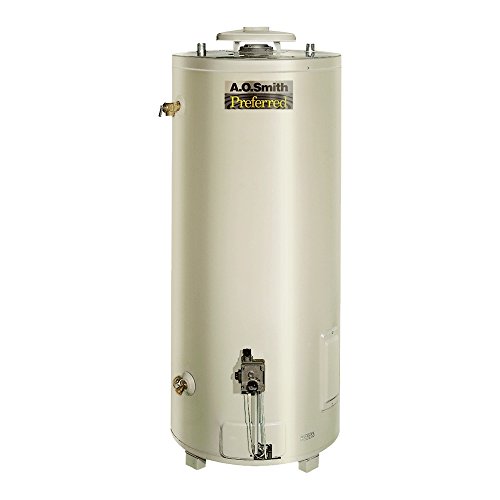
A. O. Smith
AO Smith BT-100 Tank Type Water Heater with Commercial Natural Gas
- Standing Pilot
- CSA Certified and ASME Rated TandP Relief Valve
- Complies with SCAQMD Rule 1146.2, Southern California and texas Approved.
If you need a dependable workhorse right now, the AO Smith BT-100 Tank Type Water Heater is a commercial-grade natural gas unit with a standing pilot and a handhole cleanout for easy maintenance. It’s built for heavy use, so it handles a busy household without breaking a sweat. We’ll get to why commercial units make sense for some homes later.

Storage Tank Water Heaters: The Default Choice
Most homes in America use a storage tank heater. It’s a simple concept: a big insulated cylinder holds 30 to 80 gallons of water, keeps it hot with a burner or heating elements, and refills as you use it. Natural gas models heat faster and cost less to run than electric ones in most regions.
The numbers matter here. A standard 50-gallon gas tank heater costs roughly $600 to $1,200 for the unit itself. Installation runs another $500 to $1,500 depending on your local codes and whether you need venting work. The tank lasts 10 to 13 years with basic maintenance—flushing it once a year to clear sediment, checking the anode rod every few years.
Operating cost is where gas shines. A gas tank heater in a typical household runs about $300 to $400 per year. An electric tank heater in the same house might cost $500 to $700 per year, because electricity is more expensive per unit of heat than natural gas. If you live somewhere with high electric rates like California or Hawaii, that gap widens.
The downside is standby loss. The tank constantly reheats water that cools down, even when nobody uses hot water. Modern tanks have better insulation than older ones, but you’re still paying to keep 50 gallons hot 24/7. That’s the price of convenience.
For most families, a gas tank heater remains the best type of water heater because it’s cheap to buy, cheap to run, and easy to repair. The parts are standard, plumbers know them inside out, and you can usually get a replacement same-day if something fails.
Tankless Water Heaters: Endless Hot Water, Higher Price
Tankless units heat water on demand with a powerful burner or electric coil. No storage tank, no standby loss. You turn on the tap, cold water flows through a heat exchanger, and you get hot water within a second or two. They mount on a wall and take up a fraction of the space.
The appeal is obvious: endless hot water. You can run the dishwasher, the washing machine, and two showers at once without running out. That’s a real advantage for larger households or anyone who’s been burned by a small tank in the past.
But here’s the catch: flow rate. A tankless unit is rated by how many gallons per minute (GPM) it can raise by a certain temperature rise. A typical 9.8 GPM unit can handle two showers in the Northeast during winter, but only one shower in the Midwest where incoming ground water is much colder. You need to calculate your peak simultaneous demand and match it to the unit’s output at your specific incoming water temperature.
Upfront cost is the big hurdle. A good tankless unit runs $1,200 to $2,500. Installation is more involved because you need larger gas lines, a new vent, and sometimes an electrical outlet for the control board. Total installed cost often lands between $2,500 and $4,500. That’s two to three times what a tank heater costs.
Operating costs are lower, though. You save roughly 20% to 30% on water heating energy compared to a tank because you’re not reheating stored water. For a family that uses 50 gallons of hot water a day, that’s maybe $80 to $120 per year in savings. Do the math and the payback period stretches to 10 to 15 years. That’s longer than many tankless units last—most are rated for 15 to 20 years, but they need annual descaling to hit that number.
One more thing: power outages. Most tankless units need electricity to run the control board and ignition. A gas tank heater with a standing pilot works without power. If you live in an area with frequent outages, that’s a dealbreaker.
Heat Pump Water Heaters: The Efficiency Champion
Heat pump water heaters (HPWHs) are the quiet overachievers of the group. They use electricity to move heat from the surrounding air into the water, rather than generating heat directly. Think of it like a refrigerator running in reverse—it pulls warmth from the room and dumps it into the tank.
The efficiency numbers are impressive. A heat pump unit has an energy factor (EF) around 3.0 to 4.0, meaning it produces three to four times more heat energy than the electricity it consumes. Compare that to a standard electric tank heater with an EF around 0.9. In plain terms, a heat pump uses roughly one-third the electricity of a conventional electric tank.
Annual operating cost for a heat pump in a typical household runs about $200 to $300, depending on your electric rate. That’s a solid chunk of savings compared to a standard electric tank at $500 to $700 per year.
But there’s a catch: it needs space and warm air. The unit pulls heat from the surrounding air, so it needs to be installed in a space with at least 1,000 cubic feet of air volume—a basement, garage, or utility room works. If you put it in a small closet, it will cool the room down and work harder. In cold climates, the room temperature drops, which reduces efficiency. Some units have a backup electric resistance element for those conditions, but that defeats the purpose.
First cost is moderate. A heat pump unit runs $1,500 to $2,500 for the equipment. Installation is similar to a standard electric tank, so total cost lands around $2,000 to $3,500. Federal tax credits and many utility rebates can knock $500 to $1,500 off that price. Check your local utility’s website—many offer significant rebates because HPWHs help them manage grid demand.
The noise is something people don’t expect. The compressor and fan make a low hum, around 45 to 55 decibels—about as loud as a refrigerator. It’s not annoying, but it’s noticeable in a quiet basement.
For households with electric water heating and a suitable space, the heat pump is arguably the best type of water heater on operating cost alone. The payback period is usually 5 to 8 years after rebates, and the unit lasts 10 to 15 years. Just don’t put one in an unconditioned garage in Minnesota.
Solar Water Heaters: The Long Game
Solar water heaters use roof-mounted collectors to capture the sun’s energy and transfer it to a storage tank. They’re not common, but they make sense in specific situations: sunny climates, homes with south-facing roofs, and owners who plan to stay put for 15 years.
There are two main types. Active systems use pumps to circulate fluid between the collectors and the tank. Passive systems rely on gravity and natural convection—no pumps, no electricity, fewer moving parts. Passive systems are simpler and cheaper to maintain, but they need the tank positioned above the collectors, which isn’t always practical.
The cost is steep. A complete solar water heating system runs $5,000 to $8,000 installed, sometimes more. That’s the highest upfront cost of any option here. The payoff comes from near-zero operating costs. In a sunny region, solar can cover 70% to 80% of your annual water heating needs. The backup element (usually electric or gas) covers the rest on cloudy days and winter months.
Payback is slow. If you’re saving $400 to $600 per year versus a conventional heater, it takes 10 to 15 years to break even. That’s why solar water heaters make sense for people who plan to stay in their home long-term and who live in states with good solar incentives. Some states offer tax credits that cover 20% to 30% of the installed cost, which shortens the payback considerably.
Maintenance is more involved. The collectors need periodic cleaning, the antifreeze fluid in active systems needs checking, and the pumps can fail. It’s not set-and-forget like a tank heater. Also, you still need a backup water heater for cloudy stretches, so you’re maintaining two systems.
Given the high upfront cost and long payback, solar is rarely the best type of water heater for the average homeowner. It’s a niche choice for the eco-conscious with deep pockets and a long horizon.
Comparison Table: Four Water Heater Types at a Glance
| Feature | Storage Tank (Gas) | Storage Tank (Electric) | Tankless (Gas) | Heat Pump |
|---|---|---|---|---|
| Upfront Cost (Installed) | $1,200 – $2,500 | $800 – $1,800 | $2,500 – $4,500 | $2,000 – $3,500 (before rebates) |
| Annual Operating Cost | $300 – $400 | $500 – $700 | $200 – $300 | $200 – $300 |
| Lifespan | 10 – 13 years | 10 – 13 years | 15 – 20 years | 10 – 15 years |
| Space Required | Large footprint | Large footprint | Wall-mounted, compact | Large + 1,000 cu ft air volume |
| Recovery Rate | Fast (gas) | Slow | Fast, but limited by GPM | Slow |
| Power Outage Operation | Yes (standing pilot) | No | No (needs electricity) | No |
| Maintenance | Annual flush | Annual flush | Annual descale | Annual filter clean + flush |
| Best For | Most households | Homes without gas | Small spaces, high demand | Electric homes with basement/garage |
The table shows the basics, but the real decision comes down to your fuel source, your climate, and your budget. A gas tank heater is the safe default. A heat pump is the efficiency winner for electric homes. Tankless is a premium option that pays off only if you use a lot of hot water simultaneously. Solar is a long-term investment for sunny, stable households.
Sizing Your Water Heater: The Step Most People Skip
You can buy the best type of water heater on the market and still be miserable if it’s the wrong size. Sizing isn’t about tank volume alone—it’s about peak demand and recovery rate.
For tank heaters, use the first-hour rating (FHR). This number tells you how many gallons of hot water the unit can deliver in the first hour of heavy use, accounting for the tank capacity plus the recovery rate. To find your household’s peak demand, add up the hot water usage during your busiest hour. A typical morning might include a shower (10 gallons), a shave (2 gallons), a dishwasher load (6 gallons), and a washing machine load (7 gallons). That’s 25 gallons. A 40-gallon tank with a 30-gallon FHR would struggle. A 50-gallon tank with a 45-gallon FHR handles it fine.
For tankless units, you’re calculating flow rate, not volume. Add up the GPM of every fixture you might run simultaneously. A shower uses 2.5 GPM, a kitchen faucet 1.5 GPM, a washing machine 2 GPM. Running two showers and a faucet means 6.5 GPM. Then check the unit’s output at your incoming water temperature. In the Southeast, ground water is around 60°F, and a 9.8 GPM unit can handle that easily. In the Northeast, ground water might be 45°F in winter. The same unit might only deliver 6 GPM at that temperature rise. Always size for your coldest month, not the annual average.
One more rule: bigger isn’t always better. An oversized tank wastes energy because you’re heating more standby water than you need. An oversized tankless unit costs more and still delivers the same flow. Match the size to your actual usage, not your fear of running out.
If you have a large family or a home with high simultaneous demand, a commercial-grade unit like the AO Smith BT-100 with a 100-gallon tank and a fast recovery rate makes sense. It’s built for continuous heavy use, so it won’t struggle during a holiday gathering or a week of houseguests. The handhole cleanout makes annual maintenance much easier than standard units, which saves you money over time.
Frequently Asked Questions
How long does a water heater actually last?
A standard tank heater lasts 10 to 13 years with regular maintenance. Tankless units last 15 to 20 years if you descale them annually. Heat pump units are in the 10 to 15 year range. The biggest factor is water quality—hard water shortens lifespan because sediment builds up and corrodes the tank. Flushing the tank once a year and replacing the anode rod every 3 to 5 years can add several years to any tank heater.
Should I replace my water heater before it fails?
Yes, if it’s past 10 years old and showing signs—rumbling noises, rusty water, or inconsistent temperatures. A proactive replacement costs the same as an emergency one, but you get to choose the installer and the model. When a tank fails, it usually floods the floor, and you’re stuck paying overtime rates for an emergency call. Plan ahead and you’ll have time to compare options and maybe catch a rebate.
Is a tankless water heater worth the extra cost?
Only if you need endless hot water or you’re short on space. The energy savings are real but modest—about 20% to 30% less than a tank heater. For a typical family, that’s $80 to $120 per year. The upfront premium is $1,500 to $2,500 more than a tank. That’s a 15-year payback, which is longer than most people stay in a home. If you have a hot tub, multiple bathrooms used simultaneously, or a teenager who takes 40-minute showers, the convenience alone might justify it.
What’s the cheapest water heater to run?
A heat pump water heater is the clear winner on operating cost, using roughly one-third the electricity of a standard electric tank. Natural gas tank heaters are next, costing about $300 to $400 per year. Tankless gas units are slightly cheaper than tank gas units because they don’t have standby losses. Solar is the cheapest to run once installed, but the equipment cost is so high that the total cost of ownership rarely beats a heat pump.
Can I install a water heater myself?
If you’re handy, replacing an electric tank with another electric tank is sometimes doable—it’s essentially a big appliance with two wires and a drain line. Gas units are a different story. They need proper venting, gas line sizing, and combustion air supply. A mistake here can cause carbon monoxide poisoning or an explosion. Most municipalities require permits and inspections for gas water heater installations. Pay a licensed plumber for anything involving gas. It’s not worth the risk.
What to Do Next: A Practical Checklist
- Check your fuel source first. Natural gas is usually cheaper than electricity, so a gas tank heater is the default pick if you have a gas line nearby.
- Measure your peak demand. Count how many showers and appliances run at once, then match that to the FHR (for tanks) or GPM (for tankless).
- Look at your space. A heat pump needs 1,000 cubic feet of air volume—a basement or garage works, a closet doesn’t.
- Calculate the payback period for any upgrade. Divide the extra upfront cost by the annual energy savings. If it’s over 8 years, it’s probably not worth it.
- Check rebates. Utility companies and state programs often offer $500 to $1,500 for heat pump units. That changes the math significantly.
- Budget for installation. The unit cost is only half the story. Get three quotes and ask about venting, gas line upgrades, and permit fees.
- If you have a large household or want commercial durability, consider a unit like the AO Smith BT-100. It costs more upfront but handles heavy use without strain and lasts longer with the handhole cleanout.
There’s no single perfect answer for every home. The best type of water heater for you depends on your fuel source, your climate, and how much hot water your household actually uses. Start with the fuel you have, size it correctly, and you’ll be happy with whatever you pick.


