You turn on the faucet in your RV sink or under-counter kitchen tap. Cold water spits out. You wait. And wait. It never gets hot. That tiny electric unit you bought from an online marketplace promised instant hot water, but you’re still rinsing dishes in lukewarm water. Sound familiar?
That scenario happens because most people don’t understand the real limits of 110-volt electric water heating. A standard household outlet can only deliver about 1,500 to 1,800 watts consistently. That’s enough to warm a cup of coffee, not shower you. The 110-volt electric heaters that actually work require a dedicated circuit, thicker wire, and a breaker rated for 30 amps or more. This article walks through what those units can and cannot do, how they compare to heat pump water heaters, and exactly what to look for before you buy.

xwdzswgs
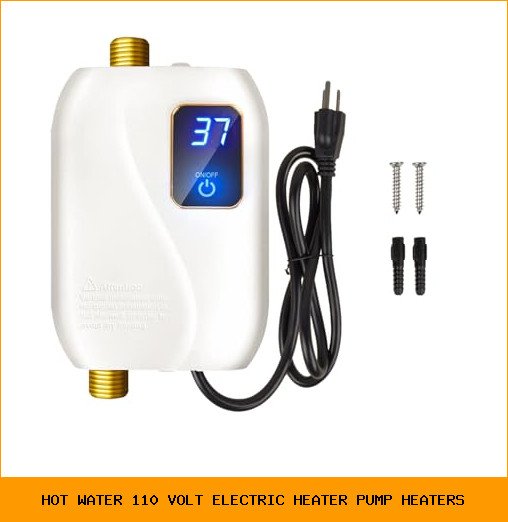
Tankless Water Heater Electric 110V, 3000W Instant Water Heater Under Sink, On Demand Hot Water Heater Electric with Digital Display, Electric Mini Water Heater for Kitchen Bathroom Washin
- ✔ MINI INSTANT HOT WATER HEATER - This 110 volt water heater is equipped with state-of-the-art technology, with 3000W power, LED d…
- ✔ SAFETY INTELLIGENCE RELIABLE - This under sink water heater has multiple protection functions. IPX4 waterproof, leakage protecti…
- ✔ LIGHTWEIGHT PORTABLE DESIGN - This small water heater compact design, is suitable for installation in the bathroom, kitchen unde…
By the end you’ll know whether a 110-volt tankless heater fits your setup, or if you’re better off with a heat pump or a small storage tank.
A good example of a capable 110-volt unit is the xwdzswgs Tankless Water Heater Electric 110V, 3000W Instant Water Heater Under Sink. It’s built for point-of-use applications and requires a dedicated 32-amp breaker with 2.5mm² wire. It raises water temperature by 82°F at 0.3 gallons per minute, which is enough for hand washing and light kitchen tasks.
Myth #1: A 110-Volt Heater Can Supply a Full Shower
This is the biggest mistake people make. The physics are simple. Water has a specific heat capacity. Raising 1 gallon of water by 1°F takes about 8.3 BTUs. A 3,000-watt heater running on 110 volts can deliver roughly 10,200 BTUs per hour. Compare that to a typical tank water heater that puts out 30,000 to 50,000 BTUs. There’s a gap.
A 110-volt tankless unit like the one above can give you a temperature rise of 82°F if you keep the flow down to 0.3 GPM. At 0.5 GPM it maxes out at a 55°F rise. A standard shower head flows 2.0 GPM or more. Even a low-flow shower head runs 1.5 GPM. You would need a 120°F rise to get a comfortable 105°F shower from 45°F incoming water. That unit can’t do it. You’d get cold water.
So these heaters work best for sinks, not showers. The smaller the flow, the hotter the water gets. That’s a fundamental trade-off. If you need a shower, look at 240-volt tankless units or a small 110-volt storage tank that preheats water slowly.
Myth #2: Higher Wattage Means More Hot Water
Wattage matters, but only up to the limit of your electrical system. A 110-volt circuit can handle about 1,800 watts continuous on a standard 15-amp breaker. That’s a hair dryer. To get 3,000 watts you need a 30-amp breaker and 10-gauge wire (or 2.5mm² as specified). Many units advertise 5,000 watts on 110 volts, but that would require over 45 amps — impossible on a standard 110-volt system without a very heavy dedicated circuit.
Instead of focusing only on wattage, look at the product’s rated temperature rise at a specific flow rate. The spec sheet matters more than the power number. A 1,500-watt unit that claims infinite hot water means nothing if the flow must be slowed to a trickle. Ask yourself: what temperature do I need at what flow?
The xwdzswgs unit handles 0.3 GPM for a 82°F rise. That’s about enough for hand washing with cold incoming water around 50°F. If your groundwater comes in at 40°F, the output will be 122°F — still usable. But if you want 130°F water for sanitizing dishes, you’ll need to turn the flow down even more. The unit’s digital display lets you set the target temperature in Fahrenheit or Celsius, but the actual output temperature depends entirely on how fast water moves through the heating chamber.
110-Volt Tankless vs. Heat Pump Water Heaters: Which One Fits?
The term “pump heaters” in the keyword likely refers to heat pump water heaters. These are completely different beasts. A heat pump uses electricity to move heat from the surrounding air into the water, rather than generating heat directly. They are extremely efficient — often 3 to 4 times more efficient than a resistance heater. But they have their own trade-offs.
Below is a comparison to help you decide.
| Feature | 110V Tankless (Point-of-Use) | 110V Heat Pump (Hybrid) | Standard 120V Storage Tank |
|---|---|---|---|
| Typical flow rate at 80°F rise | 0.3–0.5 GPM | N/A (uses storage, up to 3 GPM draw) | 2–3 GPM (draw from tank) |
| Best use case | Single sink, RV, small bar | Small home, apartment, cabin | Whole-house with low demand |
| Installation complexity | Moderate (dedicated circuit, wall-mount) | High (needs venting, condensate drain, space) | Low (standard outlet, floor stand) |
| Efficiency (COP) | 1.0 (all electricity becomes heat) | 3.0–4.0 (moves heat from air) | 1.0 |
| Continuous hot water? | Yes, but at very low flow | No, tank depletes after 10–20 min | No, tank depletes |
| Space required | Very small (wall-mounted under sink) | Large (water heater footprint + air space) | Medium (2 x 2 ft) |
| Cost range (unit only) | Check current price | Check current price | Check current price |
The tankless unit wins for size and simplicity in a single-location setup. The heat pump wins for whole-house energy savings but takes up real floor space and needs a minimum air temperature (usually 40–50°F). The storage tank is the easiest to install but wastes energy keeping water hot 24/7. If you need hot water at only one sink and you’re on a budget, the 110V tankless makes sense. If you have a small house with a family, the heat pump pays off over time.
Installation Realities: It’s Not Plug-and-Play
Many buyers assume a 110-volt water heater plugs into any wall outlet. That’s dangerous. The xwdzswgs unit, like most 3,000-watt heaters, must be hardwired to a dedicated circuit with a 32-amp breaker and wire that’s at least 2.5mm² (roughly 14 AWG). Plugging it into a 15-amp outlet will trip the breaker immediately or cause the wire to overheat.
The manual warns: install the heater vertically to avoid an E2 error code. That error indicates air trapped in the heating chamber, which can cause dry-firing and damage. If you mount it sideways or horizontal, air pockets prevent proper heating and the safety cutoff trips. Also, the inlet and outlet are 1/2-inch NPT connections — standard for US plumbing, but you need flexible supply lines or threaded adapters.
One more detail: the unit has IPX4 water resistance. That means it can handle splashes but not direct jets of water. Install it under a sink where it stays dry. The safety features include automatic shutoff when the unit overheats or when no water flows. That’s good — it prevents a fire if the faucet is left off while the heater is on.
If you’re not comfortable with basic electrical work, hire a licensed electrician. A $50 service call is cheaper than replacing a burnt-out heater or fixing a short circuit.
Frequently Asked Questions
Can this heater run off a standard wall outlet?
No. A standard 15-amp 110-volt outlet can only supply about 1,800 watts continuous. This unit draws 3,000 watts (27.3 amps). It needs a dedicated 30-amp or 32-amp circuit with heavy-gauge wire. Using a standard outlet voids the warranty and creates a fire hazard.
How much hot water can I actually get from a 110-volt tankless heater?
Enough for one sink at a time. At 0.3 GPM flow, you get a 82°F rise. If your incoming water is 50°F, output will be 132°F. Turn the faucet to a normal stream (1.0 GPM) and the temperature drops dramatically — maybe only 20–30°F rise. You’ll get lukewarm water. For washing hands or rinsing a few dishes at low flow, it works. For a shower, it does not.
Is a 110-volt tankless heater better than a heat pump water heater?
It depends on your needs. For a single sink in an RV, workshop, or rental property where you have no space for a tank, the tankless unit is better. It’s small, instant, and cheap. For a whole home or a family of four, a heat pump is far more efficient and delivers more flow. But a heat pump costs more upfront and requires a large installation area.
Can I use a 110-volt tankless heater for an entire house?
No. Even the most powerful 110-volt tankless heaters max out at about 4,000 watts. That’s roughly 13,600 BTUs. A typical whole-house load of 2–3 showers, dishwashers, and laundry would need 100,000+ BTUs. You’d need multiple units or a 240-volt system. Stick to point-of-use for one or two low-flow fixtures.
How do I maintain a 110-volt tankless electric water heater?
Minimal maintenance. If you have hard water, mineral scale can build up inside the heating chamber. The manufacturer recommends flushing the unit with a descaling solution (vinegar or citric acid) every 6–12 months. Turn off power and water, disconnect the inlet and outlet, and pump the solution through. Also clean the inlet filter screen occasionally. That’s about it. No anode rod, no tank to drain.
What You Should Actually Do Next
- Measure your incoming water temperature and desired output temperature. Subtract to find the temperature rise you need.
- Decide the maximum flow rate you’ll use (GPM). A typical bathroom faucet runs 1.0–1.5 GPM. Kitchen sink can be 1.5–2.0 GPM.
- Check your electrical panel. Do you have a spare 30-amp breaker slot? If not, plan for an upgrade.
- If you only need hot water at one sink and can tolerate a slow flow, a 110-volt tankless like the xwdzswgs unit works well. Read the manual for wire size and vertical mounting requirements.
- If you need a shower or multiple fixtures, skip 110-volt tankless. Go with a 240-volt tankless or a small heat pump water heater.
- For temporary use in an RV or camping, a propane instant water heater might be simpler than running a dedicated 110-volt circuit.
- Always size your circuit breaker and wire per the manufacturer’s specifications. Undersizing causes nuisance trips and fire risk.


