You turn on the kitchen faucet expecting lukewarm water, and for a few seconds, you get nothing but cold pipe water. Then it hits — a steady stream of hot water that never stops. No tank, no waiting for recovery. That’s the promise of a tankless water heater. But how does it actually deliver?
This article walks through the mechanics, the real-world trade-offs, and the one thing most people get wrong when they buy one. By the end, you’ll know exactly what happens inside that box on your wall the moment you open a hot water tap.

WINTEMP
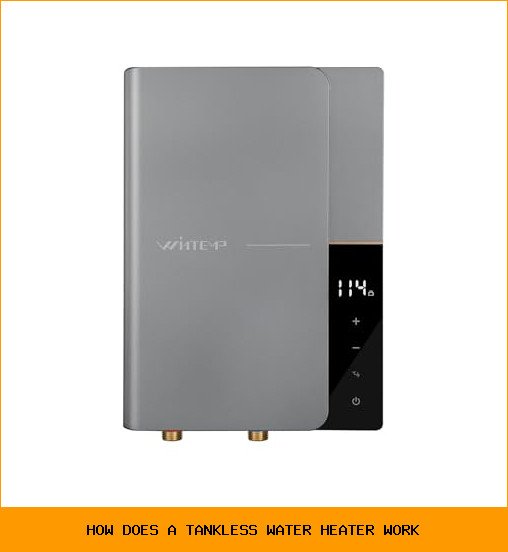
WINTEMP 8kW Tankless Electric Water Heater 240V, Single Fixture | Point of Use Water Heater for Kitchen Sink, Bathroom & Utility Room, LED Temp Display, Up to 1.9 GPM, ETL Listed
- ELECTRICAL REQUIREMENT - Check Electrical Before Purchase: 8KW 240V, max 33A. Requires 40A DP breaker & 10 AWG wiring. Compact wal…
- SINGLE FIXTURE HOT WATER SOLUTION - Designed for single point-of-use applications, the WINTEMP 8kW 240V tankless electric water he…
- COMPACT ON-DEMAND WATER HEATING - Enjoy hot water without the space requirements of a traditional storage tank. The compact tankle…
If you’re considering a small unit for a single sink or workspace, the WINTEMP 8kW Tankless Electric Water Heater is a solid example of a point-of-use electric heater. Compact, wall-mounted, and designed for one fixture — it shows how small-scale tankless tech works in practice.
The Basic Mechanism: What Happens When You Open the Tap
Inside every tankless water heater — electric or gas — the same chain reaction starts the moment water flows. A flow sensor detects movement, usually triggered by a minimum flow rate around 0.3 to 0.5 gallons per minute. Below that threshold, the unit stays off.
Once the sensor trips, it sends a signal to the control board. The board fires up the heating elements (electric) or opens the gas valve and ignites the burner (gas). Water enters a heat exchanger — a coiled metal tube with a lot of surface area — and heat transfers directly into the water as it passes through.
The whole process takes about one to three seconds. You don’t feel that delay because the cold water still sitting in the pipes has to flush out first. The heater itself is ready almost instantly.
A key point: the unit modulates. That means it adjusts its heat output based on flow rate and incoming water temperature. If you open the tap halfway, the heater uses less power. If you open it full, it fires at maximum. This modulation prevents overheating when flow is low and scalding when flow is high.
Electric vs. Gas Tankless: How They Differ Under the Hood
The core idea is the same, but the hardware changes a lot. Electric units use resistive heating elements — like a giant version of the coils in a space heater. Water runs directly over the elements (or through a block that holds them). Efficiency is near 99% because all the heat goes into the water. But the electrical load is heavy. A standard whole-house electric tankless needs 60 to 150 amps. Most older homes don’t have that spare capacity without a panel upgrade.
Gas units burn natural gas or propane to heat a heat exchanger, usually made of copper or stainless steel. Efficiency runs 82% to 96% depending on the model and how much heat goes up the flue. Gas models can handle higher flow rates — think 6 to 11 GPM — which is why they’re common for whole-house applications. But they need proper venting, and the burner assembly takes up more physical space.
| Feature | Electric Tankless | Gas Tankless |
|---|---|---|
| Typical flow rate | 1.5 – 4 GPM (point-of-use) 3 – 6 GPM (whole-house) |
4 – 11 GPM |
| Energy efficiency | ~99% (electric) | 82-96% (depends on model) |
| Installation cost | Lower if electrical is already adequate | Higher (vent pipe, gas line) |
| Power requirement | High amps (often 40-150A) | 120V for controls + gas |
| Best use case | Single sink, small cabin, warm climate | Whole house, cold climates |
| Lifespan | 15-20 years | 15-20 years |
One practical difference you’ll notice: gas units produce a small delay during ignition (maybe 1–2 seconds), while electric units are near-instant. Gas also requires yearly maintenance on the burner and vent. Electric units need only occasional descaling if you have hard water.
Sizing and Installation: Why Most People Get This Wrong
This is where the rubber meets the road. The biggest mistake? Buying a tankless heater based on “gallons per minute” without calculating temperature rise. Temperature rise is the difference between your incoming cold water temperature (groundwater temp) and your desired hot water temperature.
Let’s use a real number. In the northern U.S., incoming water in winter can be 40°F. If you want 110°F at the tap, you need a 70°F rise. A standard 8 kW electric unit like the WINTEMP 8kW typically delivers about 1.5 GPM at a 70°F rise in a warm climate, but only 0.8 GPM at that rise in colder conditions. That’s barely enough for a slow shower. In a warmer climate where groundwater sits at 60°F, the same unit gives you 2.8 GPM — usable for a single shower.
For electric units, the formula is rough: kW × 3.4 ÷ temperature rise = GPM. So an 8 kW unit at a 70°F rise gives about 0.39 GPM? Wait, that’s off. Let’s redo: Actually, the common rule is 1 kW produces about 3.4 BTUs, and a gallon of water weighs 8.33 lb. To raise 1 GPM by 1°F takes about 500 BTUH. So kW × 3,412 ÷ (500 × rise) = GPM. For 8 kW at 70°F: (8 × 3412) / (500 × 70) = 27,296 / 35,000 = 0.78 GPM. That matches the lower end. For a 60°F rise: 27,296 / 30,000 = 0.91 GPM. So don’t expect a single 8 kW unit to run a shower in a cold climate.
That’s why point-of-use units like the WINTEMP 8kW are rated for single fixtures — kitchen sink, bathroom sink, utility sink — where you only need 1–1.5 GPM max. Pair it with a low-flow faucet and you’re set.
Installation specifics matter too. The WINTEMP 8kW requires a 40-amp double-pole breaker and 10 AWG wire. If you pull a 50-amp breaker, you risk tripping with a sustained load (the unit draws 33.3 amps max, but breakers are sized at 125% of continuous load — 33.3 × 1.25 = 41.6A, so 40A is correct). Never oversize the breaker to avoid nuisance trips; code exists for a reason.
Performance Realities: When Tankless Heaters Struggle
I’ve installed and lived with both types. Here’s the honest truth: tankless heaters aren’t magic. They solve the “running out of hot water” problem but introduce their own quirks.
First, cold water sandwich effect. If you turn off the hot water and then turn it back on within a minute or two, you might get a burst of cold water as the heater resets. That’s the unit cooling down between uses. Some modern units handle this better with a buffer tank, but budget models still do it.
Second, simultaneous usage kills performance. In a house with a gas tankless rated at 8 GPM, running a shower (2.5 GPM) plus a dishwasher (1.5 GPM) plus a washing machine (2 GPM) totals 6 GPM. Fine. Add a second shower (another 2.5 GPM) and you’re at 8.5 GPM — now the outlet temperature drops. With an electric unit, the drop is even sharper because electrical limits are fixed. You can’t just add more elements without upgrading the service.
Third, hard water is a killer. Scale buildup inside the heat exchanger reduces heat transfer and eventually blocks flow. If you live in an area with hard water (over 7 grains), plan to descale every 6–12 months. Use a vinegar or citric acid flush. Skip this and you’ll replace the heater in under 5 years.
5 Real Questions People Ask About Tankless Water Heaters
How long does it take to get hot water?
The unit itself delivers hot water within 1–3 seconds of detecting flow. But you still have a run of cold water in the pipes between the heater and the tap. In a typical house, that’s around 10–15 seconds for a nearby sink. A recirculation pump can fix this, but it adds cost and complexity.
Can a tankless water heater run out of hot water?
No — not the way a tank heater does. As long as the flow rate stays below the heater’s capacity (given your temperature rise), you’ll get endless hot water. But if you exceed that flow limit, the outlet temperature drops. So yes, you can run out of hot enough water, but the heater never empties a tank.
Do I need a special breaker for an electric tankless?
Yes. Most residential tankless electric units require a double-pole breaker sized at 125% of the continuous load. For the 8 kW WINTEMP pulling max 33.3A, that means a 40A breaker. The wiring must be 10 AWG copper. Don’t use a standard 15A or 20A circuit — the unit won’t work and you’ll trip the breaker immediately.
What maintenance does a tankless water heater need?
Minimal but essential. For electric units: flush the heat exchanger with white vinegar or a descaling solution once a year (every 6 months if you have hard water). Turn off power, disconnect the water lines, and run the solution through with a small pump. For gas units: clean the burner assembly and check the venting annually. Most homeowners can do the descaling themselves, but gas maintenance is safer with a pro.
Can I install a tankless water heater myself?
It depends on your skills. A point-of-use electric model is fairly straightforward if you’re comfortable with basic plumbing and electrical. You need to hardwire the unit to a dedicated breaker, connect two water lines (usually 1/2-inch NPT), and mount it on a wall. But if you’ve never wired a 240V circuit, hire an electrician. Gas units almost always require a pro for venting and gas line sizing — a leak or carbon monoxide risk isn’t worth saving a few hundred dollars.
What You Should Actually Do Next
- Measure your groundwater temperature in winter. That’s your baseline for sizing. Don’t rely on “average” climate data — test it with a thermometer at the outside spigot.
- Calculate your needed temperature rise. Desired outlet temp minus incoming temp. Then look at heater performance charts — not just GPM ratings.
- Match the unit to the fixture. A 8 kW electric is perfect for a sink or utility room, not for a shower unless you live in a very warm climate and use a low-flow head (1.5 GPM or less).
- Check your electrical panel first. If you don’t have spare breaker slots or available amperage, factor in the cost of a panel upgrade — often $500–$1500.
- Buy a point-of-use model rated for your intended flow. The WINTEMP 8kW fits small spaces and single sinks. For whole-house, look at 24–36 kW units (electric) or a gas model with at least 7 GPM.
- Plan to descale annually. Hard water areas need it every 6 months. Skip this and you lose efficiency and eventually the unit.
- Don’t oversize the breaker. Follow the manufacturer spec exactly. Using a 50A breaker on a 40A-rated unit is a fire risk and code violation.


