You bought a solar heater for your pool or off-grid cabin. You set it up. Now you stand there waiting, watching the water, wondering if it’s actually working. Maybe you’ve read claims like ‘heats your pool in hours’ or ‘free hot water instantly.’ Those claims are mostly marketing fluff. The real answer is more complicated and a lot less sexy.
This article tells you exactly how long a solar powered heater takes to heat water, under what conditions, and why most people get the math wrong. You’ll walk away knowing how to estimate your own wait time, whether you own a small pool mat or a full rooftop system.

Intex
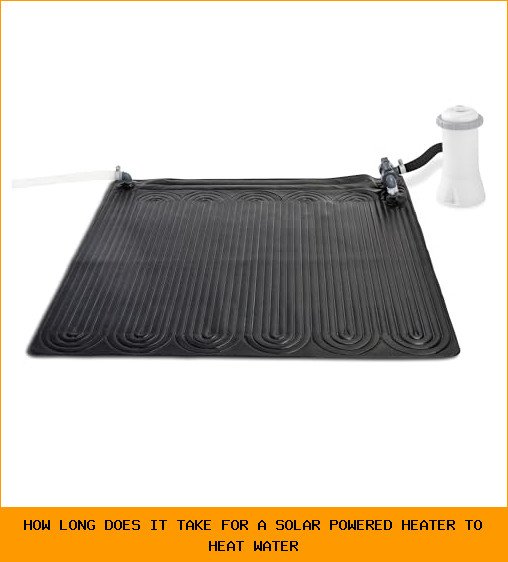
INTEX Solar Pool Water Heater Mat for Above Ground Swimming Pools | 28685E - Energy-Efficient Heating - Designed to work with INTEX Filter Pumps up to 2,000 GPH, 47.25" x 47.25"
- Solar heater mat uses solar technology to increase the temperature of the pool water by approximately 5 to 9 degrees depending on…
- Features an 11-square-foot surface to absorb the sun's rays to heat up above-ground pools; Dimensions (L x W): 47.25 x 47.25 inche…
- Simple and economical to use, compatible with filter pumps with up to 1/3 HP or a pump flow rate less than 2,000 GPH; Weight: 6.41…
One popular entry-level option is the Intex 28685E Solar Pool Heater Mat. It’s a 47-inch square black mat that sits on the ground next to an above-ground pool. It’s not the most powerful system, but it’s a cheap way to add a few degrees on sunny days.
The Short Answer: It Depends (And That’s Not a Cop-Out)
For a small solar mat like the Intex, you’ll see a temperature rise of 5 to 9 degrees Fahrenheit after several hours of direct sun. That’s the manufacturer’s own number. But ‘several hours’ is vague on purpose. On a perfect June day with your pump running, you might gain 1 degree per hour for the first few hours, then the rate slows as the water gets closer to ambient air temperature. On a cloudy day, you might gain nothing.
For a full rooftop solar water heating system with evacuated tubes or flat plates, the story changes. Those systems can heat a tank of water from cold to hot (say 50°F to 120°F) in 4 to 6 hours of good sun. But that assumes the tank is sized properly and the collector area matches the demand. Oversize the tank and you’ll wait all day. Undersize it and you’ll run out of hot water by noon.
The key variable is solar irradiance – the actual amount of sunlight hitting the collector. In peak summer, that’s roughly 1000 watts per square meter. In winter, it can drop to 300, or less at high latitudes. So ‘how long’ depends more on where you are and when you’re using it than on the heater itself.
Myth #1: Solar Heaters Work in Any Sunlight
People assume that if the sun is up, the heater works. Not true. The sun needs to hit the collector directly. Diffuse light through clouds still carries energy, but it’s maybe 10–20% of direct beam radiation. A solar mat lying flat on the ground loses another 20–30% compared to one angled toward the sun. And if your panel is in shade for part of the day, you’re just circulating cold water through a dark plastic sheet.
I tested this with a portable solar shower bag. On a sunny 85°F day, the bag reached 105°F in three hours. On a partly cloudy 85°F day, it barely hit 80°F in the same time. Same bag, same orientation, same starting water temperature. The difference was cloud cover. So if you’re wondering how long it takes for a solar powered heater to heat water, ask yourself first: how much direct sun will the collector actually see?
Another common mistake: placing the mat on a surface that reflects light or stays cool, like concrete. Black mats get hot when they sit on dark ground. On light concrete, they stay cooler because the ground doesn’t heat the underside. Put your solar mat on dirt or dark gravel if you can.
Myth #2: Bigger Mat = Faster Heat (Not Always)
Larger collector area means more total energy capture. That’s just physics. But the rate of temperature rise depends on how fast you circulate water through the collector. If your pump is too small, the water sits in the mat too long, loses heat to the surroundings, and never makes it back to the pool warm. If your pump is too large, the water flows so fast it barely absorbs heat. There is a sweet spot.
For the Intex mat, the manufacturer specifies a maximum pump flow rate of 2,000 GPH and a max 1/3 HP pump. Go above that and the mat won’t work as well because the water rushes through without enough contact time. Go below 1,000 GPH and the water moves so slowly that it cools off before it leaves the mat. Matching pump flow to collector size matters more than collector size alone.
Also, bigger mats cost more and take up space. The Intex mat has 11 square feet of surface. That’s fine for an 8,000-gallon pool, but expect only modest temperature gains. If you want to raise a pool 15 degrees, you’d need multiple mats or a different system entirely. Don’t buy the biggest mat you can find if your pump can’t support it. You’ll just waste money and space.
Real-World Times: What You Can Expect
The table below gives rough estimates for different solar water heating setups. Times assume midday direct sun in summer (July at 40°N latitude). Winter times can be 2–3x longer, if they work at all.
| System Type | Water Volume | Temp Rise | Time (peak sun) |
|---|---|---|---|
| Small pool mat (Intex style) | 8,000 gal pool | 5–9°F | 4–6 hours |
| Rooftop flat plate (40 sq ft) | 80 gal tank | 40–50°F | 4–5 hours |
| Evacuated tube (30 tubes) | 120 gal tank | 60–70°F | 3–5 hours |
| Portable solar bag | 5 gal | 40°F | 2–3 hours |
Notice that the pool mat only raises temperature by a handful of degrees, not to ‘hot tub’ levels. That’s fine for taking the chill off a pool. If you want hot water for a shower, you need a dedicated solar water heater, not a pool solar mat. The Intex mat is meant to supplement your pool’s temperature, not replace a heater.
One more factor nobody mentions: wind. A breeze across wet surfaces or even across the dry mat pulls heat away. Wind chill works on collectors too. On a windy day, you’ll lose 10–20% of your heat gain. Some people build a simple windbreak around their mat, or buy a unit with a glass cover (like a flat plate collector). That makes a real difference.
Frequently Asked Questions
Can a solar powered heater heat water on a cloudy day?
Yes, but very slowly. Diffuse sunlight still carries some energy, maybe 100–200 watts per square meter compared to 1000 in full sun. Expect the time to increase by 3–5x. On completely overcast days, the mat may not raise temperature at all.
How does water volume affect heating time?
It’s a straight ratio. Double the water volume and you double the time to reach the same temperature, assuming the same collector. That’s why big pools need many mats or a high-output system. A small tank heats far faster than a large one.
Does the color of the mat matter?
Yes. Dark colors absorb more visible light. Almost all solar water heaters are black or very dark blue. The Intex mat is black. That’s correct. A light-colored mat would reflect more sunlight and take longer to heat water. Avoid any solar heater that isn’t dark-colored unless it’s a vacuum tube design (which uses a different mechanism).
Can I use a solar mat in winter?
You can, but don’t expect much. At high latitudes winter sun is weak and low in the sky. Even at noon, the angle reduces direct intensity. Plus, ambient temperatures below 50°F cause the mat itself to stay cold, so heat loss to the air cancels out any gain. Many people drain their solar mats before winter to prevent freeze damage.
How long does it take for a solar powered heater to heat water from a cold start (like a full tank after winter)?
If the water is very cold (40–50°F), calculation is the same as any other start. The heating rate depends on collector size and sun, not on initial temperature. But the total energy needed is larger since you need to raise the temperature more. That means longer total time. A pool starting at 50°F might need 2–3 sunny days to reach 80°F using the Intex mat.
What happens if I leave the pump running overnight? Does the water lose heat?
Yes. Overnight, the water in the mat cools down to ambient temperature. If the pump keeps running, it pumps warm pool water through a cold mat and dumps heat to the night air. That actually cools your pool. Most people run the pump only during peak sun hours. The Intex system includes a bypass valve so you can shut off flow through the mat without stopping the filter pump.
Things Worth Remembering
- For a small pool solar mat like the Intex, expect 5–9°F gain after 4–6 hours of direct summer sun. That’s the realistic max.
- Match your pump to the mat. Too fast or too slow both hurt performance. The Intex works best with a pump under 2,000 GPH and 1/3 HP.
- Orientation and location matter more than anything else. Angle the mat toward the sun (south in the Northern Hemisphere) on dark ground, away from shade and wind.
- Solar mats do not make water hot enough for a shower. They’re for taking the chill off a swimming pool. Don’t buy one thinking you’ll get free hot water for the house.
- Check the current price of the Intex mat on Amazon before buying. Prices vary a lot by season, but the thing itself rarely changes.
- Drain and store the mat in winter. Freeze damage will crack the PVC and ruin it.
- If you want hot water fast, consider a gas or electric back-up heater. Solar is slow, cheap, and green, but it’s not instant.


