You got the electric bill last month and it was higher than you expected. Or maybe you’re shopping for a water heater and the sales pitch says tankless models ‘save up to 50% on energy.’ Before you spend money on installation, you need straight answers — not marketing fluff. The real question is not just whether a tankless water heater uses less electricity, but how much it actually draws, when it draws it, and how that compares to the traditional tank heater you already have.
This article gives you the math, the context, and the common misconceptions. We’ll walk through kilowatt-hour calculations, compare summer vs. winter conditions, and explain why the same heater can cost very different amounts depending on where you live and how you use hot water. By the end, you’ll know exactly what to expect from an electric tankless water heater.
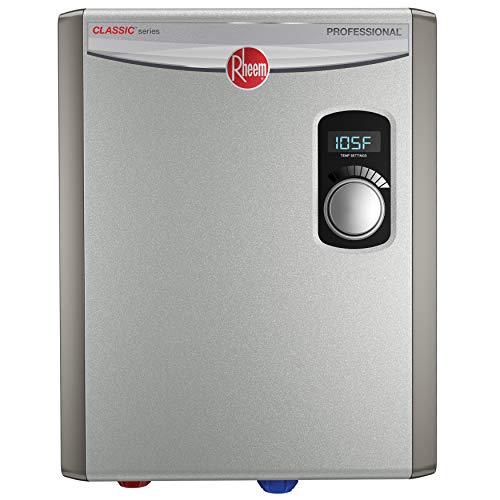
Rheem
Rheem 18kW 240V Tankless Electric Water Heater, Gray
- External digital thermostatic control with LED display (+/1 degree accuracy)
- Most advanced self-modulation, adjust power to meet hot water demand
- Durable Copper immersion two heating elements, field Serviceable. Flow Rate- up to 4.4 GPM
Take the Rheem 18kW 240V Tankless Electric Water Heater (model B01MR7Z39V) as a concrete example. It’s a widely available unit that handles up to 4.4 gallons per minute, and it self-modulates — meaning it only uses the power needed to hit your set temperature. It’s a good reference point for the numbers we’re about to run.

The Basic Math: Watts, Kilowatt-Hours, and Run Time
Every electric tankless water heater has a rated power draw in kilowatts. The Rheem 18kW unit can pull 18,000 watts at full load. That sounds enormous — and it is. But the key word is ‘can.’ It only draws that maximum when the incoming water is very cold and you’re running hot water at full flow.
Here’s the simple formula:
- kWh used = (kW rating) × (hours of actual operation)
- If the Rheem runs flat out for 1 hour, it consumes 18 kWh.
- A typical shower uses hot water for 10 minutes (0.167 hours). That’s about 3 kWh per shower at full power.
But the heater won’t run at full power in most situations. In warm months, the incoming water might be 60°F instead of 40°F. The heater needs less power to raise it to 120°F. Self-modulation drops the draw to maybe 12 kW or 14 kW. So actual consumption varies day to day.
Myth #1: Higher Wattage Means Higher Bills
People see an 18 kW rating and assume it’s an electricity hog. But wattage is capacity, not consumption. A higher-wattage unit finishes heating a given volume of water faster and then shuts off completely. A lower-wattage unit might run longer to deliver the same hot water, or it might struggle and never fully meet demand, causing you to turn up the temperature (which wastes energy).
Think of it like a car engine. A 400-horsepower engine uses more gas when you floor it, but if you just need to cruise at 65 mph, a small engine might work harder and burn similar fuel. The heater’s modulation system matters more than the max kW. The Rheem with its self-modulation adjusts smoothly, so you’re not wasting either way.
Myth #2: Tankless Always Saves Electricity Compared to a Tank Heater
This one needs a careful look. Tank water heaters lose heat through the tank walls — standby loss — which can be 10-20% of total energy use. A tankless unit has zero standby loss because there’s no stored hot water. So in theory, tankless wins.
But theory meets reality. Electric tankless heaters use resistance heating, which is 100% efficient at converting electricity to heat. Electric tank heaters are also 100% efficient at the point of use — the difference is standby loss. So the savings come entirely from eliminating that standby loss, not from better heating technology.
If your household uses very little hot water (a couple of quick showers per day), the standby loss from a tank is a big percentage of total energy. Tankless saves a lot. If you run hot water for long periods (big family, frequent baths), the tankless runs for longer stretches, and the savings shrink because the tank heater wasn’t losing standby heat during those times anyway.
Also, electric tankless heaters often require large electrical service upgrades (200+ amps). That has a cost. In cold climates, the incoming water temperature can be 40°F or lower. The heater needs to work harder, and flow rate drops. You might have to install a larger unit or accept slower flow.
Real-World Comparison: Tankless vs. Tank
Let’s put numbers on it. Assume a family of four using 60 gallons of hot water per day. Incoming water at 50°F, set temperature 120°F.
| Heater Type | Energy per Day (kWh) | Notes |
|---|---|---|
| Electric tank (50-gallon, standard) | ~12–14 kWh | Includes ~2 kWh standby loss |
| Electric tankless (18 kW, Rheem example) | ~10–11 kWh | No standby loss; modulation reduces draw in mild weather |
| Electric tankless (27 kW, for cold climates) | ~12–13 kWh | Runs at higher power for longer in winter; closer to tank heater consumption |
These are rough estimates. The tankless saves about 15-20% in this scenario, but the upfront cost and electrical work can offset the savings for years. In warmer climates (incoming water ~70°F), tankless really shines — you might see 30-40% less electricity use.
What About Standby Power?
Even when no water flows, tankless units consume a small amount of electricity — usually 1-5 watts — to power the control board, LED display, and sensors. That’s roughly $0.01 per day or less. Negligible. Tank heaters also have a small standby draw for the thermostat and controls, though older mechanical ones have none.
Factors That Change the Numbers
- Incoming water temperature. Colder water needs more power. A 10°F drop raises kWh by about 5% per shower.
- Flow rate. High-flow shower heads (2.5 gpm) demand more power than low-flow (1.5 gpm). You can cut kWh by using low-flow fixtures.
- Set temperature. Bumping the thermostat from 120°F to 130°F increases energy use by about 8-10%.
- Climate and season. A home in Minnesota will see much higher consumption in January than in July. A tankless heater in Florida might run at half power year-round.
Frequently Asked Questions
Does a tankless water heater use electricity when it’s not running?
Yes, a tiny amount — typically 1 to 5 watts — for the electronic controls and display. It’s less than a dollar per year. Nothing to worry about.
How many amps does an 18 kW tankless heater draw?
At 240 volts, 18,000 watts divided by 240 volts equals 75 amps. That’s a lot. You’ll need a dedicated 80-amp or 100-amp double-pole breaker, and the wire gauge must be at least #4 AWG copper for the run length. Most older homes with 100-amp service can’t handle that without an upgrade.
Can I run an electric tankless water heater on a 100-amp service?
Probably not, unless your other loads are very small. The heater alone draws 75 amps, leaving only 25 amps for the whole house — lights, fridge, outlets, furnace, etc. A 200-amp service is typical for electric tankless installations. Always consult a licensed electrician.
Which uses more electricity overall: tankless or tank?
It depends on your household usage and climate. For low to moderate hot water use, tankless wins by eliminating standby loss. For very high use, the difference narrows. In cold climates, the gap shrinks further because the tankless runs at near-max power for longer. There’s no universal winner.
Is an electric tankless water heater worth the money?
That depends on your cost per kWh, how many people live in your home, and your local climate. The Rheem 18kW unit costs around $400–$600 (check current price on Amazon). Installation and electrical work can easily add $1,000–$2,000. The energy savings might pay back in 5–10 years, or never if you have cheap electricity and low usage. Tankless does give you endless hot water and more space in your utility room. That benefit is real but hard to quantify.
What You Should Actually Know Before Buying
- An 18 kW heater uses roughly 3 kWh per average shower in winter, 2 kWh in summer.
- Compare your electricity rate (e.g., $0.12/kWh) to see the per-shower cost: about $0.36 in winter, $0.24 in summer.
- Electric tankless only saves 10-25% on energy compared to a modern tank heater — not the 50% some ads claim.
- You almost certainly need an electrical service upgrade to 200 amps. Get a quote from an electrician before buying the heater.
- Low-flow shower heads and lower set temperature (120°F) cut consumption more than the heater type does.
- In mild climates (incoming water above 60°F), tankless is efficient and reliable. In cold climates, expect lower flow and higher consumption.
- The Rheem 18kW unit is a solid choice for warm climates and 1-2 bathrooms. For colder regions or larger homes, consider the 24 kW or 27 kW models.
Know your numbers, talk to an electrician, and you’ll make a decision that actually saves you money — not just a decision that sounded good in a brochure.


