You just bought a new electric tankless water heater. The box says it draws 120 amps. You glance at your main breaker — 200 amps. That should be fine, right? Maybe. Maybe not. It depends on what else is running when that heater kicks on. Most people don’t realize how close they are to tripping the main.
This article walks you through the actual load calculation, the common mistakes, and the one scenario where 200A really is enough. You will learn exactly how to check your panel, what amp draw to expect from different tankless units, and whether you need to upgrade your service or swap to a gas unit. No fluff. No marketing spin.

After reading, you will know if your home can handle it — and what to do if it cannot.
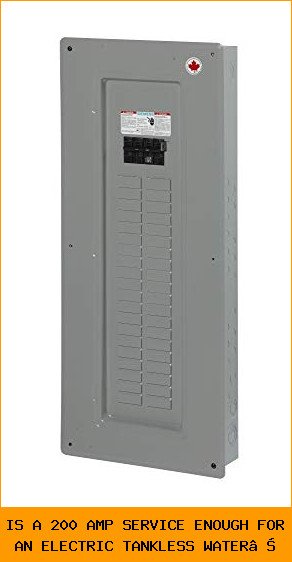
If you need to upgrade your main panel or install a new subpanel for the water heater, the Siemens SEQ40200 200A Service Entrance Loadcenter with Main Breaker is a solid option. It includes a factory-installed 200A main breaker and spaces for up to 40 circuits. That gives you room to add the dedicated 50A or 60A breaker for a tankless heater, plus other circuits. Pair it with a properly rated disconnect and you have a clean install.
The math that decides everything (most people skip it)
Your 200A service is not a blank check. The National Electrical Code (NEC) requires you to calculate the total load on your main breaker. You cannot just add up all breaker ratings. You use demand factors — because not everything runs at full load at the same time.
Here is the simplified version: start with 100% of the first 10 kW of your general load (lights, outlets, and a few small appliances). Then add 40% of the rest. Then add 100% of any large fixed appliances — your range, your dryer, your AC unit. And then add 100% of the electric tankless water heater.
Most electric tankless units require between 50A and 150A, depending on the flow rate they support. A typical 4.5 GPM unit (good for one shower) pulls about 60A. A 9 GPM whole-house unit can pull 120A or more. That is a massive chunk of your 200A bus.
Real example: a house with a 3-ton AC (30A), an electric range (50A), a dryer (30A), and a 60A tankless water heater. Add lighting and small appliance loads (say 8,000 watts after demand factor). That already totals over 170A. Add a microwave running at the same time — you trip the main.
So the short answer: for a single-point-of-use tankless (under 60A) with modest other loads, 200A can work. For a whole-house electric unit, it almost always fails.
Myth #1: More watts always means better hot water
Manufacturers love to advertise high wattage. A 36 kW unit sounds impressive. But watts do not equal performance if your panel cannot supply them. A 36-kW heater running on 240V pulls exactly 150 amps. That leaves only 50A for the rest of the house — not enough for a refrigerator and lights.
These high-wattage units exist for homes with 400A services. If you have 200A, you need to look at lower wattage models — typically 12 kW to 18 kW. They produce less hot water per minute (maybe 2 to 3 GPM), but they fit the electrical budget.
I have seen homeowners install a 27-kW unit on a 200A panel and pop the main every time they ran the dishwasher and a shower together. The fix: either upgrade the service (expensive) or swap to a smaller unit. Do not trust the “200A compatible” sticker on the box. Check the actual continuous amp draw.
Here is a rule of thumb: for every 1 GPM of hot water output at a 40°F temperature rise, expect about 28 additional amps. A 2.5 GPM shower requires roughly 70A. That is before anything else.
Myth #2: Soft-start or load-shedding devices fix everything
Some companies sell load management systems that stagger large loads. They claim you can run an 80A tankless on a 200A panel by shedding the dryer or AC when the water heater kicks on. That works in theory — but in practice? Not always.
These devices cost between $300 and $800. They require professional installation. And they still cannot prevent a scenario where the water heater, the AC, and the oven are all on at the same time. The load-shedding relay only controls one circuit at a time. If two heavy loads fire simultaneously, the main breaker still trips.
Also, many load-shedding devices are not UL listed for this use. An inspector may flag it. Your homeowners insurance might have an opinion too.
I am not saying they are useless. For a carefully planned setup — say, a tankless heater that never overlaps with the range or dryer — it can work. But do not expect it to solve a basic capacity problem. The real fix is either a bigger main panel or a smaller water heater.
Options that actually work with 200A service
Here are the three paths that do not require a service upgrade.
- Point-of-use electric tankless. These sit near one sink or shower. They draw 25A to 50A. You install a dedicated breaker and wire directly. They give endless hot water at that one fixture, while the main water heater handles everything else. Total load stays manageable.
- Small whole-house unit (12-18 kW). These provide 2-3 GPM — enough for one shower at a time, not two. They draw 50A to 75A. You must ensure you are not also running the oven and AC simultaneously. Works in mild climates where incoming water is not freezing cold.
- Gas or propane tankless. Combustion units use much less electricity — maybe 1A for the fan and control board. They can run on a standard 15A circuit. If you have gas available, this sidesteps the entire electrical problem. Installation is more involved (venting, gas line), but the electrical load drops to near nothing.
Below is a quick comparison of these options. Use it to decide which fits your situation.
| Option | Typical Amp Draw | Minimum Panel Size | Flow Rate (GPM at 40°F rise) | Best For |
|---|---|---|---|---|
| Point-of-use (electric) | 25-50A | 100A (single breaker) | 1.5 – 2.0 | One sink or shower |
| Small whole-house (12-18 kW electric) | 50-75A | 150A (with careful load mgmt) | 2.0 – 3.0 | Small home, mild climate |
| Large whole-house (24-36 kW electric) | 100-150A | 300A or 400A | 4.0 – 7.0 | Large home with 400A service |
| Gas / propane tankless | <1A (electric) | Existing service fine | 3.0 – 8.0 | Any home with gas line |
FAQ: Five questions people actually ask
Can I add a 60 amp breaker to a 200 amp panel without upgrading?
Yes, if the panel has a free slot and the total calculated load stays under 200A. But the real question is whether the main breaker will hold when everything is on. A 60A tankless plus a 30A dryer plus a 40A range already equals 130A. Add lighting and AC (maybe 40A) and you are at 170A. That leaves 30A of headroom — too tight for safety. NEC generally recommends staying under 80% of the main breaker for continuous loads (160A for 200A). So that 60A tankless leaves you 100A for everything else. That is often okay if the rest of the house is moderate.
What gauge wire do I need for an electric tankless water heater?
It depends on the amp draw. A 50A unit needs #6 AWG copper (4 AWG aluminum). A 60A unit needs #6 copper or #4 aluminum. A 100A unit requires #2 copper or #1/0 aluminum. Always check the manufacturer spec sheet — some require a specific minimum size even if ampacity allows smaller. And never forget: ground wire must be the same gauge as the hot conductors for that circuit.
Will a 200 amp service support a 27 kW tankless?
Not safely. A 27 kW unit at 240V draws 112.5 amps. That leaves only 87.5A for the entire house. Most homes need at least 100A for the rest (lights, appliances, AC). You would be constantly tripping the main. Stick to 18 kW or less on 200A.
Do I need a permit to install an electric tankless water heater?
In almost every jurisdiction, yes. A tankless water heater is considered a new appliance requiring a dedicated circuit. Most local codes demand a permit and an inspection. Skipping it can void your insurance if something goes wrong. The electrician should pull the permit. If you DIY, pull it yourself. It is not difficult, but it is mandatory.
Can I run two electric tankless water heaters on a 200 amp service?
Only if both are very small point-of-use units. Two 30A units = 60A total. That is fine if nothing else heavy runs at the same time. But two 50A units = 100A. That leaves only 100A for the rest of the house. Very tight. Most people go with a single whole-house gas unit instead.
What to do next (five things to check now)
- Look at the nameplate on your current water heater. Find its amp draw or wattage. Divide watts by 240 to get amps. If that number is 80 and above, you likely need a service upgrade or a different heater.
- Check your main breaker rating. It should be printed on the handle or near the bus. If it is 100A or 150A, you have even less room.
- List every major appliance in your home (AC unit, electric range, dryer, well pump, hot tub). Add up their amp ratings. If the total exceeds 160A when everything plausible is on, you need a service upgrade for a whole-house tankless.
- Consider going gas if available. The electrical load drops to almost nothing. You will spend more on installation (venting, gas line) but skip the panel upgrade entirely.
- If you decide to proceed with a smaller electric tankless, buy a quality load center like the Siemens SEQ40200 to ensure you have enough breaker slots and a solid main breaker. Inspect your panel condition before installation — old panels with corrosion or aluminum bus bars may not handle the additional current well.
Electric tankless water heaters are impressive, but they demand respect for electrical limits. A 200A service can handle them only if you pick the right size unit and manage your other loads. Do the math first. Buy the right equipment. Hire a licensed electrician. That is how you get endless hot water without endless problems.


