Your toes are cold. The central heating kicks on for the whole house, but you just want one room warm. Dragging a clunky radiator out of the closet feels like overkill. You need something small, something that disappears into the wall, something that heats just the space you’re sitting in. That’s the promise of a plug in wall space heater.
These compact devices screw directly into an outlet and push warm air into a small room without taking up floor space or tangling cords. They’re not meant to replace your furnace. They’re meant to take the edge off a chilly home office, keep a bathroom comfortable, or warm a bedroom before you climb in. The two models here—the Ontel Handy Heater Turbo and the Brightown 800W—take different approaches to the same job.
Both plug straight into the wall, both use ceramic heating, and both cost far less than a space heater with legs. But they differ in wattage, control style, and ideal placement. I’ve spent time with each one to figure out which suits which room. Here’s what I found.
Here is a quick look at how the two stack up on paper.
| Features | Ontel Handy Heater Turbo | Brightown 800W |
|---|---|---|
| Heating Power | 800 watts | 800 watts |
| Coverage Area | Up to 250 sq ft | Up to 100 sq ft |
| Control Method | On-unit dial | Remote + touch display |
| Plug Design | Fixed orientation | 180° rotating |
| Timer Range | 12-hour programmable | 12-hour programmable |
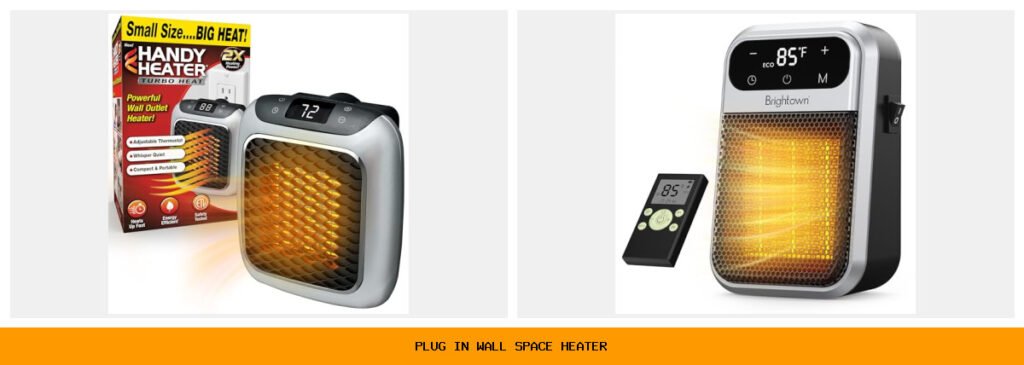
Ontel Handy Heater Turbo
The Ontel Handy Heater Turbo is a small ceramic heater that plugs directly into a standard wall outlet. It’s built for rooms up to 250 square feet, which puts it in a different class than most plug-in models. This is the one you want for a medium-sized bedroom, a home office, or a den where you actually spend time.
What stands out is the adjustable thermostat. You set a target temperature between 60 and 90 degrees Fahrenheit, and the heater cycles on and off to maintain it. That’s a feature usually reserved for larger floor units. The 12-hour timer lets you program it to run for a set window, so you can have it warm the bathroom before your morning shower or heat the bedroom for an hour before you go to sleep. It runs quietly—you’ll hear a low fan hum, not a rattle.
The trade-off is the plug orientation. The heater is designed to sit with the cord pointing down, so it works best in a lower wall outlet. If your only available outlet is near the floor, you’re fine. If it’s higher up, the unit might feel awkward. It’s also bulkier than the Brightown, so it sticks out from the wall a bit more. That’s the price of the larger heating capacity.
- Heats up to 250 sq ft with 800 watts of power
- Adjustable thermostat from 60–90°F for precise comfort
- Programmable 12-hour timer for scheduled warmth
- Cool-touch housing and auto shut-off for safety
- Quiet ceramic heating technology
Best for: Someone who needs to heat a medium-sized room and wants precise temperature control without a floor unit taking up space.
Brightown 800W Plug in Heater
The Brightown 800W is a more compact option with a clever trick up its sleeve. The plug rotates 180 degrees, so you can mount the heater in any outlet orientation. That makes it far more flexible in tight spaces—behind a desk, under a cabinet, or in a bathroom where the outlet sits sideways. It’s rated for rooms up to 100 square feet, so it’s best for small spaces.
The remote control is the standout feature here. You can adjust the temperature or set the 12-hour timer from across the room without getting up. The touch LED display is bright and easy to read, showing the current set temperature. It runs under 40 decibels, which is genuinely quiet—you’ll barely notice it in a bedroom or office. The 800-watt draw is low enough that you don’t have to worry about tripping a circuit breaker in an older home.
The limitation is coverage. At 100 square feet, this heater is for a small bathroom, a dorm room, or a single desk area. It won’t keep a living room warm. The manufacturer also notes it’s suitable for bathroom use if installed above the sink to avoid direct water splashing—so it’s not meant to sit right next to a shower. The remote is small and easy to lose, so keep it in a designated spot.
- 180° rotating plug for flexible outlet placement
- Remote control with touch LED display
- Heats up to 100 sq ft with low 800W draw
- Near-silent operation under 40 dB
- Overheat protection and flame-retardant materials
Best for: Anyone with a small room or awkward outlet placement who wants remote control and a heater that disappears into the wall.
How We Chose These Products
We focused on plug-in wall heaters that solve a specific problem: adding heat to a small space without the footprint of a traditional space heater. The selection criteria started with wattage and coverage area. An 800-watt unit is the sweet spot for plug-in design—it’s powerful enough to make a difference but draws little enough current to run safely on a standard household circuit. Both models here hit that mark.
We also evaluated control options, safety features, and real-world usability. A heater you can’t adjust easily is a heater you’ll stop using. The Ontel offers a thermostat dial for precise control, while the Brightown adds a remote for convenience. Both include auto shut-off and overheat protection. We weighed the trade-offs of each design and matched them to different room sizes and use cases.
Buying Guide: What Really Matters
Before you buy a plug-in wall heater, measure the room you intend to use it in. Coverage ratings are the single most important spec. A unit rated for 100 square feet will struggle in a 200-square-foot room, running constantly and driving up your electric bill. Match the heater to the space, not the other way around.
Look at the plug design carefully. Some heaters, like the Brightown, have rotating plugs that fit any outlet orientation. Others, like the Ontel, are fixed and work best in lower outlets. Know where your outlets are before you order. Also consider how you’ll control the unit. A dial on the side is simple and reliable, but a remote is far more convenient if the heater is mounted high or behind furniture.
Safety matters, but don’t overthink it. Both models here have overheat protection and auto shut-off. Make sure the heater you choose has these features, then move on. The bigger safety concern is placement—keep it away from water sources and don’t run extension cords to it. Plug it directly into the wall.
Our Top Recommendation
The Ontel Handy Heater Turbo is the better all-around choice for most people. Its 250-square-foot coverage is nearly double the Brightown’s, making it useful in more rooms. The adjustable thermostat is a genuine feature, not a gimmick—you set a temperature and the heater does the rest. If you have a bedroom or office that needs steady, quiet warmth, this is the one to get.
But the Brightown 800W is the right pick for tight spaces and tricky outlets. The rotating plug is a lifesaver in bathrooms and behind desks, and the remote control adds real convenience. If your room is under 100 square feet, you’ll save money and get a more flexible unit. Check the current prices on Amazon—the right choice often comes down to a few dollars and your specific room layout.
Frequently Asked Questions
Can I leave a plug-in wall heater running overnight? Both models include a 12-hour timer and auto shut-off, so you can set them to run for a specific window and they’ll turn off on their own. That’s the safe way to use one overnight. Set the timer for an hour before you wake up, and you’ll have a warm room without running the heater all night.
Will an 800-watt heater raise my electric bill significantly? An 800-watt heater running for 8 hours uses about 6.4 kilowatt-hours. At the average US electricity rate, that’s roughly 75 cents per day. It’s far cheaper than heating the whole house. The thermostat on the Ontel helps here—it cycles off once the room reaches your set temperature, saving energy.
Are these heaters safe to use in a bathroom? The Brightown is explicitly noted as suitable for bathroom use when installed above the sink to avoid direct water splashing. The Ontel doesn’t carry that specific recommendation. For any heater, keep it away from water sources and never touch it with wet hands. If you need a bathroom heater, the Brightown is the safer bet.
What’s the difference between ceramic and fan-based plug-in heaters? Ceramic heaters use a heating element that warms ceramic plates, then a fan blows air across them. They heat up faster and are more energy-efficient than older coil-based designs. Both models here use ceramic technology, which is why they’re compact and quiet. There’s no warm-up lag—you feel heat within seconds.



