You’ve just unboxed a new tankless water heater. The unit looks compact, the manual is thick, and the plumber you hired keeps muttering about pressure drops and pipe diameters. It’s easy to assume any half-inch line will do, but that assumption turns into lukewarm showers and a service call you didn’t budget for.
This article walks through the actual numbers behind tankless water flow size piping. You’ll learn how to match supply lines to your home’s demand, why gas piping matters more than you think, and where venting fits into the equation. No fluff, just the details that keep the water hot when you need it.

Rheem
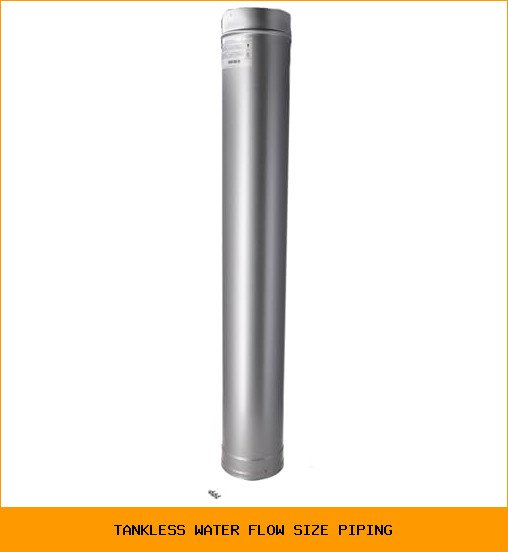
Rheem RTG20270D Tankless 36 in. Concentric Vent Pipe
- Fast and Easy Installation: Features a 1 step connection system for quick and hassle-free setup
- Leak-Proof Design: Seamless precision formed gasket ensures reliable, leak-proof performance
- Durable Construction: Made with high-quality stainless steel material for long-lasting durability
You’ll also see a practical comparison table, five common questions with straight answers, and a checklist you can hand to your contractor.
If your install involves venting, the Rheem RTG20270D ProTech 36" Concentric Straight Vent Pipe is worth a look. It’s stainless steel, uses a one-step connection system, and includes a precision-formed gasket that seals without extra fuss. It solves the venting side of the job so you can focus on the water lines.
What Flow Rate Actually Demands From Your Pipes
Flow rate is the starting point. Tankless units are rated in gallons per minute (GPM). A typical 6.5 GPM unit covers two showers running at once, maybe a shower plus a washing machine. But the rated GPM is measured at a specific temperature rise, usually 35°F or 45°F. If you live in Minnesota and your ground water sits at 50°F, you’ll need a higher temperature rise to hit 120°F at the tap. That cuts the effective GPM down to maybe 4.5 or 5.
Here’s the part that gets overlooked. The pipe has to carry that full flow without excessive pressure loss. A half-inch copper line can handle about 6 GPM at short distances, but push it past 20 feet and the friction adds up. The pipe walls create drag. Water slows down, pressure drops, and your shower head sputters.
Most manufacturers publish a pressure drop chart. A 3/4-inch line feeding a 6 GPM unit at 40 feet will lose roughly 3 to 4 psi. A 1/2-inch line over the same distance loses nearly 12 psi. That’s the difference between a steady stream and a weak trickle when the washing machine kicks in.
Rule of thumb I use: for any run over 15 feet, step up to 3/4-inch. For runs over 40 feet, consider 1-inch. It costs a few extra dollars and saves you from redoing the wall.
Gas Piping: The Part Nobody Measures Twice
Water flow gets all the attention, but gas piping fails more often. A tankless heater at full burn pulls anywhere from 150,000 to 200,000 BTU per hour. That’s a serious appetite. A standard 1/2-inch black iron pipe can deliver about 60,000 BTU over 50 feet. You’d need a 3/4-inch line for most units, and some high-output models require 1-inch.
Check the nameplate on your unit. It lists the maximum BTU input. Then measure the distance from the gas meter to the heater. Include every fitting, elbow, and tee in that count because each one adds resistance. A single 90-degree elbow is equivalent to about 2.5 feet of straight pipe. Three elbows on a 30-foot run changes your calculation.
Natural gas and propane have different densities, so the tables differ. Propane flows easier, so you can often use a smaller line. But never guess. Look up the specific gas piping chart for your fuel type and pipe material. Black iron, CSST (corrugated stainless steel tubing), and copper all have different friction factors.
One thing I’ve learned the hard way: the gas meter itself can be the bottleneck. Municipalities sometimes undersize the meter for a home with a tankless unit added later. Your plumber should verify the meter’s capacity before you buy the heater. If the meter tops out at 175,000 BTU and your unit needs 199,000 BTU, you’ll get poor performance and a pilot light that struggles to stay lit.
Venting: The Third Side of the Triangle
Water and gas lines get measured, but venting often gets treated as an afterthought. That’s a mistake. Tankless units produce exhaust gases that are cooler than traditional tank heaters, but they still need a dedicated path outside. The venting material matters. Most manufacturers require stainless steel or approved PVC, depending on the unit’s efficiency rating.
A concentric vent carries intake air and exhaust in one pipe, which simplifies the installation. You only cut one hole through the wall instead of two. The Rheem RTG20270D fits this category. It’s 36 inches long, made of stainless steel, and uses a gasket that seals without sloppy pipe dope. The one-step connection system means you don’t need a second pair of hands to hold pieces together while you tighten clamps.
Vent runs have maximum lengths. A 3-inch concentric vent might allow 60 feet of straight run, but each elbow cuts that by 5 to 10 feet. High-altitude installs reduce capacity further because the air is thinner. Always check the manual’s venting table before you plan the route.
Here’s a practical tip: keep the vent as short and straight as possible. Every fitting you add reduces the unit’s ability to breathe. A starved combustion chamber leads to soot buildup, which is both a fire hazard and a maintenance nightmare.
Comparing Pipe Sizes for Common Scenarios
To make this concrete, here’s a comparison based on typical residential setups. These numbers assume standard friction loss tables and a 6 GPM demand at 40 feet of run.
| Pipe Size | Material | Max Flow (GPM) | Pressure Loss (psi/100ft) | Best For |
|---|---|---|---|---|
| 1/2 inch | Copper | 4.5 | 8.5 | Short runs under 10 ft, single fixture |
| 3/4 inch | Copper | 7.5 | 4.2 | Most whole-home tankless installs |
| 1 inch | Copper | 12 | 2.1 | Long runs, high-demand homes |
| 1/2 inch | PEX | 4.0 | 9.8 | Short branch lines only |
| 3/4 inch | PEX | 6.5 | 5.1 | Mid-length runs with moderate demand |
Notice that PEX has a smaller internal diameter than copper of the same nominal size. That’s because the fittings and crimps reduce the opening. If you’re using PEX, step up one size from what you’d use with copper. A 3/4-inch PEX run behaves like a 5/8-inch copper pipe.
Also, consider the hot water recirculation loop if you have one. That adds constant flow even when no one is using water. The pump adds pressure, but the pipe still needs to handle the combined flow of recirculation plus demand. Account for that in your sizing.
Five Questions People Actually Ask
Can I use the existing 1/2-inch line from my old tank heater?
Probably not. A traditional tank heater uses a 3/4-inch cold inlet and a 1/2-inch hot outlet. The tank itself stores water, so the flow rate is limited by the outlet size. A tankless unit needs the full supply from the inlet to the tap. If you keep the 1/2-inch line, you’ll choke the flow. Replace it with 3/4-inch from the main supply to the unit, then you can branch off with 1/2-inch to individual fixtures.
How do I calculate the total GPM my house needs?
Add up the fixtures you expect to run at the same time. A bathroom shower uses 2.5 GPM, a kitchen sink about 1.5 GPM, a washing machine 2.0 GPM. If you run two showers and the washer, that’s 7 GPM. Then check the temperature rise. If your incoming water is 55°F and you want 120°F, that’s a 65°F rise. Most units can’t deliver 7 GPM at that rise. You’d need a higher-output model or you stagger the usage.
Does pipe diameter affect the temperature of the water?
Not directly. But it affects pressure and flow. If the pipe is too small, flow drops, and the unit’s flow sensor may not activate. Many tankless units have a minimum flow rate around 0.5 GPM to turn on. If your undersized pipe restricts flow below that, the heater won’t ignite. You get cold water and frustration.
What happens if I use a longer vent than the manual allows?
The unit will likely throw an error code. Combustion needs a specific air-to-fuel ratio. A long vent increases back pressure, which disrupts that ratio. Some units shut down entirely. Others run rich and produce carbon monoxide. Neither outcome is good. Measure your vent run before you cut any holes.
Is it worth upgrading to 1-inch pipe from the meter?
It depends on your home’s total gas load. If you have a gas stove, dryer, and a tankless heater, you might exceed the capacity of a 3/4-inch line. Add up the BTU ratings of all appliances. If the total exceeds the pipe’s capacity at your run length, upgrade. The pipe itself is cheap. The labor to replace it later is not.
Putting It All Together Without Overthinking
Here’s the short version you can act on today.
- Measure your actual fixture demand in GPM, then add 20% for safety margin.
- Use 3/4-inch copper or PEX for any run over 15 feet. Step to 1-inch for runs over 40 feet.
- Calculate gas line capacity with the unit’s max BTU input and the distance from the meter. Include fittings in your count.
- Verify the gas meter itself can handle the total load of every appliance in the house.
- Keep the vent run as short as possible. Use stainless steel or approved PVC, and never exceed the manufacturer’s maximum length.
- Check the pressure drop chart in the manual before you buy fittings. A few extra dollars on pipe now beats a redo later.
- If venting is part of your project, the Rheem 36" concentric vent pipe simplifies the job with its one-step connection and leak-proof gasket.
Get these three things right—supply lines, gas lines, and venting—and your tankless heater will run for years without a hiccup. Skip one, and you’ll be back in the crawlspace with a wrench and a bad attitude.


