You just finished installing a new boiler, or maybe you’re renovating an old house and need to replace the pipework that’s been leaking for years. The question hits you: what kind of pipe should actually go in the walls for hot water central heating? It’s not a trivial choice. Pick the wrong material and you could face corrosion, oxygen ingress ruining your boiler, or a burst pipe in the middle of winter.
This article walks through the four main pipe types used in residential and light commercial hydronic systems: copper, PEX, steel, and multilayer composite. You’ll learn the temperature and pressure limits each can handle, where they shine, where they fall short, and how to match them to your specific setup. No fluff, just the details that matter when you’re holding a pipe cutter.

honigo
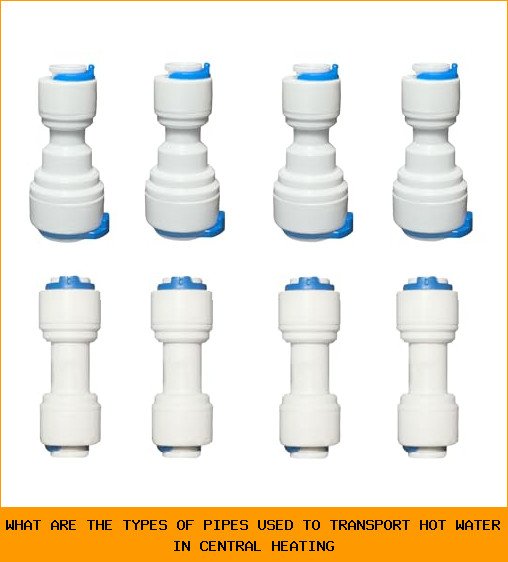
Quick-Connect Plumbing Fittings1/4" To 3/8" Pipes-4 Pcs I-Type,4 Pcs 1/4 Inch I-Type Straight Quick Connectors,Push-Fit Fittings For Reverse Osmosis Water Pipes,Fixed Joints, RO Water Purifier
- Push-fit quick-connect couplers: Simply insert 1/4 inch OD (outer diameter) pipes or 3/8 inch OD pipes into the quick connectors t…
- Reverse osmosis hose connectors are made of high-strength, eco-friendly POM material, which is food-grade, non-toxic, and odorless…
- No additional tools required: Just insert the pipe to the bottom for connection. To remove the pipe, first take out the fixed blue…
Let’s start with a quick practical note. While central heating pipes carry hot water under moderate pressure, other plumbing tasks — like connecting a reverse osmosis system or a refrigerator ice maker — use smaller, lower-temperature tubing. For those jobs, a push-fit quick-connect fitting like the honigo Quick-Connect Plumbing Fittings (4 pieces 1/4 inch to 3/8 inch I-Type straight connectors) makes assembly dead simple. You push the tube in, the collet grabs it, and you’re done. No soldering, no crimping. Just keep in mind that these are made for cold or low-temperature drinking water lines, not for central heating circuits where water can hit 180°F.
Copper Pipe – The Old Reliable
Copper has been the default choice for central heating pipework in North America and Europe for decades. It handles temperatures up to about 200°F (93°C) with ease, though the solder joints in a conventional system start to degrade above 210°F, so stay under that.
Common sizes for heating circuits are 15 mm (about 1/2 inch) for radiators and 22 mm (about 3/4 inch) for main manifold lines. The pressure rating is generous: copper can handle 150–200 psi at room temperature, but at 180°F the allowable pressure drops to about 100–120 psi — still well above the typical 20–30 psi of a residential hydronic system.
What’s the real catch? Cost has climbed a lot in the past few years. A 10-foot length of 1/2-inch copper tube runs around $15–$20. You also need a torch, flux, solder, and the skill to make clean joints. One bad solder joint can leak behind a wall and cause serious damage. If you’re not comfortable sweating pipes, you’ll pay a plumber premium labor rates.
On the plus side, copper is extremely resistant to UV light and rodents, it doesn’t degrade in oxygen-rich water (unlike steel), and it handles frequent thermal cycling without fatigue. For high-temperature systems like steam radiators or near-boiler connections, copper is still the safest bet.
PEX – Flexible, Fast, But Not Without Caveats
Cross-linked polyethylene (PEX) took the plumbing world by storm because you can run it around corners without fittings, and it insulates better than metal. But for central heating, you cannot just grab any PEX.
Standard PEX (PEX-A, B, or C) is rated for 180°F at 100 psi. That’s fine for most modulating-condensing boilers, but some high-mass cast-iron systems can spike water temperature to 200°F or more — at which point PEX starts to soften. The real issue is oxygen permeability. All PEX tubing allows a small amount of oxygen to diffuse through the wall. In a closed hydronic system, that oxygen corrodes ferrous components (boilers, pumps, radiators) over time.
The fix is PEX with an oxygen barrier (EVOH layer). This type of PEX is marked “O2 barrier” or “heating grade.” It looks the same but has a thin plastic coating that slows oxygen ingress to below 0.1 g/m³ per day — acceptable for most modern boilers. Without it, manufacturers will void your boiler warranty. Always check the spec sheet before buying.
Installation is fast. You crimp or clamp the fittings with a tool that costs $50–$100. No open flame, no glue fumes. The downside: PEX is softer than metal, so it can be damaged by sharp objects, UV light (it must be kept out of direct sunlight), and some rodents love to chew it. Also, the fittings have a smaller internal diameter than copper of the same nominal size, which can restrict flow if you undersize the pipe.
Steel Pipe – Heavy, Durable, Mostly Obsolete
Black iron (schedule 40 steel) was the standard for central heating before copper became affordable. It’s still sometimes used in commercial systems or for exposed pipework where you want a rugged, industrial look. But for residential hydronic systems, it’s a poor choice today.
Steel handles temperatures up to 250°F and pressures over 300 psi — more than any home system will ever see. The problem is corrosion. Oxygen in the water causes internal rust that eventually flakes off and clogs valves, pumps, and boiler heat exchangers. Even with chemical inhibitors, steel pipe has a service life of 20–30 years in a well-maintained system; copper and PEX last 50+ years.
Galvanized steel is even worse for heating. The zinc coating reacts with hot water and forms scale that blocks pipes. Don’t use it. Some older systems still have galvanized returns, but they’re a ticking time bomb of reduced flow and leaks.
Threading steel pipe takes skill, heavy dies, and a lot of muscle. Labor costs are high. Unless you have a specific need (e.g., very high temperature or pressure, or a historical replica), skip steel.
Multilayer Composite Pipe (PEX-AL-PEX)
This is the middle ground. It’s a sandwich: inner and outer layers of PEX with a thin aluminum tube in between, bonded together. The aluminum gives the pipe shape memory — it holds a bend without springing back, which is handy for neat installations.
Multilayer pipe typically handles 200°F at 145 psi, and the aluminum layer acts as a near-perfect oxygen barrier (no need for EVOH). It also has lower thermal expansion than plain PEX, so it doesn’t buckle or pull out of fittings when hot water flows through.
Installation uses press-fit or compression fittings that require a special tool (manual or electric). The tool costs $200–$600, which is steep for a one-time DIY job. But if you’re a professional doing multiple systems, the speed and reliability pay off quickly. Multilayer is also more resistant to kinking than PEX, though not as flexible.
The main drawback is price: it costs about 30–50% more than standard PEX, and not every local supplier stocks the fittings in common sizes. If you want the performance of copper with the ease of plastic, and you’re willing to buy the tool, multilayer is a solid option.
Quick Comparison Table
| Pipe Material | Max Continuous Temp | Max Working Pressure (at 180°F) | Relative Cost per Foot | Corrosion Resistance | Ease of Installation | Best Use Cases |
|---|---|---|---|---|---|---|
| Copper (Type L) | 200°F (93°C) | 100–120 psi | $$$ | Excellent | Medium (soldering skill needed) | Near-boiler, exposed runs, high-temp zones |
| PEX (oxygen-barrier) | 180°F (82°C) | 80–100 psi | $ | Good (with barrier) | Easy (crimp/clamp tool) | Radiant floor, long runs, retrofit |
| Black Steel (Schedule 40) | 250°F (121°C) | 200+ psi | $$ | Poor (rusts internally) | Hard (threading) | High-temp commercial, steam |
| Multilayer (PEX-AL-PEX) | 200°F (93°C) | 145 psi | $$$ | Excellent (aluminum barrier) | Medium (press tool needed) | New construction, high-performance retrofits |
Frequently Asked Questions
Can I use standard PEX without an oxygen barrier for central heating?
Not if you want your boiler to last. Without the EVOH barrier, enough oxygen diffuses through the PEX to cause corrosion in steel radiators, pumps, and the boiler heat exchanger. Most boiler warranties explicitly require oxygen-barrier PEX. If you already installed non-barrier PEX, you can add a corrosion inhibitor and monitor pH levels, but it’s a risk.
What pipe size do I need for radiators vs. underfloor heating?
Radiators typically use 15 mm (1/2 inch) for individual units and 22 mm (3/4 inch) for main feeds. Underfloor heating loops are almost always 16 mm (5/8 inch) PEX because the flow rates are lower and the bends are tighter. Oversizing a floor loop reduces water velocity and increases the chance of air pockets; undersizing a radiator line causes pressure drop that starves the last radiators.
Is it okay to mix copper and PEX in the same system?
Yes, as long as you use brass or bronze transition fittings. Do not connect copper directly to steel without a dielectric union — electrolytic corrosion will eat the steel. Copper-to-PEX connections are fine because PEX is non-conductive. Dielectric unions with brass inserts work well.
Why do some plumbers still swear by copper for heating?
Copper doesn’t degrade in sunlight, it stands up to tools dropped on it, and it conducts heat extremely well for fin-tube baseboard. In a boiler room where temperatures can spike near the heat exchanger, copper’s safety margin matters. Also, if you ever need to solder a repair, copper is straightforward; repairing a PEX leak often requires cutting out a section and adding a coupling.
Can I use push-fit fittings (like SharkBite) for central heating pipes?
Yes, but only with compatible materials and temperature ratings. Standard push-fit fittings are rated up to 200°F, which covers most systems. However, they are bulkier than soldered or crimped fittings and cost significantly more per fitting. For a few joints in a tight spot, they’re fine. For an entire house, the cost adds up fast. Also, some push-fit fittings use O-rings that can degrade over 15–20 years; copper solder joints last twice that.
What You Should Actually Do Next
- Check your boiler’s maximum outlet temperature before choosing pipe. If it runs above 180°F (common with some older oil boilers), avoid standard PEX.
- For a DIY retrofit where you’re snaking pipe through floor joists and walls, oxygen-barrier PEX is your best balance of cost, ease, and performance. Just keep it out of sunlight and wrap it where it passes through sharp edges.
- If you’re building new from scratch and want a system that won’t need re-piping in 30 years, go with copper or multilayer. The upfront cost is higher, but the reliability and repair simplicity are worth it.
- Never mix galvanized steel with any other pipe material in a closed loop — the galvanic reaction destroys the steel quickly. Replace it entirely.
- Buy a professional-grade pipe cutter (even for PEX) — a clean square cut reduces leaks by 90%. Dull blades crush the pipe and deform the O-ring groove in fittings.
- Pressure-test every joint at 1.5 times the system’s working pressure before burying pipes in walls or concrete. A leak found after tiling costs ten times more to fix.
- For small-diameter connections like RO water filters or ice makers, the honigo Quick-Connect Fittings let you swap tubing in seconds without tools. Just remember to use tubes with perfectly round ends — cut them with a sharp blade, not scissors.


