You just installed a nice jacuzzi tub. The jets are plumbed, the tile looks great. Then you fill it, run the hot water, and by the time the tub is half full the tank is empty. Sound familiar? That’s the moment everyone starts Googling ‘what size water heater for jacuzzi tub’ — usually in a cold bathroom.
The standard answer you’ll find online is dead wrong in a frustrating way. Most articles tell you to just ‘get a bigger tank,’ as if everyone has room for a 75-gallon water heater and the budget to re-pipe their whole house. That advice ignores two real problems: recovery rate (how fast the heater can reheat new water) and the fact that a jacuzzi tub often uses water at two different temperatures at once. Let’s fix that.

Titikula
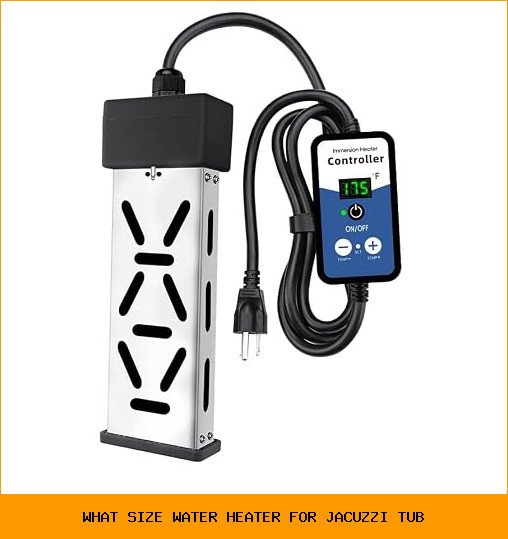
Immersion Water Heater with Controller, Portable Bucket & Bathtub Heater, 304 SS Immersion Heater for Bathtub, Auto Shut-Off, Anti-Dry Burn, 14AWG Cord, Water Heater for Inflatable Pool & Tub, 1800W
- Ultimate Safety: Anti-Dry Burn & Auto Shut-off: Safety is paramount for any portable immersion water heater. Our device is equippe…
- Smart Temp Control & Real-Time Display: Upgrade your heating experience with our intelligent immersion water heater. The integrate…
- Heavy-Duty 14AWG Cord & 304 Stainless Steel: Built to outlast the competition, this bucket heater is crafted with a high-grade 304…
By the end of this article you’ll know exactly how to calculate the right size for your specific tub, why wattage matters more than tank size in some cases, and when a portable immersion heater like the Titikula 1800W model can save your soak.
If you already have a water heater that’s undersized and can’t justify replacing it, a portable immersion heater is a practical workaround. The Titikula Immersion Water Heater with Controller (check current price on Amazon) plugs into any standard outlet, heats water up to 175°F, and shuts off automatically when it hits your set temp. It’s not a replacement for a proper tank — but it can boost the temperature of an already-filled tub so you don’t have to wait for the main heater to recover.
The Big Myth: ‘More Gallons Always Fixes It’
People assume the solution is a bigger storage tank. A 50-gallon tank holds 50 gallons. Your jacuzzi tub holds 60 gallons. So you need a 60-gallon tank, right? Not exactly.
Jacuzzi tubs are usually filled with a mix of hot and cold water. You don’t fill them with pure 140°F water — you’d burn your skin. Typical tub fill temperature is around 100-105°F. If your incoming cold water is 50°F (winter in many places) and your water heater stores water at 120°F, roughly 70% of the fill volume will be hot water and 30% cold. So a 60-gallon tub actually requires about 42 gallons of hot water from the tank. A standard 40-gallon tank could handle that — if it had all that water sitting ready.
But it doesn’t. The moment you draw hot water, cold water enters the tank and mixes. The usable hot water before the temperature drops significantly is only about 70% of the tank’s rated capacity (this is called ‘first-hour rating’ or FHR). So a 40-gallon tank might really give you 28 gallons before the output turns lukewarm. That’s not enough for a 42-gallon hot-water demand.
Bigger tanks help, but only up to a point. The real limiter is recovery rate — how many gallons per hour the burner or element can reheat after you start drawing.
Wattage Confusion: No, 1800W Isn’t Weak
Another common myth: ‘A bigger heating element means faster hot water.’ In truth, the size of the heating element (watts) and the tank size are two different knobs. A 4500W element heats water faster than a 3000W element, yes. But most residential electric water heaters are capped at 4500W because that’s the limit of a typical 30-amp circuit. Gas heaters recover much faster — a typical gas burner delivers 30,000 to 40,000 BTU, which is equivalent to roughly 8800 to 11,700 watts.
So if you have an electric water heater, the recovery rate is slower no matter the tank size. A 50-gallon electric tank with a 4500W element can reheat about 21 gallons per hour (at a 90°F rise). That means after you drain the first 28 usable gallons, you’ll wait about an hour to get another 21 gallons. For a jacuzzi tub that takes 42 gallons of hot water, you’d need the tank to recover 14 additional gallons during the fill — which it can’t do fast enough. Result: lukewarm water halfway through your fill.
Gas tanks aren’t magic either. A 40-gallon gas water heater with a 40,000 BTU burner recovers about 40 gallons per hour. That’s much faster. But if your tub demands 42 gallons of hot water, a 40-gallon gas tank still falls short on usable capacity (28 gallons) before recovery kicks in, unless you fill slowly.
The lesson: for a jacuzzi tub, recovery rate matters as much as tank size. A small gas tank can outperform a large electric tank for this specific use.
The Math You Actually Need: Calculate Your Tub’s Hot-Water Demand
Stop guessing. Here’s the formula that works for any jacuzzi tub:
- Measure your tub’s total volume in gallons (fill it with buckets or use the manufacturer spec).
- Decide your desired fill temperature. Most people want 102°F. Let’s say 102.
- Measure your incoming cold water temperature (winter low is the worst case). Call it 50°F.
- Your water heater’s storage temperature. Factory default is often 120°F, but you can set it higher (up to 140°F safely with a mixing valve). We’ll use 120°F.
The formula: (desired temp – cold temp) / (tank temp – cold temp) = fraction of hot water needed per gallon.
Example: (102 – 50) / (120 – 50) = 52 / 70 = 0.74. So 74% of each gallon in the tub must come from the water heater. For a 60-gallon tub: 60 x 0.74 = 44.4 gallons of hot water from the tank.
Now compare that to your water heater’s first-hour rating (FHR). The FHR is listed on the yellow Energy Guide sticker. For a 40-gallon electric tank typical FHR is about 44 gallons. That’s barely enough — and that’s at 120°F tank temperature. If you drop the tank temp to 110°F to save energy, you’d need 62% of each gallon to be hot water, which is 37 gallons — but the FHR drops too because the heater cycles less often.
Bottom line: a 50-gallon gas water heater with a high FHR (60+ gallons) is the safe choice. An electric tank needs to be 60+ gallons to have enough FHR. But there’s a cheaper workaround.
When a Portable Immersion Heater Saves the Day (and Your Budget)
If you already own a standard 40-gallon electric water heater and can’t replace it, a portable immersion heater lets you fill the tub with mostly cold water and then heat it up directly. The Titikula 1800W model with smart temperature control is designed for exactly this scenario. You fill the tub to the desired level (say, 60 gallons at 80°F from a mix of hot and cold), drop the heater in, set it to 102°F, and let it run. At 1800W, it raises the temperature of 60 gallons by about 15-20°F per hour. That means from 80°F to 102°F takes around 70 minutes. You can start it while you’re getting ready.
It’s not instant. But it’s a fraction of the cost of a new water heater and installation. The anti-dry burn and auto shut-off features make it safe to run unattended — just make sure the heating element stays fully submerged. The 304 stainless steel construction won’t rust or leach into the water, and the cord is thick 14AWG, so it doesn’t overheat.
Is it perfect? No. You need a nearby outlet (GFCI protected is best). And it only heats, it doesn’t circulate water like the tub’s jets would. But for occasional use, it’s a great backup.
Comparison: Water Heater Options for a Jacuzzi Tub
| Water Heater Type | Typical Tank Size | FHR (Gallons) | Recovery Rate | Fits 60-gal Tub @102°F? |
|---|---|---|---|---|
| Electric (4500W) | 40 gal | 44 gal | 21 gal/hr | Barely, in summer only |
| Electric (4500W) | 50 gal | 52 gal | 21 gal/hr | Yes, if fill slowly |
| Gas (40,000 BTU) | 40 gal | 62 gal | 40 gal/hr | Yes |
| Gas (40,000 BTU) | 50 gal | 72 gal | 40 gal/hr | Yes, with margin |
| Tankless electric (24kW) | N/A | Unlimited* | ~3 gpm @77°F rise | Maybe, depends on flow rate |
| Tankless gas (199,000 BTU) | N/A | Unlimited* | ~5 gpm @70°F rise | Yes, if sized correctly |
| Portable immersion (1800W) | N/A | Heats directly in tub | ~2-3°F per 10 gal per 10 min | Yes, but slow (adds 15-20°F per hour) |
* Tankless heaters have unlimited hot water as long as flow rate stays within spec. But for a jacuzzi tub fill (typically 2-3 gpm), most tankless electric units can’t raise the temperature enough in cold climates. Gas tankless is more reliable.
5 Real Questions People Ask About Water Heaters for Jacuzzi Tubs
Can I use a standard 50-gallon electric water heater for a 60-gallon jacuzzi tub?
In most climates, yes, if you fill the tub slowly (turn the hot water valve to half flow) and you have a high first-hour rating tank. A 50-gallon electric tank with a 4500W element typically has a FHR around 52 gallons. That means you get about 52 gallons of hot water before it drops to lukewarm. For a 60-gallon tub requiring 44 gallons of hot water, you have 8 gallons of margin. But if your incoming cold water is colder than 50°F (say 40°F in winter), the hot water demand jumps to 50 gallons and you’re borderline. You might get a lukewarm final few minutes. Many people find it works fine in summer but fails in winter.
What size water heater do I need for a two-person jacuzzi tub?
A standard two-person jacuzzi tub holds 40-50 gallons. Using the same formula: desired 102°F, cold 50°F, tank 120°F → 52% hot water per gallon. For a 45-gallon tub, that’s 23.4 gallons of hot water. A 40-gallon electric tank with a FHR of 44 gallons easily covers it. So for a typical two-person tub, a standard 40-gallon gas or 50-gallon electric is sufficient. No need for oversized equipment.
Will a tankless water heater work for a jacuzzi tub?
It can, but you have to be careful with the flow rate. A jacuzzi tub fills at maybe 2.5 gallons per minute. A typical tankless electric unit (27kW) can raise water temperature by about 50°F at 2.5 gpm. If your incoming water is 50°F, it can output 100°F — perfect. But if you live where groundwater hits 35°F in winter, the same unit will only manage about 85°F output. You’d need a larger electric unit (36kW) or a gas tankless (199,000 BTU) to handle that. And remember: the tub’s jets and fill are two separate flows. The fill is the bottleneck. Many homeowners install a dedicated tankless just for the tub. That’s the cleanest solution but costs $1,500-3,000 installed.
Is it safe to use an immersion heater in a jacuzzi tub?
Yes, if you buy one with built-in safety features. The Titikula model has anti-dry burn protection (cuts power if water level is too low) and an automatic thermostat that stops at your set temperature. The 304 stainless steel guard prevents the element from touching the tub’s surface. One thing: never use an immersion heater without a GFCI outlet or adapter. And don’t leave it running while you’re in the tub — though the Titikula is designed for pre-heating, not use while bathing. Always follow the manual.
Can I just set my water heater temperature higher to get more hot water?
Yes, but with a warning. Raising the tank temperature from 120°F to 140°F increases the usable hot water because you mix more cold water at the tub. For our 60-gallon example: at 140°F tank temp, the fraction becomes (102-50)/(140-50) = 52/90 = 58% hot water, so only 35 gallons needed. That’s a huge difference. But water above 130°F poses a scalding risk, especially for children or elderly. You must install a mixing valve at the tank to blend cold water down to 120°F before it reaches the rest of the house. That adds cost but gives you 140°F storage without danger. Many pros recommend this as the cheapest fix for an undersized tank.
What to Do Next: Five Actionable Takeaways
- Measure your tub’s actual volume. Don’t trust the brochure — fill it with a hose and a flow meter, or count buckets. Numbers change everything.
- Use the hot-water-demand formula (desired temp minus cold temp divided by tank temp minus cold temp) to find your real gallon need. Don’t guess.
- Check your water heater’s yellow EnergyGuide sticker for the first-hour rating (FHR). That’s your effective capacity, not the tank size.
- If your FHR falls short by 10 gallons or less, consider raising the tank thermostat to 140°F and adding a mixing valve — it’s cheaper than a new heater.
- If you can’t or won’t upgrade, a portable immersion heater like the Titikula 1800W model is a practical, low-cost way to boost tub temperature after filling. It’s not fast, but it works for occasional use.


