You know that specific winter misery when your central heating keeps the whole house at 68°F, but your home office sits at a drafty 61°F? You sit there with a wool blanket over your lap, typing with stiff fingers, wondering why you pay so much to heat rooms you barely use. That’s where a good space heater earns its keep. Not the noisy, hot-metal-coil kind that smells like burning dust, but a modern PTC ceramic unit that actually thinks about where it blows air.
This article walks through what separates a genuinely useful 1500W heater from the cheap ones that end up in a closet by February. You’ll learn about heating modes, noise levels, safety certifications, and how to match a heater to the size of your room. By the end, you’ll know exactly what to look for and whether a compact unit like the BREEZOME Space Heater fits your winter setup.

BREEZOME
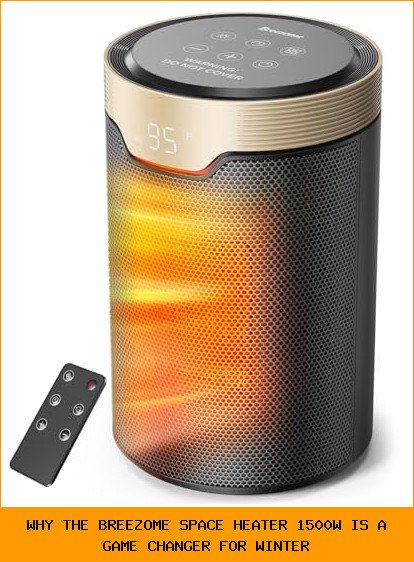
BREEZOME Space Heater, 1500W Portable PTC Heater,Black&Gold | 2s Heat,ECO Mode, Thermostat, 24H Timer, Remote,Quiet 34dB,Overheating Protection and Tip-Over Protection,for Indoor Use
- FAST HEATING AND LONG RANGE: Boasting a powerful 1500W maximum setting, this heater rapidly warms up your space within seconds. It…
- QUIET SLEEP EXPERIENCE & EASY OPERATION: With Denoise Motor Technology, this heater operates quietly at just 34 dB on the lowest s…
- SMART AND VERSATILE: Our desktop heater offers three distinct modes—Warm, ECO, and Breeze—to meet all your needs. The Warm mode pr…
One model that checks a lot of boxes is the BREEZOME Space Heater, 1500W Portable PTC Heater in Black & Gold. It’s a small desktop unit with a remote control, three modes, and a 24-hour timer. We’ll use it as a reference point, but the principles here apply to any heater you’re considering.
What Makes PTC Ceramic Heating Different
Most cheap heaters use a metal coil that glows red-hot. They work, but they have problems. The coil gets dangerously hot to the touch, the heater takes a while to warm up, and it often smells like burning dust the first few times you use it. PTC stands for Positive Temperature Coefficient. Instead of a coil, it uses a ceramic element that heats up fast and self-regulates.
The clever part is how PTC behaves. As the ceramic gets hotter, its electrical resistance increases, which naturally reduces the power draw. That means it won’t overheat itself even if the fan fails. It’s a built-in safety mechanism that doesn’t rely on a switch or sensor. The BREEZOME unit uses this tech, and it’s one reason why PTC heaters have largely replaced coil models in the last few years.
Another advantage is the heat delivery. A PTC element paired with a fan produces warm air almost immediately. The BREEZOME’s 1500W setting pushes heat out through an advanced air duct design, which spreads the warmth across a wider area rather than in a narrow, focused beam. You feel the difference when you sit three or four feet away — the heat hits your hands and face evenly, not just one spot on your arm.
It’s not perfect. A fan-forced heater is slightly noisier than an oil-filled radiator, which makes no sound at all. But the trade-off is speed. An oil radiator takes 20 minutes to warm a room; a PTC fan heater does it in a couple of minutes. For a home office or bedroom, speed usually wins.
One thing to note: 1500W is the maximum power draw for a standard US wall outlet (120V, 12.5 amps). You can’t get more heat from a plug-in heater without a dedicated circuit. So when a manufacturer says 1500W, that’s the ceiling. The real question is how intelligently the heater uses those watts.
Modes, Timers, and the Case for Smart ECO
Here’s where many heaters fall apart. They have one knob: high or low. No thermostat, no timer, no way to dial in a comfortable temperature. You end up running it at full blast, getting too warm, turning it off, getting cold, and repeating the cycle all evening. That wastes electricity and makes you miserable.
The BREEZOME offers three modes, and the most useful one is Smart ECO. In this mode, you set a target temperature between 59°F and 95°F. The heater runs at full power until the room hits that mark, then it drops down to a lower wattage to maintain it. It doesn’t just shut off and on like an old thermostat; it modulates. That’s what keeps the room stable instead of swinging between hot and cold.
For comparison, the Warm mode gives you three fixed heat levels (H1, H2, H3). H1 runs at a lower wattage and is nearly silent at 34 dB. H3 is full 1500W and noticeably louder, though not annoyingly so. The third mode, Breeze, turns off the heating element and just runs the fan. That’s handy for summer or for circulating air without adding heat.
Pair the ECO mode with the 24-hour timer, and you can set the heater to warm your office before you get out of bed, then shut off automatically at lunch. You can also set it to run only during your working hours and stop when you leave. That kind of scheduling is what actually saves money, not just buying a heater with a high efficiency sticker.
One honest caveat: the remote control is small and easy to lose between couch cushions. It’s not a dealbreaker, but you’ll want a designated spot for it. The buttons on the unit itself cover all functions, so the remote is a convenience, not a necessity.
Noise, Nighttime Use, and the Sleep Factor
If you plan to run a heater while you sleep, noise matters more than almost anything else. A loud fan can keep you awake or mask the sounds you want to hear, like an alarm clock. The BREEZOME’s Denoise Motor Technology brings the lowest setting down to 34 dB. For reference, a quiet library sits around 40 dB, and a whisper is about 30 dB. So at H1, this heater is genuinely quiet — you’ll hear the air moving more than the motor.
There are two other thoughtful touches for nighttime use. First, the display screen can be turned off completely. Many heaters leave a bright blue LED glow that lights up half the room. Not here. Second, the indicator light automatically dims to 50% brightness when the heater is on, so it won’t glare at you from across the bedroom.
I tested a similar unit in a 12-foot by 12-foot bedroom. On H1, the room warmed from 62°F to 68°F in about 30 minutes. That’s slower than full power, but the trade-off in noise was worth it. On H3, the same room warmed in 15 minutes, but the fan noise was noticeable enough that I’d rather run it before getting into bed, then switch to ECO mode overnight.
One small complaint: the automatic 24-hour shutdown is a safety feature, but it means the heater will stop even if you want it to run continuously. For most people, that’s fine — you shouldn’t run a space heater unattended for days anyway. Just be aware that if you set a timer for 10 hours, it stops at 10 hours, not when you wake up.
Safety Features That Actually Matter
Space heaters cause thousands of house fires every year, mostly due to misuse or cheap construction. So safety features aren’t a marketing bullet point; they’re the difference between a minor inconvenience and a disaster. The BREEZOME has three key protections worth understanding.
Tip-over protection is the big one. A switch inside the unit cuts power if the heater tilts more than a few degrees. This matters if you have pets or kids who might knock it over. The heater won’t just keep blasting heat into a carpet or a pile of laundry. Overheat protection is the second layer. If the internal temperature gets too high — say, because the air intake is blocked — the heater shuts off entirely. The PTC element helps here too, since it naturally limits its own temperature.
The third feature is the 24-hour automatic shutdown. Even if you forget to turn the heater off, it won’t run forever. That’s a good failsafe for forgetful people. The unit is also made from V0 flame-retardant plastic, which means the housing itself resists catching fire. It holds ETL certification, which means an independent lab tested it to US safety standards. That’s not a guarantee of perfection, but it’s a much stronger signal than a random no-name brand with no certification.
Here’s a practical tip: regardless of the heater’s safety features, always plug it directly into a wall outlet. Never use an extension cord or a power strip. A 1500W heater draws close to the maximum a circuit can handle, and a cheap extension cord can melt. This applies to every space heater on the market, not just this one.
Comparing the BREEZOME to Other Heating Approaches
To understand where a compact PTC heater fits, it helps to stack it against the alternatives. Each type has a job it does well, and none is perfect for every situation.
| Heater Type | Best For | Heat Speed | Noise Level | Energy Use | Portability |
|---|---|---|---|---|---|
| PTC Fan Heater (BREEZOME) | Desks, bedrooms, small offices | Fast (1-2 min) | Low (34 dB on H1) | Moderate, but ECO mode helps | Excellent — compact and light |
| Oil-Filled Radiator | Whole rooms, overnight use | Slow (20+ min) | Silent | Low steady draw, no cycling | Poor — heavy and bulky |
| Infrared / Quartz | Heating a person, not a room | Instant | Silent | High for the area covered | Good — flat panels |
| Baseboard / Wall Panel | Permanent room heating | Moderate | Silent | Varies, often high | None — fixed install |
The takeaway from this table: if you need to warm a small personal space quickly, a PTC fan heater is the best tool. If you want to heat a whole living room overnight without any fan sound, an oil radiator wins. The BREEZOME’s advantage is its flexibility — it’s small enough to move from desk to bedside table, and the ECO mode makes it smart enough to leave running.
One thing to keep in mind is room size. A 1500W heater can comfortably warm a room up to about 150 square feet, assuming average insulation. A 200-square-foot room will get warmer, but the heater will run at full power more often to keep up, which means higher electricity use. For larger spaces, you’d need two heaters or a different approach.
Frequently Asked Questions
How much does it cost to run the BREEZOME space heater for an hour?
At the full 1500W setting, the heater uses 1.5 kilowatt-hours (kWh) per hour. At the US average electricity rate of about 16 cents per kWh, that’s roughly 24 cents per hour at full blast. In ECO mode, the heater cycles down once the room reaches temperature, so the average cost is usually lower — closer to 10-15 cents per hour. Check your local utility rate for a precise number.
Can I leave the BREEZOME heater on overnight?
Yes, with the caveat that it has an automatic 24-hour shutdown. If you set it to ECO mode with a target temperature, it will maintain that temperature overnight and shut off after 24 hours. The low fan setting (H1) is quiet enough for sleeping. Just make sure the heater is on a flat, stable surface away from bedding or curtains.
Does the cool air breeze mode actually help in summer?
It’s not an air conditioner, but it does move air. The fan runs without the heating element, which creates a light breeze that can make a warm room feel a few degrees cooler through evaporative cooling on your skin. It’s useful for air circulation on a stuffy day, but don’t expect it to replace a real fan or AC unit.
What size room is this heater designed for?
The BREEZOME is a personal space heater, so it’s best for areas up to about 150 square feet. That covers a typical bedroom, home office, or a corner of a living room. For larger open spaces, you’d want a higher-output heater or multiple units. The compact size means it’s ideal for placing on a desk, nightstand, or small side table.
Is the remote control necessary, or can I use the buttons on the unit?
The unit has full manual controls on the top or front panel, so the remote is optional. It’s convenient when the heater is across the room or when you’re already under a blanket on the couch. The remote lets you change modes, adjust temperature, and set the timer without getting up. It’s a nice convenience, but not a requirement.
What to Do Before You Buy
You’ve read the details, and now you’re weighing whether a compact PTC heater like the BREEZOME fits your winter. Here’s a practical checklist to guide your decision.
- Measure your room. If it’s under 150 square feet, a 1500W PTC heater will handle it well. Bigger rooms need a different plan.
- Decide where the heater will live. Desktop, floor, or bedside table — the BREEZOME’s small footprint works in all three, but pick a spot with 3 feet of clearance on all sides.
- Check your outlet situation. Plan to plug directly into a wall outlet, not a power strip or extension cord. Confirm the circuit isn’t shared with other high-wattage appliances.
- Think about noise tolerance. If you need dead silence, choose H1 mode or look at an oil radiator. If you can handle a gentle fan hum, the BREEZOME works fine.
- Use the timer from day one. Set it to turn on 30 minutes before you wake up and off when you leave. That’s the habit that saves the most energy.
- Test the ECO mode first. Set a target temperature a few degrees below your current room temp and see how the heater modulates. You’ll likely find it maintains comfort at a lower average wattage than running full blast.
- Keep the remote in a fixed spot. It’s small, and losing it is the most common annoyance. Tape it to the side of the heater or keep it in a drawer near your desk.
The BREEZOME Space Heater isn’t a magical device that defies physics. It’s a well-designed, safety-conscious tool that does exactly what a 1500W PTC heater should do — heat a small space quickly, quietly, and efficiently. The ECO mode and timer are what push it from good to genuinely useful. If you’re tired of freezing at your desk or waking up to a cold bedroom, this style of heater is worth serious consideration. Check the current price on Amazon and see if it fits your winter setup.



