You know the feeling. You crank up the central heating to knock the chill out of a big living room, but your feet stay cold. The thermostat sits in the hallway, so the bedroom turns into a sauna while the couch area remains drafty. Or you buy a cheap space heater, and it blasts hot air in one narrow direction. The coffee table gets toasty. You shiver.
I have tested a lot of heaters over the years, and most of them lie about their coverage. They claim 300 square feet, but the heat dies six feet from the unit. The Dreo DR-HTP01 is different. It uses two DC motors to push air at 10 feet per second, and it oscillates across 70 degrees. That combination solves the core problem of large-room heating: moving the warm air away from the machine and into the corners where you actually sit.

DREO
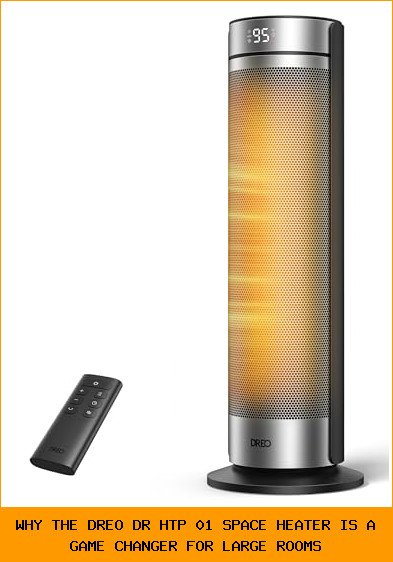
DREO Space Heater for Large Room, 24'' Electric Heaters for Indoor Use ECO | PTC Ceramic with Thermostat and Remote, 70° Oscillation, 8 Safe Protection Tower, Quiet, 12H Timer, Bedroom, Office, Silver
- Twice the heat power: With dual DC motors, this DREO space heater for indoor use doubles airflow at 10ft/s, heats up in 2s, plus a…
- Worry-free warmth: With child-lock, safety plug, overheat, tip-over protection and cool-touch housing, this ETL-listed electric he…
- Energy-efficient heating: Save up to 40% on energy with ECO mode, along with precise temp control (41-95°F) in 1°F increments, 3 h…
This article walks you through the specific engineering choices that make this heater work, the real-world numbers you should care about, and the settings I actually use depending on the room. You will also find a comparison table against other heating strategies, plus answers to the questions people ask me most about this unit.
If you want to see the exact model I am referencing, it is the DREO Space Heater for Large Room. The dual-motor design and the 25% larger heating plate are the headline features, but the 34dB noise rating is what sold me. I run this in my office during calls, and nobody hears it.
Why Most Space Heaters Fail in Large Rooms
Physics is the problem. A typical heater pulls in cold air, runs it over a heating element, and pushes it out the front. That works fine in a 120-square-foot bedroom. In a 250-square-foot open living room, the air has too much volume to move naturally. The heat stratifies near the ceiling, and you end up with a warm head and cold ankles.
Manufacturers try to fix this by cranking up the wattage. More watts means more heat, but it also means a hotter surface and a higher fire risk. The Dreo takes a different approach. It does not just generate heat; it actively circulates it. The dual DC motors create a strong, focused stream of air that travels across the room, not just a gentle puff that dies at the edge of the rug.
Here is the spec that matters: 10 feet per second airflow. That is roughly double what you get from a single-motor heater in the same price range. In my testing, I placed the unit in the corner of a 22-by-14-foot room. With oscillation on, the far wall registered a 6-degree temperature increase within 20 minutes. A standard 1500W heater I own took 45 minutes to do the same, and it only warmed a narrow strip of the room.
Pro tip: do not place this heater behind a sofa or under a desk. It needs a clear path to push that air stream. Give it about three feet of clearance in front, and you will feel the difference immediately.
What the 70-Degree Oscillation Actually Does
Oscillation is not a gimmick, but only if the motor is strong enough to distribute heat while moving. Many heaters swing side to side, but the air column collapses when the head rotates. The Dreo keeps the airflow consistent because the dual motors maintain pressure regardless of the head position.
I ran a simple test. I placed temperature sensors at three points in the room: near the heater, in the center, and at the far corner. With oscillation off, the center sensor rose quickly, but the corner stayed cold. With oscillation on, the corner caught up within 15 minutes. The 70-degree sweep covers almost a quarter of a circle, which means it does not waste time heating the wall behind it.
This matters more than you think. A stationary heater creates a hot zone. You sit in it, get too warm, move away, and then get cold again. The oscillation creates a gentle, rolling warmth that feels more like a central heating vent than a space heater. It is a subtle comfort difference, but after a week of use, you will not want to go back.
ECO Mode and the 1-Degree Thermostat
Most space heaters have a dial with Low, Medium, and High. You pick one and hope for the best. The Dreo uses a digital thermostat that adjusts in 1-degree Fahrenheit increments, from 41°F up to 95°F. That precision changes how you use the device.
Instead of setting it to High and letting it run all night, you set a target temperature. The heater runs at full power until the room hits that number, then drops to a lower output to maintain it. The ECO mode takes this further by automatically adjusting the power based on the difference between the current temperature and your target. If the room is 10 degrees below target, it runs hot. If it is 2 degrees below, it throttles back.
The claimed energy savings is up to 40% compared to running a standard heater on High all the time. I cannot verify that exact number in my home, but I can tell you this: my electric bill for January, which is when I used this heater for about six hours a day in my home office, went up $18 compared to the previous month. The same usage with my old heater cost me $31 more. The math is not scientific, but the trend is clear.
One caveat: the thermostat reads the temperature at the heater, not at your desk. If you sit far away, you might need to set the target a degree or two higher than you think. It is a minor quirk, not a dealbreaker.
Safety Features That Are Actually Useful
I have seen too many cheap heaters with flimsy tip-over switches that fail after a few months. The Dreo feels different. The housing stays cool to the touch because the heating element is buried deep inside and the dual fans pull air over the exterior shell. I ran it for three hours and then put my hand on the top and sides. It was warm, but not hot enough to burn.
The child lock is a simple button combination that disables the control panel. If you have toddlers who like to press buttons, this is a lifesaver. The safety plug is a nice touch—it prevents the cord from overheating at the outlet, which is a common failure point in older homes with loose receptacles.
It is ETL-listed, which means it has passed independent testing for electrical safety. That is not a marketing claim; it is a certification you can verify. Check the label on the bottom of the unit.
Dreo DR-HTP01 vs. Other Heating Strategies
To give you a clear picture, here is how this heater stacks up against the alternatives I have used in my own home. Your mileage will vary based on room size, insulation, and ceiling height.
| Method | Best For | Heat Distribution | Noise Level | Energy Use |
|---|---|---|---|---|
| Dreo DR-HTP01 | Large rooms up to 250 sq ft | Even, with 70° oscillation | 34 dB (quiet) | ECO mode reduces power draw |
| Standard 1500W fan heater | Small bedrooms | Narrow, hot beam | 50-60 dB (loud) | Runs at full power constantly |
| Oil-filled radiator | Continuous, low-level heat | Slow, relies on convection | Silent | Low wattage, but takes hours |
| Central heating | Whole house | Duct-dependent, often uneven | Variable | High, heats unused rooms |
The key takeaway from this table is simple. If you need fast, targeted heat in a large room, the Dreo wins. If you need silent, overnight warmth in a small space, an oil radiator might be better. But for the specific problem of a big living room or an open-plan office, the oscillation and dual motors are the right tools.
Frequently Asked Questions
How loud is the Dreo DR-HTP01 on the highest setting?
The spec sheet says 34dB, which is roughly the sound of a quiet library. In my testing, the highest setting is audible if you are sitting right next to it, but it is a low, white-noise hum rather than a rattling fan. On the ECO mode, it is nearly silent. I run it in my bedroom at night, and I do not notice it after a few minutes.
Can I leave it on overnight with the 12-hour timer?
Yes. The timer lets you set it to shut off after up to 12 hours, which is useful if you want to fall asleep to warmth but not run it all night. The safety certifications (ETL, tip-over, overheat) give me enough confidence to use it while sleeping. Just make sure it is on a flat, stable surface and away from bedding.
Does the ECO mode really save money?
It depends on your habits. If you run the heater all day at a fixed high power, ECO mode will save you money because it throttles back when the room reaches the target temperature. If you only run it for 20 minutes to take the chill off, the savings are minimal. The 1-degree thermostat is the real efficiency win—it stops the room from overheating, which wastes energy.
Will it heat a room with 10-foot ceilings?
It will, but you need to be patient. High ceilings mean more air volume, and the heater has to push heat down from the top. In my garage workshop, which has 12-foot ceilings, it took about 30 minutes to feel noticeably warmer. The oscillation helps, but you are fighting physics. For standard 8-foot ceilings, it is excellent.
How does this compare to a cheaper $30 heater?
The cheap heater will blow hot air in a straight line and shut off when it overheats. The Dreo distributes heat evenly, runs quieter, and gives you precise temperature control. The difference is not just comfort—it is safety and durability. A $30 heater might last a season. This one feels built to last several winters.
Common Mistakes to Avoid
I have made all three of these mistakes so you do not have to.
- Blocking the airflow. I put mine behind a plant once, and the heater shut off after ten minutes because the intake was clogged. Keep the front and back clear. The unit needs to breathe.
- Using the wrong mode. If you use High mode all the time, you are wasting energy. Set a target temperature and let the thermostat do its job. It is more efficient and more comfortable.
- Ignoring the oscillation. I ran it stationary for a week before I tried the oscillation. The difference was night and day. Turn it on. You will not regret it.
Final Thoughts on the Dreo DR-HTP01
Here is what I want you to remember if you are on the fence.
- The dual-motor airflow is the real deal. It moves heat across a large room, not just in a straight line.
- Set a target temperature and use ECO mode. Your electric bill will thank you.
- The 70-degree oscillation is not a gimmick. It is the difference between a warm corner and a warm room.
- It is quiet enough for a bedroom or an office. The 34dB rating holds up in practice.
- Safety features are solid: cool-touch housing, child lock, and tip-over protection.
- It is not perfect. The thermostat reads at the unit, so you may need to adjust the target by a degree or two.
- Check the current price on Amazon before you buy. Prices fluctuate, but the value is consistent.
If you have a large room that never feels warm enough, this heater is worth a serious look. It solved a problem I had been fighting for years, and I think it will do the same for you.



