You hear a low rumble from the basement. Maybe a pop. Then hot water from the tap smells like rotten eggs. Most homeowners shrug it off — old water, they think. But that smell and those noises are your water heater sending signals. Ignore them long enough, and you’re gambling with something much worse than a cold shower.
A Bradford White water heater explosion risk is real, but it’s also rare and almost always preventable. The typical scary story — the tank turning into a rocket through your roof — requires a perfect storm of neglected maintenance and failed safety devices. What’s more common is a slow, costly leak. Or a sudden burst that floods your basement. Either way, the root cause is the same: internal corrosion that nobody sees until it’s too late.

Corro-Protec
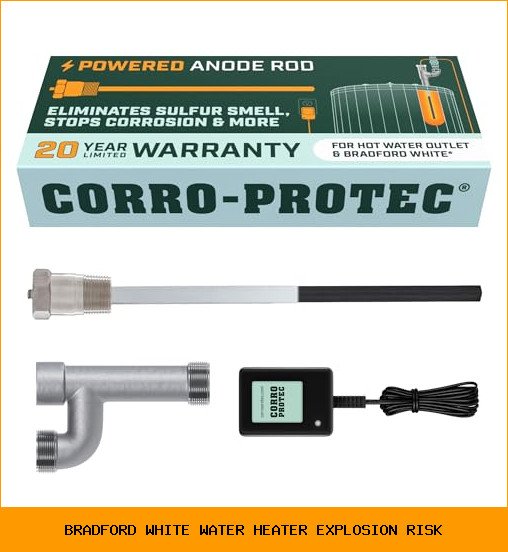
Corro-Protec Powered Anode Rod for Bradford White & Hot Water Outlet | 24-Hour Sulfur Smell Removal. Stops Corrosion & Reduces Sediment Buildup in Tank. 20-Year Warranty. WQA-Certified.
- HOT WATER OUTLET INSTALLATION [STANDARD FOR BRADFORD WHITE*] - Designed for 10-120-gallon water heaters, this model is tailored fo…
- INSTALLATION SIMPLIFIED & PATENT-PENDING - Includes step-by-step instructions for easy installation of the water heater anode rod…
- SAY GOODBYE TO ODORS - Eliminate your water heater odor problem by removing the rotten egg smell in hot water with our advanced po…
This article walks you through the three most common failure paths, the one component everyone gets wrong (it’s the anode rod), and a practical fix that stops both odor and corrosion. No fluff, no scare tactics — just what a Bradford White owner needs to know.
The Anode Rod Myth Most People Believe
If you ask a plumber why water heaters explode, nine out of ten will say “pressure relief valve failure.” That’s partly true, but it misses the real driver.
The T&P (temperature and pressure) valve is a last-resort safety device. It’s supposed to open if pressure hits 150 psi or water temperature exceeds 210°F. But here’s the catch: it can’t pop open if sediment or corrosion has glued it shut. A T&P valve that’s never been tested is a paperweight.
Most people think the magnesium or aluminum anode rod inside the tank lasts the life of the heater. It doesn’t. A standard anode rod sacrifices itself to protect the steel tank. In hard water — much of the U.S. has it — that rod can dissolve completely in 3–5 years. Once it’s gone, corrosion starts eating the tank liner. That’s when you get pinhole leaks, then cracks, and eventually a catastrophic failure.
So the real question is not “Will the T&P save me?” The real question is “Is my anode rod still doing its job?”
How a Powered Anode Rod Changes Everything
A conventional anode rod works by being more reactive than the steel tank. It literally corrodes away so the tank doesn’t. Once it’s gone, you’re unprotected. A powered anode rod works differently: it uses a tiny electrical current to prevent corrosion without sacrificing itself. It lasts decades, not years.
The Corro-Protec Powered Anode Rod for Bradford White & Hot Water Outlet is built for exactly this problem. Instead of requiring a separate anode port — which on many Bradford White tanks is buried under insulation or inaccessible — this rod installs in the hot water outlet port. It comes with a stainless steel Wye fitting that reroutes your hot water supply, so you don’t have to move the tank or cut pipes. The included instructions walk you through the whole process. Basic plumbing skills are enough. The 12-foot power cord plugs into a standard outlet, and the rod handles any water hardness, even softened water which is extra corrosive.
It also fixes that rotten egg smell. That odor comes from sulfate-reducing bacteria that thrive in a standard anode rod’s chemical reaction. The powered rod stops the reaction, killing the bacteria and the smell for good.
Three Failure Paths — and How to Spot Them Early
Let’s be specific about what actually fails, not what the internet panic says.
Path 1: Sediment buildup. Over years, minerals settle at the bottom of the tank. That layer insulates the water from the burner, causing the metal to overheat and weaken. The tank can bulge, crack, or split. Flushing the tank once a year prevents this. Most people don’t do it.
Path 2: Anode rod depletion. As explained above, this is the silent killer. No warning lights, no smells (until the bacteria show up). You need to actually inspect the rod every 2–3 years. On many Bradford White models, the anode is hidden behind a plastic cap or buried under foam. If you can’t get to it, a hot-water-outlet powered anode like the Corro-Protec is the only practical option.
Path 3: T&P valve failure. The valve itself gets crusty. Most codes require it to be tested annually — lift the lever, let it snap shut. If water doesn’t flow freely, or if it drips after closing, the valve needs replacement. A stuck valve can’t relieve pressure. Combined with a dead anode rod and heavy sediment, that’s the scenario that leads to an explosion.
Table: Comparison of Corrosion-Protection Methods
Here’s how your three options stack up.
| Standard Magnesium Anode | Standard Aluminum Anode | Powered Anode (Corro-Protec) | |
|---|---|---|---|
| Lifespan | 3–5 years (hard water) | 4–6 years (hard water) | 20+ years (warranted) |
| Odor control | Can cause rotten egg smell | Less odor, still possible | Eliminates odor |
| Install location | Dedicated anode port only | Dedicated anode port only | Hot water outlet or anode port |
| Works on softened water | Consumes faster | Consumes fast | Yes, no extra wear |
| Maintenance | Inspect every 2 years, replace | Inspect every 2 years, replace | Check plug connection yearly |
| Price range | $20–40 | $30–50 | ~$110–130 (check current price) |
| Best for | Short-term, easy access | Budget, low-odor areas | Long-term, tough access, odor problems |
A powered anode costs more upfront, but you never have to replace a sacrificial rod again. And if your tank has a stuck or inaccessible anode, a powered rod in the hot water outlet is the only real fix.
Five Questions People Actually Ask About Bradford White Water Heater Explosion Risk
Can a Bradford White water heater really explode?
Yes, but the odds are low — about 1 in 10,000 over the heater’s life. The explosion requires three failures simultaneously: a dead anode rod, a sediment-cracked tank, and a clogged T&P valve. That combination is rare, but not impossible. Regular maintenance kills the risk almost entirely.
Does the smell of rotten eggs mean my water heater is about to explode?
Not directly. The smell is caused by bacteria reacting with the sacrificial anode. But it’s a warning sign that your anode is wearing out fast. A depleted anode leaves the tank vulnerable to corrosion. So the smell itself won’t cause an explosion, but ignoring it might.
How often should I replace the anode rod in my Bradford White?
Every 3–5 years, depending on water hardness. Some Bradford White models come with a combination anode/hot-water outlet nipple — those are a pain to remove. If you can’t get to the dedicated anode port, swap to a powered anode rod in the hot water outlet, and you’re set for two decades.
Can I install a powered anode rod myself, or do I need a plumber?
If you can turn off the water, drain the tank, and use a pipe wrench, you can install it. The Corro-Protec kit includes step-by-step instructions, the Wye fitting, and the power cord. The only tricky part is fitting the stainless steel Wye threads — they gall easily, so use gray Teflon tape for stainless steel connections. Count on about 90 minutes the first time. If that sounds too much, a plumber can do it in under an hour.
Will a powered anode rod void my Bradford White warranty?
No. Under U.S. federal law (the Magnuson-Moss Warranty Act), a manufacturer cannot void your warranty just because you used a non-OEM part, unless they prove that part caused the damage. A powered anode rod does not damage the tank — it protects it. Bradford White’s warranty covers defects in manufacturing, not wear and tear from corrosion. The powered anode extends tank life, so it’s a net benefit.
What Actually Matters: Your Action List
- Test your T&P valve every year. Lift the lever, let it snap shut. If water doesn’t flow or it won’t close, replace the valve immediately.
- Inspect your current anode rod. If it’s less than 3/8-inch thick or you see a steel core, swap it out. If you can’t reach the anode port, install the Corro-Protec powered rod in the hot water outlet.
- Flush the tank annually. Attach a garden hose to the drain valve, open it, and let water run until it’s clear. Do this in spring, not winter — you don’t want the drain valve freezing.
- If you smell rotten eggs, suspect the anode, not the water heater itself. Replace it with a powered anode, and the odor disappears within a week.
- Don’t ignore strange noises. Popping, rumbling, or sizzling means sediment is baking on the bottom. Flush it and consider a water softener if your water is very hard.
- Know your water quality. Test strips for hardness are cheap. If you have softened water, a standard anode wears out 3x faster. A powered anode handles it without issue.
- Replace any water heater older than 12 years, even if it looks fine. Internal corrosion is invisible until it fails. A new tank with a powered anode rod will outlast your warranty by a long shot.


