You‘re parked at a beautiful campsite, ready for a hot shower, but the water stays cold. Your first move: check the RV‘s fuse box. You flip a breaker, nothing resets. You swap a glass fuse, still cold. That‘s when most people start guessing. And guessing wrong can cost you a whole weekend — or worse, a fire.
The part you‘re actually looking for isn‘t a traditional fuse. It‘s a thermal cutoff — a small, one-time safety device buried inside your water heater. In the RV world, people call it the “hot water fuse box” even though it‘s not a box at all. By the time you finish this article, you‘ll know exactly what it does, why it blows, and how to replace it without second-guessing yourself.

TOMOON
TOMOON Thermal Cut Off Fit for Atwood 93866 91447 RV Water Heaters 9 Pack | 93866 Thermal Cut Off Fit Include with ECO Thermostat Assembly Dometic Thermal Cutoff Fuse Fit GC6AA-10E Atwood Water Heater
- Overheat Protection: If the temperature exceeds the dometic thermal cutoff fuse's limit, it will blow to stop the flow of gas to t…
- Premium Quality: 93866 91447 RV Water Heater Thermal Fuse is made of metal and designed to withstand a maximum of 98℃(208.4℉)
- Thermal Cutoff Kit: The 93866 thermal cut off kit contains all you need to fix your Atwood RV water heater, including 2 x tinned c…
We‘ll cover the common myths (yes, a bigger fuse is a bad idea), give you a step-by-step testing plan, and show you what to look for in a replacement kit. This is the stuff that experienced RV techs wish every owner knew.
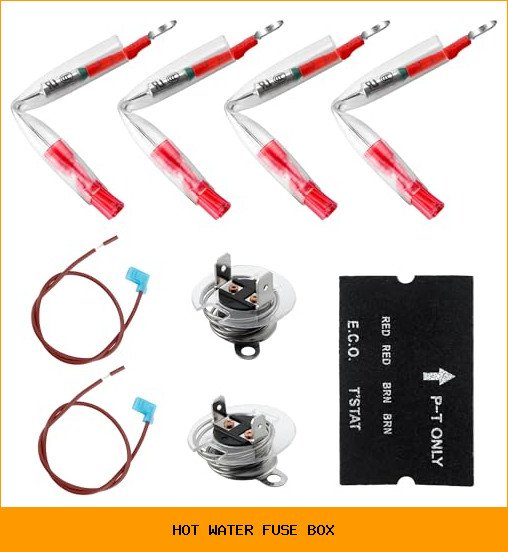
When you need a reliable replacement, the TOMOON Thermal Cut Off kit (ASIN B0D6966BK5) covers most Atwood RV water heaters with all the right parts. It includes four fuses, two tinned copper wires, an ECO thermostat assembly, a T‘STAT assembly, and a black foam cover. That‘s everything you‘d need for a full swap without hunting for separate pieces.
The Biggest Misconception: It‘s Not a Circuit Breaker
Your RV‘s electrical panel has breakers for 120V AC and maybe some blade fuses for 12V. The hot water fuse box isn‘t any of those. It‘s a thermal cutoff fuse (often called a “heat limiter”) that sits on the outside of the water heater tank, wired in series with the gas valve.
When temperatures hit 208.4°F (98°C) — way above normal operating temps — the fuse opens permanently. It doesn‘t reset. You can‘t push a button or flip a switch. Once it blows, it‘s done. That‘s by design: if the water heater overheats from a failed thermostat or a stuck gas valve, this fuse kills the gas supply before something catches fire.
Most people assume it‘s just a tripped breaker and waste hours checking the main panel. I‘ve seen posts where someone replaced every 12V fuse in their rig, then gave up and called a mobile tech for a $200 service call. The culprit? A $3 thermal fuse they could have swapped in ten minutes.
Why Your RV‘s Hot Water Fuse Box Keeps Blowing — Real Causes
A thermal fuse that blows once might be bad luck. If it blows twice in a row, something else is wrong. Here are the most common reasons:
- Failed ECO (Emergency Cut Off) thermostat — This is a secondary high-limit switch located under the same cover. It‘s supposed to open before the thermal fuse blows, but if it fails closed, the tank can overheat. Many replacement kits include both the ECO and the main thermostat for this reason.
- Stuck gas valve — A valve that doesn‘t close completely keeps the burner lit, driving tank temp above 208°F. This is rare but dangerous. If you smell gas or hear the burner running non-stop, shut everything down and get a professional.
- Loose or corroded wiring — A bad connection at the thermal fuse or thermostat can create resistance, generate heat, and cause the fuse to open even when the water isn‘t actually overheating. Check for burned terminals or melted wire insulation.
- High water pressure — Less common, but excessive pressure (above 80 PSI) can cause the water heater‘s temperature/pressure relief valve to leak, and in extreme cases, contribute to overheating. Install a pressure regulator if you don‘t have one.
No, a Higher Amp Fuse Won‘t Fix Your Problem
Here‘s a myth that keeps fire departments busy: someone blows a thermal fuse, can‘t find a replacement, so they jam in a fuse rated for 250°F or “just for testing.” Or they bypass it with a wire nut. That‘s not a fix — it‘s a fire risk.
The thermal cutoff is not a performance part. It‘s a deliberate weak link. Atwood designed it to open at 208°F because that‘s the safe limit before the tank‘s metal and internal seals start to degrade. A higher-temperature fuse won‘t blow, which means the tank can reach 250°F or more. At that point, the T&P valve should open, but those can fail too. Now you have a bomb under your RV.
I‘ve heard people say, “I‘ve been running a 250°F fuse for two years, no problem.” That‘s like saying you‘ve been driving without seatbelts and haven‘t crashed. The safety margin is gone. Replace with the correct temperature rating — 208°F (98°C) — every time.
How to Test and Replace the Thermal Cutoff Fuse Correctly
Testing is simple if you have a multimeter. Set it to continuity (or ohms). Disconnect the water heater from all power sources — 120V and 12V. Remove the exterior access panel. You‘ll see the thermal fuse and thermostat assembly held in place with a clip or screws.
- Label every wire before disconnecting. Use tape or a marker. Photos help. The TOMOON kit includes extra tinned copper wires if yours are brittle.
- Remove the thermal fuse. It‘s a small silver disc with two terminals. Touch your meter leads to the terminals. If you get continuity (beep or near-zero ohms), the fuse is good. If you get an open circuit (OL or infinite), it‘s blown.
- Check the ECO and main thermostat the same way. The ECO should have continuity at room temp. The thermostat should open when heated above its set point (usually around 120°F).
- Replace all suspect parts at once. A kit like the TOMOON gives you a new ECO, T‘STAT, and multiple fuses. Swap them out, reattach the wires exactly as labeled, and button it up.
- Re-light the pilot or electronic ignition per your manual. Watch for normal operation. If the fuse blows again within minutes, you have a deeper issue — likely a failed gas valve or wiring short.
Installation videos are available on YouTube for most Atwood models. Take your time, and don‘t start without the power off.
Replacement Approach Comparison
| Approach | What You Get | Ease of Installation | Cost Consideration | Best For |
|---|---|---|---|---|
| Kit (TOMOON) | 4 fuses, 2 wires, ECO, T‘STAT, foam cover | High — everything in one box | Check current price on Amazon; often cheaper than buying parts individually | First-time fix or full preventive swap |
| Individual OEM Parts | Single fuse or thermostat (sold separately) | Moderate — may need to order multiple items | Higher per-part cost plus shipping | Targeted replacement if you know exactly which part failed |
| Generic / No-Name Parts | Unbranded fuse and/or thermostat | Low — usually fits, but quality varies | Cheapest upfront, but risk of early failure | Emergency backup only; not recommended for long-term |
I prefer the kit approach because you get spare fuses and the foam cover (which often disintegrates). Saves a second trip to the parts store.
5 Real Questions People Ask About the Hot Water Fuse Box
1. What is a hot water fuse box in an RV?
It‘s a loose term RV owners use for the thermal cutoff fuse assembly on the water heater. There‘s no separate “box” — it‘s a small disc-shaped fuse mounted on the tank under the exterior access panel. It protects against overheating by cutting off gas flow when the tank reaches 208°F.
2. How do I know if my thermal cutoff fuse is blown?
Your water heater won‘t light or stay lit, and the gas valve never gets power. The sure test is a multimeter check for continuity. If you don‘t have a meter, look for visible damage like a cracked disc or melted plastic near the terminals. Many fuses blow cleanly without visible signs, so the meter is your friend.
3. Can I bypass the thermal fuse to get hot water faster?
No. Bypassing or shorting the fuse removes the overheat protection. The tank can reach temperatures that weaken the metal and cause the pressure relief valve to fail. You‘ll get hot water for a while, but you‘re gambling with a possible boiler explosion. Don‘t do it.
4. How often should I replace the thermal fuse?
Only replace it when it blows. It has no service life like an air filter. However, if you‘re opening up the water heater to replace a thermostat, it‘s smart to swap the fuse at the same time since they‘re cheap and the labor is the same. Keep a spare fuse in your RV toolkit.
5. Why does my RV water heater blow fuses even after replacing?
You have a root cause that isn‘t fixed. Most likely the ECO thermostat is failing (stuck closed) or the gas valve is leaking by. Check wiring for shorts and ensure the tank is full of water before startup — running it dry destroys fuses fast. If the problem persists, consult a certified RV technician.
What to Remember Next Time Your RV Water Heater Goes Cold
- The “hot water fuse box” is really a thermal cutoff fuse — not a resettable breaker. It opens once at 208°F and must be replaced.
- Never replace it with a higher temperature rating. That‘s a shortcut that can burn your rig down.
- Always check the ECO thermostat when the fuse blows. They often die together.
- Use a multimeter to test continuity. Guessing is how people end up buying parts they don‘t need.
- Label every wire before you take anything apart. A photo saves a headache.
- Keep a spare fuse or a full replacement kit like the TOMOON in your RV. It takes up almost no space and turns a campground crisis into a 15-minute fix.
- If fuses keep blowing after you‘ve replaced everything, stop and get help. A gas valve leak can kill you silently.