You’re sitting on the couch and you hear it: a short, sharp beep from the utility closet. Then another. Then a pause. Then three more. Your Rheem water heater is beeping without warning, and nothing on the display looks obviously wrong. The water is still hot. The pilot light is on. So what is it trying to tell you?
Rheem water heaters don’t beep for fun. Every beep pattern corresponds to a specific fault code or a physical condition inside the unit. The problem is that most owners never see the manual after installation, so a beeping tank feels like a mystery. This article walks you through the actual diagnostic steps, the specific error codes you’ll encounter, and the fixes that usually stop the noise. You’ll also learn when to call a plumber versus when you can handle it with a $15 tool and twenty minutes.

Skoutag
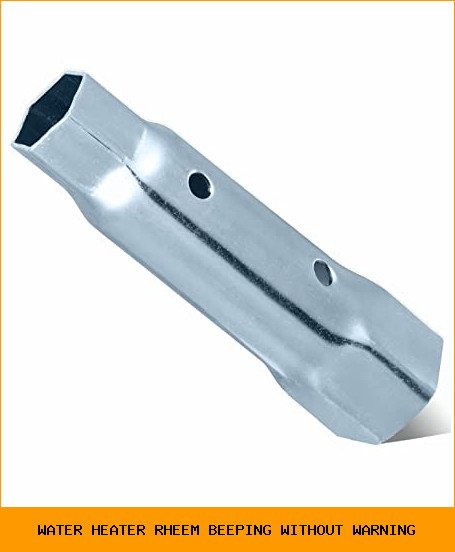
Skoutag RV Water Heater Element Wrench Socket, Dual Hex Wrench Removal Tool for Anode Rod, 1-1/16 in x 1-1/2 in x 6 in, Hex Socket for All Residential and RV Camper Travel Trailer Motorhome
- Skoutag dual hex socket wrench removal tool is made of quality Carbon Steel Galvanized, sturdy and anti-corrosion, specially desig…
- One end size 1-1/2" hex, fits most residential screw-in water heater elements.
- One end size 1-1/16" hex, fits all 3/4" thread anode rods.
One quick note before we dive in: if your beeping comes from a tank that also shows a blinking light on the control board, you’re dealing with a fault code, not a hardware failure. That distinction matters because most fault codes are resettable. A hardware failure usually means a replacement part. We’ll cover both scenarios below.
If you end up needing to open the tank for a closer look, a decent dual hex wrench makes the job far less painful. The Skoutag RV Water Heater Element Wrench Socket has a 1-1/2 inch hex on one end for residential elements and a 1-1/16 inch hex on the other for anode rods. It’s a solid tool to keep near the tank, especially if you’re already troubleshooting and want to inspect the element while you’re in there.
Why Rheem Water Heaters Beep: The Short Answer
Rheem uses an audible alarm to draw attention to the control board’s status light. The beeping is tied to a specific fault code, which you read by counting the blinks on the LED. Most units have a small window or a clear plastic cover on the front of the control panel. The beep pattern and the blink pattern match each other.
There are four common causes:
- Fault code 1 or 2: Ignition failure or flame loss. The burner didn’t light, or it lit and then went out. This is the most common cause of intermittent beeping.
- Fault code 3: Overheating. The tank got too hot, usually because the gas valve is stuck or the thermostat is miscalibrated.
- Fault code 4: Sensor failure. The temperature sensor or the flame sensor has gone bad.
- Stuck key: A button on the control panel is physically stuck down. This happens more than you’d think, especially on units installed in dusty garages.
You need to identify which one you’re dealing with before you touch anything. Opening the tank or replacing parts without knowing the code is a waste of time.
How to Read the Fault Code on Your Rheem
Go to the control panel and look for the LED light. It’s usually a small red or green light near the temperature dial. On newer models, there’s a digital display that shows the code directly. On older models, you’ll count the blinks.
Here’s the process:
- Turn off the power to the water heater at the breaker or the gas valve. Wait 30 seconds.
- Turn it back on and watch the LED closely for the first 60 seconds.
- Count the blinks in each cycle. A long pause separates one cycle from the next.
- Write down the number of blinks. That’s your fault code.
If you have a digital display, it will show something like “E1” or “E2” or “ER” followed by a number. Write that down too.
Once you have the code, check the chart on the side of the tank or in your manual. If you don’t have the manual, Rheem’s website has PDF copies for every model. Search for your model number (it’s on the label near the bottom of the tank) and download the PDF.
Here’s a quick reference for the codes you’ll most likely see:
| Fault Code | Meaning | Likely Fix | Can You DIY? |
|---|---|---|---|
| 1 or 2 | Ignition failure or flame loss | Clean the flame sensor, check the gas supply, replace the thermocouple | Yes, with basic tools |
| 3 | Overheating | Check the thermostat, flush the tank, replace the gas valve if stuck | Partially — gas valve replacement needs a pro |
| 4 | Sensor failure | Replace the temperature or flame sensor | Yes, if you’re comfortable with wiring |
| No code, just beeping | Stuck button or control board issue | Press every button firmly, check for debris, replace the control board | Yes, for the button; board replacement is trickier |
Fault Codes 1 and 2: Ignition Failure and Flame Loss
This is the most common reason a Rheem water heater beeps without warning. The unit tries to light the burner, fails, and then beeps to tell you. Or it lights, runs for a few minutes, then the flame goes out and it beeps again.
The usual culprit is a dirty flame sensor. This is a small metal rod positioned near the burner. It detects the flame’s presence by measuring the electrical current that passes through the flame. Over time, soot and carbon build up on the rod, and it stops reading correctly. The control board thinks there’s no flame, so it shuts off the gas and beeps.
Cleaning the flame sensor is a 15-minute job. You’ll need to:
- Turn off the gas and power to the unit.
- Remove the access panel on the front of the tank.
- Find the flame sensor — it’s a thin metal rod attached to a wire, near the burner.
- Unscrew it, then rub it gently with fine-grit sandpaper or a Scotch-Brite pad. Don’t use a file; you’ll remove too much material.
- Reinstall it, turn everything back on, and see if the beeping stops.
If the sensor is clean and the beeping continues, check the gas pressure. A partially closed gas valve or a weak supply line can cause intermittent flame loss. You can test this by checking other gas appliances in the house. If they’re also acting up, the problem is upstream of the water heater.
One thing I’ve seen trip people up: the thermocouple. On older Rheem units, the thermocouple is a separate safety device. If it’s failing, the unit will light, run for a few seconds, then shut off. The beep pattern is the same as flame loss. Replacing a thermocouple is cheap and easy — it’s a simple screw-in part that costs about $10.
Fault Code 3: Overheating and the Reset Button
Fault code 3 means the water inside the tank got too hot. The control board sensed a temperature above the safety limit and shut down the burner. This is a serious condition, but it’s not always a sign of a failing part.
The most common cause is a miscalibrated thermostat. If you’ve been turning the dial up and down frequently, the internal mechanism can drift. The fix is simple: turn the thermostat down to its lowest setting, wait 10 minutes, then turn it back to your desired temperature (usually 120°F to 125°F). This resets the calibration on most models.
If that doesn’t work, the tank might have sediment buildup. A layer of scale on the bottom of the tank insulates the water from the burner, so the burner runs longer to heat the same amount of water. That extra heat can trip the high-limit switch. Flushing the tank clears the sediment. Here’s how:
- Turn off the power or gas.
- Connect a garden hose to the drain valve at the bottom of the tank.
- Run the other end to a floor drain or outside.
- Open the pressure relief valve on top of the tank.
- Open the drain valve and let the water run until it’s clear. This can take 10 to 20 minutes for a 50-gallon tank.
- Close the drain valve, remove the hose, and refill the tank before turning the power back on.
If the tank is flushing clean and the thermostat is set correctly, but the code keeps coming back, the high-limit switch itself might be failing. That’s a part you can replace, but it requires opening the control panel and disconnecting wires. If you’re not comfortable with that, call a pro.
Fault Code 4: Sensor Failure and the Stuck Button Problem
Fault code 4 points to a sensor that’s either reading zero or reading a value that’s physically impossible. On Rheem units, this is usually the temperature sensor (a thermistor) that sits inside the tank. These do fail with age — they’re exposed to constant heat and vibration.
Replacing a temperature sensor is straightforward if you can access the control panel. The sensor is a small probe that screws into the tank wall. You’ll need to drain the tank below the sensor level, unscrew the old one, and screw in the new one. The part itself runs about $20 to $30. Just make sure you order the exact part number for your model; Rheem uses several different sensor types.
There’s another scenario that produces beeping without a fault code: a stuck button on the control panel. If a button is physically depressed — maybe a child pressed it, or dust got under the rubber membrane — the control board interprets it as a continuous command. It beeps because it’s trying to process an input that never ends.
Try pressing every button on the panel firmly a few times. You’re trying to dislodge whatever is stuck. If that doesn’t work, you can carefully remove the control panel cover and check the membrane for debris. A can of compressed air works well here. If the button is physically broken, you’ll need to replace the entire control board assembly, which is a bigger job.
One final note on the sensor side: if you have a hybrid heat pump model, the beeping might come from the compressor or the fan. These units have their own set of fault codes that relate to refrigerant pressure or airflow. Check the specific manual for your hybrid model, because the codes are different from the gas tank codes listed above.
When to Stop Troubleshooting and Call a Plumber
Some issues are beyond a DIY fix. If you’ve cleaned the flame sensor, flushed the tank, and reset the thermostat, but the beeping persists, you’re likely looking at a failing gas valve or a control board. Both are expensive parts, and both require professional installation.
Gas valve replacement involves working with the gas line. That’s not a job for someone without the right tools and training. A leak here is dangerous. Similarly, control board replacement requires matching the exact board to your model and reprogramming it. A mistake can cause the unit to run without proper safety limits.
Another sign you need a pro: the beeping is accompanied by a strong rotten egg smell. That’s a sign of bacterial growth in the tank, which produces hydrogen sulfide gas. It’s not a fire hazard, but it does mean you need to sanitize the tank and replace the anode rod. That’s a messy job that’s easier with a pro.
If your tank is more than 10 years old and has a recurring fault code, consider whether a repair is worth it. A new gas valve costs $200 to $400 installed. A new water heater costs $800 to $1,500. If the tank is at the end of its lifespan, the repair is a stopgap, not a solution.
Frequently Asked Questions
Why does my Rheem water heater beep but still has hot water?
That’s normal. The fault code is triggered by a safety check, not by a lack of hot water. The unit might have a minor issue like a dirty flame sensor that causes an intermittent ignition failure. The burner resets itself after a few minutes, so you still get hot water, but the beeping continues until the underlying issue is resolved. Check the LED for the blink code and start there.
How do I reset my Rheem water heater after it beeps?
Turn off the power or gas to the unit, wait 30 seconds, then turn it back on. This clears most temporary fault codes. If the beeping returns within a few hours, the issue is persistent and needs a real fix, not just a reset. Also check for a red reset button near the thermostat — pressing it can clear a high-limit trip.
Can a water heater beeping be a fire hazard?
No. The beeping is an alarm, not a fire risk. The risk comes from ignoring the underlying issue. For example, a fault code 3 (overheating) means the unit is running too hot, which can damage the tank and cause a leak. A gas leak from a faulty valve is a separate hazard. If you smell gas, leave the house and call your gas company immediately.
Why does my Rheem beep three times then stop?
Three beeps usually corresponds to fault code 3, which is overheating. Check the thermostat setting and flush the tank to remove sediment. If the beeping stops after a reset but comes back, the high-limit switch or the gas valve is likely failing. Those need professional attention.
Does a beeping Rheem water heater need to be replaced?
Usually not. Most beeping causes are minor — a dirty sensor, a stuck button, or a miscalibrated thermostat. Those are all fixable in under an hour. Replacement is only necessary if the tank is leaking, the control board is dead, or the tank is over 10 years old with recurring faults. In those cases, a new unit is often more cost-effective than a major repair.
What to Do Next: A Practical Checklist
You don’t need to be a plumber to handle most Rheem beeping issues. Here’s a quick list to work through:
- Count the blinks on the LED or check the digital display for a fault code.
- Reset the unit by turning off power and gas for 30 seconds, then back on.
- Clean the flame sensor with fine-grit sandpaper if you have a code 1 or 2.
- Flush the tank if you have a code 3 or if the water is hotter than normal.
- Press every button on the control panel firmly to rule out a stuck key.
- Replace the thermocouple if the unit lights but shuts off after a few seconds.
- Call a licensed plumber if the beeping persists after these steps, if you smell gas, or if the tank is leaking.
Keep the Skoutag dual hex wrench near the tank. When you need to pull an element or an anode rod, it saves you from buying a second tool or improvising with a pipe wrench that doesn’t fit right. The 8mm side holes let you use a screwdriver for leverage, which is handy when the element is seized.
One last piece of advice: write down the fault code and the date on a piece of masking tape and stick it to the side of the tank. If the beeping comes back in six months, you’ll know whether it’s the same issue or a new one. That little note can save you a lot of guesswork later.


